US and Canada Scramble Jets to Intercept Russian Bombers Near Alaska
Updated (13 articles)
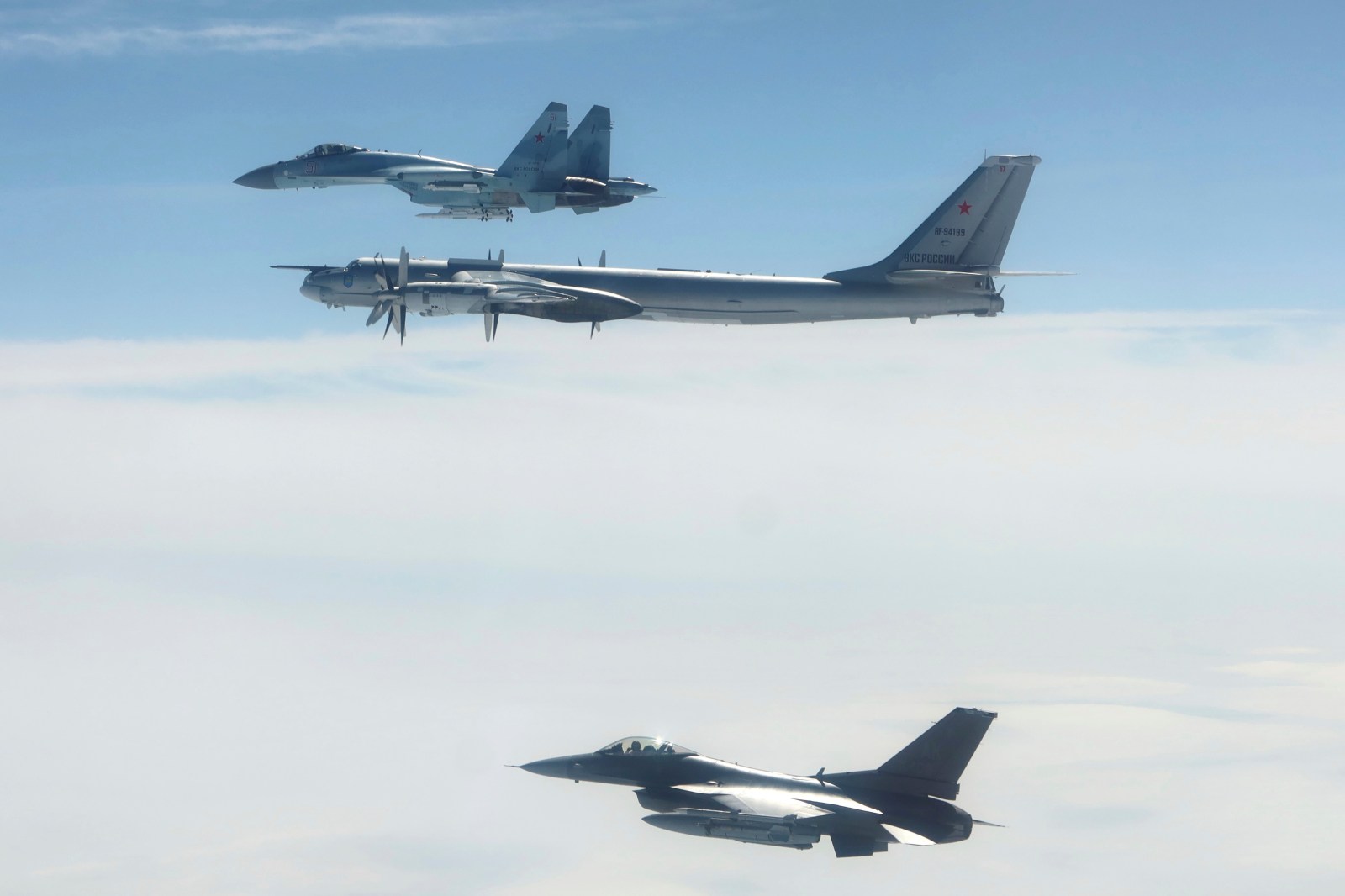

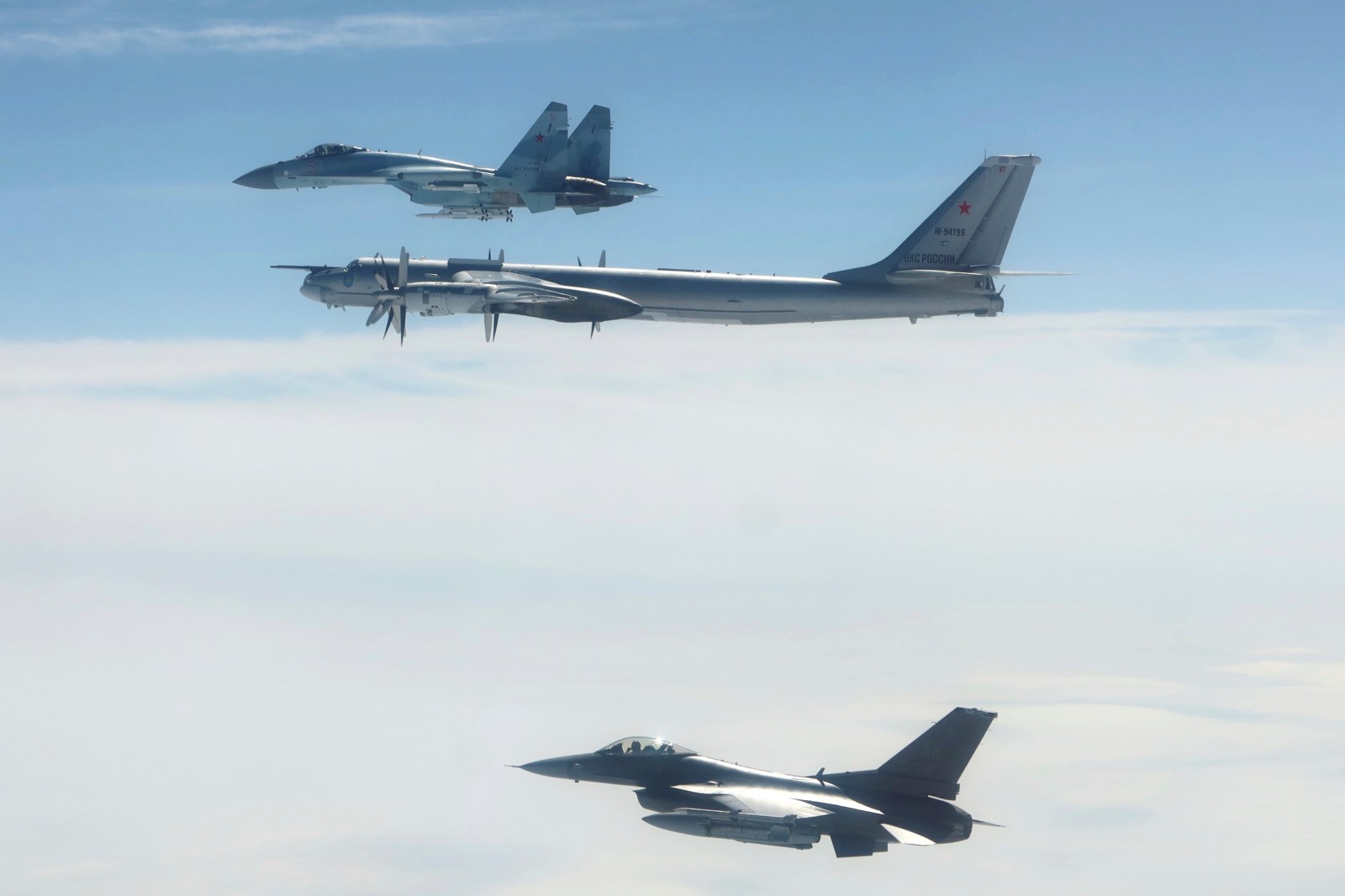
NORAD detects mixed Russian formation in Alaskan ADIZ NORAD identified two Tu‑95 strategic bombers, two Su‑35 fighters and an A‑50 airborne‑early‑warning aircraft operating within the Alaskan Air Defense Identification Zone on February 20, 2026. The United States and Canada responded with two F‑16s, two F‑35s, an E‑3 AWACS and four KC‑135 tankers to positively identify and escort the Russian fleet [1]. All five Russian planes remained in international airspace and did not cross into sovereign U.S. or Canadian airspace [1].
Joint North American response deemed routine, non‑threatening The coordinated scramble demonstrated the integrated NORAD command structure, with both nations launching assets within minutes of detection [1]. Officials emphasized that such incursions into the Alaskan ADIZ occur regularly and are not considered hostile actions [1]. No weapons were fired and the Russian aircraft continued on their flight path without incident [1].
USFK F‑16s trigger brief Chinese scramble over Yellow Sea Later that day, US Forces Korea launched several F‑16s from Osan Air Base into international waters of the Yellow Sea, positioning between South Korean and Chinese ADIZ boundaries [2][3]. China responded by dispatching fighter jets, creating a short aerial standoff that ended without any engagement [2][3]. Both USFK and the South Korean defense ministry withheld the drill’s specific objectives, noting only a “combined defense posture” [2][3].
Exercise reflects Washington’s shift toward ally‑led China deterrence The Yellow Sea flight aligns with the U.S. National Defense Strategy released in January 2026, which urges allies such as South Korea to assume greater responsibility for deterring Chinese aggression [2]. USFK commander Gen. Xavier Brunson highlighted “flexibility” and presented a “bubble perimeter” map indicating forces already positioned for rapid response [2][3]. The drills illustrate a broader effort to recalibrate USFK’s role from a primarily North‑Korea focus to a dual‑theater posture that includes China [2][3].
Sources
-
1.
Newsweek: US Fighter Jets Intercept Russian Bombers and Spy Plane Near Alaska: Details the detection of two Tu‑95s, two Su‑35s, and an A‑50 in the Alaskan ADIZ and the joint U.S.–Canada launch of F‑16s, F‑35s, an E‑3 and KC‑135 tankers, noting the aircraft stayed in international airspace .
-
2.
Yonhap: USFK F‑16 Exercise Triggers Brief Chinese Fighter Jet Response Over Yellow Sea: Reports the USFK F‑16 sortie from Osan into the Yellow Sea, the Chinese scramble, the brief non‑violent standoff, and links the drill to the new U.S. defense strategy urging allies to share China‑deterrence duties .
-
3.
Yonhap: USFK and Chinese Jets Briefly Face Off Over Yellow Sea: Provides a parallel account of the same Yellow Sea encounter, emphasizing the gap between South Korean and Chinese ADIZ, the lack of clash, and Gen. Xavier Brunson’s “bubble perimeter” concept as part of a broader USFK role redefinition .
Related Tickers
Timeline
Jul 23, 2019 – Russia and China conduct their first joint bomber patrol, sending two Tu‑95MS and two H‑6K bombers over the Sea of Japan, Tsushima and Miyako Straits, establishing a pattern of coordinated long‑range flights [5].
2020‑2023 – Joint patrols extend into the Philippine Sea; 2022 marks the first year two patrols occur, and in Nov 2022 Russian and Chinese bombers make reciprocal visits to each other’s airfields, deepening operational trust [5].
Jul 25, 2024 – The eighth joint patrol flies outside East Asia for the first time, crossing the Chukchi and Bering Seas near Alaska; U.S. and Canadian fighters intercept the aircraft but NORAD notes they stay within the Alaskan ADIZ and pose no threat [5].
Nov 29‑30, 2024 – The ninth patrol debuts China’s nuclear‑armed H‑6N bomber alongside Russian Tu‑95MS, signalling an upgrade in strike capability for the partnership [5].
Dec 9, 2025 – Nine Chinese and Russian aircraft (two Chinese, seven Russian) briefly enter South Korea’s KADIZ over waters east and south of the peninsula; South Korean fighters scramble but no airspace is violated, and the incursion lasts about an hour [10][11][12][13].
Dec 10, 2025 – Seoul files a formal protest with Chinese and Russian defense attaches, stating it “will actively respond… in compliance with international law” after the KADIZ breach, and dispatches fighter jets as a precautionary measure [1][9].
Dec 10, 2025 – A Newsweek map shows a joint Russia‑China patrol near Japan that includes Tu‑95MS, H‑6K bombers and the Liaoning carrier operating in the Philippine Sea; Japan scrambles fighters and declares readiness, while both Moscow and Beijing claim the maneuver is not directed at any third country [6].
Dec 20, 2025 – Analysts note that the Dec 9 patrol marks the 10th joint air patrol near Japan and that Russia‑China bomber operations have now reached the broader Pacific and Alaska, expanding the strategic reach of their nuclear‑capable fleet [5].
Jan 7, 2026 – Russia’s spy ship Kareliya enters Japanese waters, transits the Tsushima Strait and proceeds to the southwestern outlying islands, prompting Japan’s Self‑Defense Forces to monitor the vessel [3].
Jan 12‑24, 2026 – Kareliya operates around Japan’s southwestern islands before heading toward Russia’s Far East, while Japanese forces maintain surveillance of the ship’s movements [3].
Jan 2026 – A Russian Il‑20 reconnaissance plane overflies northern Japan coinciding with the U.S. plan to station 48 F‑35A fighters at Misawa Air Base; Defense Minister Shinjiro Koizumi posts on X that Japan will keep “utmost vigilance” over such intelligence‑gathering flights [3][4].
Jan 2026 – China’s intelligence ship CNS Beijixing transits the Miyako Strait into the Philippine Sea, adding to Chinese surveillance activity near Japan’s southwestern waters; Japan’s Maritime Self‑Defense Force tracks the movement [3].
Jan 23, 2026 – Japan scrambles fighter jets to intercept three groups of Russian Tu‑95MS nuclear bombers (accompanied by Su‑35/Su‑30SM fighters) over the Sea of Japan; the bombers remain in international waters for over 11 hours, and Japan vows “continuous vigilance” under international law [4].
Jan 27, 2026 – Japan’s Defense Ministry confirms recent Russian and Chinese intelligence deployments—including the Kareliya spy ship, the Il‑20 overflight, and the Beijixing vessel—and reiterates that “utmost vigilance” will be maintained as the U.S. and Japan strengthen their western‑Pacific force posture [3].
2026 (planned) – The United States intends to deploy 48 F‑35A stealth fighters to Misawa Air Base as part of a base upgrade, enhancing rapid‑response capability in northern Japan [3].
Feb 20, 2026 – U.S. Forces Korea launches an F‑16 exercise over the Yellow Sea; Chinese fighter jets scramble to the gap between South Korean and Chinese ADIZs, but the encounter ends without incident, illustrating the “flexibility” and “bubble perimeter” concept highlighted by USFK Commander Gen. Xavier Brunson [7][8].
Feb 20, 2026 – NORAD scrambles two F‑16s, two F‑35s, an E‑3 AWACS and four KC‑135 tankers to intercept five Russian aircraft (two Tu‑95 bombers, two Su‑35 fighters, one A‑50 AEW) near Alaska; officials state the planes stay in international airspace and the activity is “routine, non‑threatening” [2].
Dive deeper (4 sub-stories)
-
Newsweek: US Fighter Jets Intercept Russian Bombers and Spy Plane Near Alaska
-
USFK F‑16 Flight Over Yellow Sea Provokes Brief Chinese Jet Scramble, No Clash
(2 articles)
-
Russia and China Ramp Up Intelligence Operations Near Japan, Prompting Defense Scrambles
(4 articles)
-
South Korea Files Formal Protest After Chinese and Russian Warplanes Briefly Enter KADIZ
(6 articles)
All related articles (13 articles)
-
Newsweek: US Fighter Jets Intercept Russian Bombers and Spy Plane Near Alaska
-
Yonhap: USFK F‑16 Exercise Triggers Brief Chinese Fighter Jet Response Over Yellow Sea
-
Yonhap: USFK and Chinese Jets Briefly Face Off Over Yellow Sea
-
Newsweek: Russia and China Intensify Intelligence Operations Near Japan
-
Newsweek: Japan Scrambles Jets to Intercept Russian Nuclear Bombers
-
Newsweek: Russia and China expand bomber patrols into a wider Pacific and near Alaska
-
Newsweek: Mapped: Russia and China’s Militaries Move on US Ally’s Doorstep
-
BBC: South Korea protests Chinese and Russian warplanes entering its air defence zone
-
Yonhap: S. Korea protests to China and Russia over jets entering KADIZ
-
Yonhap: Nine Chinese and Russian aircraft briefly enter South Korea's KADIZ, JCS says
-
Yonhap: Nine Chinese, Russian aircraft briefly enter South Korea's air defense zone
-
Yonhap: Nine Chinese and Russian aircraft briefly enter South Korea's KADIZ, JCS says
-
Yonhap: 9 Chinese, Russian military aircraft briefly enter S. Korea's air defense zone: JCS
External resources (9 links)
- https://x.com/jointstaffpa/status/2014472416886718727?s=20 (cited 1 times)
- https://x.com/shinjirokoiz/status/2015759051796447593 (cited 1 times)
- https://x.com/type36512/status/1998354608973132185?s=20 (cited 1 times)
- http://eng.mod.gov.cn/2025xb/N/T/16426188.html (cited 1 times)
- https://thebulletin.org/premium/2025-03/chinese-nuclear-weapons-2025/ (cited 1 times)
- https://thebulletin.org/premium/2025-05/russian-nuclear-weapons-2025/ (cited 1 times)
- https://www.mod.go.jp/j/press/wp/wp2025/pdf/DOJ2025_Digest_EN.pdf (cited 1 times)
- https://www.mod.go.jp/js/pdf/2025/p20251209_05.pdf (cited 1 times)