Youth Congress Protest and Pax Silica Signing Dominate Closing Days of India AI Summit
Updated (9 articles)
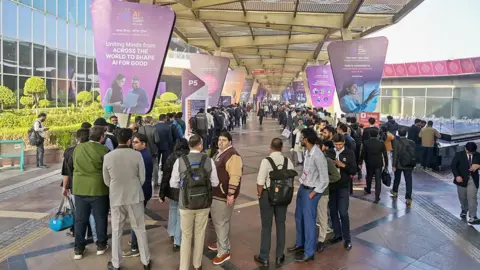
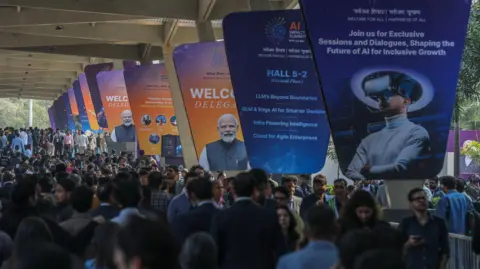
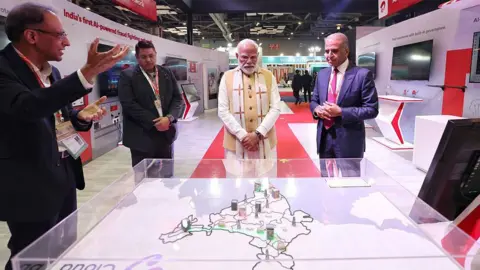
Opening Day Chaos and Extended Exhibition Highlight Summit Scale The AI Impact Summit opened on 17 February 2026 at Bharat Mandapam, Delhi, with Prime Minister Narendra Modi inaugurating the five‑day event attended by roughly 70,000 delegates, including Sam Altman and Sundar Pichai[7]. Security sweeps and last‑minute hall closures caused hours‑long queues, cash‑only food stalls, and theft of wearable AI devices, prompting IT Minister Ashwini Vaishnaw to activate a “war‑room” and apologize for the disorganization[7]. In response to the operational bottlenecks, the exhibition was extended by one day to 21 February, allowing additional students and professionals to visit under relaxed security measures[1].
Shirtless Youth Congress Demonstration Triggers Detentions and Trade‑Deal Outcry On 20 February 2026, members of the Indian Youth Congress staged a shirtless protest inside the summit venue, wearing white tees printed with Prime Minister Narendra Modi and U.S. President Donald Trump while chanting slogans against the India‑U.S. interim trade agreement[1]. Youth Congress president Uday Bhanu warned that the deal jeopardises farmer livelihoods and could expose Indian citizen and military data to foreign firms, framing the action as part of a broader 12‑year youth unemployment grievance[1]. Police detained at least ten protesters for disrupting the summit, marking the most visible political dissent during the event[1].
India Advances Non‑Binding Military AI Norms and Pax Silica Alliance While the summit proceeded, India abstained from signing the REAIM “Pathways to Action” declaration, arguing that a legally binding framework on lethal autonomous weapons is premature and preferring a flexible, accountability‑based approach that bans AI‑augmented nuclear decision‑making and encourages voluntary data exchanges[4]. Simultaneously, Union Minister Ashwini Vaishnaw oversaw India’s formal entry into the U.S.-led Pax Silica coalition, a partnership aimed at securing AI governance and semiconductor supply‑chain resilience[1]. These moves complement the “Third Way” AI governance model unveiled at the summit, which seeks a middle path between the EU’s strict regime, the U.S.’s hands‑off stance, and China’s state‑centric model, emphasizing strategic autonomy and public‑private collaboration for the Global South[5].
Military Showcases, Corporate Leaders, and Health Experts Emphasize Guardrails The Indian Army demonstrated an indigenous dual‑use AI suite—including AI Examiner, SAM‑UN, EKAM, and PRAKSHEPAN—highlighting applications in defence, disaster management, and cybersecurity, and underscoring a self‑reliance agenda[6]. Tech CEOs such as Qualcomm’s Cristiano Amon and Google’s Sundar Pichai warned that AI will reshape mobile devices, industrial robotics, and global partnerships, while IMF Managing Director Kristalina Georgieva estimated AI could add roughly 0.8 percentage points to worldwide growth[1]. Parallel health‑sector consultations on 7 February called for a rights‑based AI framework to prevent digital extractivism, bias, and workforce displacement, reinforcing expert calls for transparent, equitable AI governance across sectors[2][3].
Sources
-
1.
The Hindu: Youth Congress Protest Leads to Detentions at India AI Summit Amid Trade‑Deal Criticism and New AI Initiatives: details the shirtless protest, ten detentions, trade‑deal concerns, IMF growth estimate, Pax Silica signing, and summit extension.
-
2.
The Hindu: India’s People‑Led AI Health Consultation Calls for Rights‑Based Framework: reports the 7 Feb health forum, bias warnings, and calls for public‑funded, equitable AI in healthcare.
-
3.
The Hindu: Experts Call for Social Good, Guardrails and Governance at 2026 AI Impact Summit: compiles editorial opinions urging societal‑benefit AI applications and defense safeguards.
-
4.
The Hindu: India’s Push for a Non‑Binding Military AI Framework After REAIM Abstention: explains India’s abstention from REAIM, preference for non‑binding norms, and proposed transparency safeguards.
-
5.
The Hindu: India Positions “Third Way” AI Governance at Delhi Summit: outlines India’s “Third Way” model, recent content‑labeling amendment, and focus on Global South cooperation.
-
6.
The Hindu: Indian Army showcases homegrown dual‑use AI at India AI Summit: describes the Army’s indigenous AI platforms for defence and civilian uses, emphasizing self‑reliance.
-
7.
BBC: India's AI Impact Summit Marred by Logistical Chaos on Opening Day: reports opening‑day queueing, security lapses, Modi’s inauguration, and the IT minister’s apology.
Related Tickers
Timeline
Nov 2025 – India releases “Third Way” AI governance guidelines that focus on adoption, diffusion, diplomacy and capacity‑building, positioning the framework as an agile alternative to the EU’s compliance‑heavy regime, the US’s hands‑off stance and China’s centralized model; the draft stresses strategic autonomy and public‑private partnerships for the Global South [5].
Dec 29, 2025 – The government announces that the upcoming AI Impact Summit will match G20‑scale participation, expecting 15‑20 heads of state and roughly 100,000 delegates, and highlights over 300 pre‑summit events as evidence of mounting global interest [9].
Feb 7, 2026 – A national People‑led AI in Health consultation convenes clinicians, technologists and patient advocates in Delhi, warning that AI tools often fail outside pilot settings, may reinforce caste, gender and regional biases, and should remain a supplement to human care rather than replace health workers [3].
Feb 10, 2026 – The government amends the IT (Intermediary Guidelines and Digital Media Ethics Code) Rules to require platforms to label AI‑generated content and to remove harmful material within three hours, marking India’s first mandatory disclosure regime for synthetic media [5].
Feb 17, 2026 – The Indian Army showcases an indigenous dual‑use AI suite at the summit, demonstrating systems such as AI Examiner, SAM‑UN, EKAM, PRAKSHEPAN, XFace and deep‑fake detection, emphasizing self‑reliance, disaster‑resilience and civilian applications alongside defence [7].
Feb 17, 2026 – Prime Minister Narendra Modi inaugurates the five‑day Global‑South AI Impact Summit at Bharat Mandapam; long queues, cash‑only food stalls and stolen wearable AI products expose severe logistical failures, prompting IT Minister Ashwini Vaishnaw to apologize, label the organization “very slow” and activate a “war‑room” response team [1].
Feb 18, 2026 – India signs the Pax Silica declaration on AI and semiconductor supply‑chain security, pledging to build a domestic semiconductor ecosystem and earn global trust, while Union Minister Ashwini Vaishnaw calls the move “crucial” for India’s strategic autonomy [2].
Feb 18, 2026 – India abstains from the REAIM “Pathways to Action” declaration, arguing that a binding framework on lethal autonomous weapons is “premature” and advocating a flexible, non‑binding accountability approach that bans AI‑augmented nuclear decision‑making and promotes voluntary confidence‑building data exchanges [6].
Feb 19, 2026 – Experts publish a collection of five Hindu editorials urging guardrails for military AI, social‑good applications and robust governance, reflecting a broad scholarly consensus that AI development must balance innovation with security and ethical safeguards [4].
Feb 19, 2026 – IMF Managing Director Kristalina Georgieva tells a summit panel that IMF research estimates AI could boost global growth by about one‑percentage point, reinforcing India’s ambition to become a “Viksit Bharat” developed nation [2]; simultaneously, the summit’s exhibition is extended by a day to improve access for students and professionals [2].
Feb 20, 2026 – The Indian Youth Congress stages a shirtless protest at the summit, detaining ten activists; President Uday Bhanu claims the India‑U.S. interim trade deal harms farmers and risks sharing Indian data, including military information, with foreign firms, framing the demonstration as part of a 12‑year youth unemployment grievance [2].
Feb 21, 2026 (planned) – The AI Impact Summit’s exhibition continues under relaxed security arrangements, allowing missed delegates to attend and providing additional opportunities for networking and knowledge exchange [2].
All related articles (9 articles)
-
The Hindu: Youth Congress Protest Leads to Detentions at India AI Summit Amid Trade‑Deal Criticism and New AI Initiatives
-
The Hindu: India’s People‑Led AI Health Consultation Calls for Rights‑Based Framework
-
The Hindu: Experts Call for Social Good, Guardrails and Governance at 2026 AI Impact Summit
-
The Hindu: India’s Push for a Non‑Binding Military AI Framework After REAIM Abstention
-
The Hindu: India Positions “Third Way” AI Governance at Delhi Summit
-
The Hindu: Indian Army showcases homegrown dual‑use AI at India AI Summit
-
BBC: India's AI Impact Summit Marred by Logistical Chaos on Opening Day
-
The Hindu: India urged to expand AI rules, widen access, and upskill workforce
-
The Hindu: India eyes G20-level participation for AI Impact Summit in February
External resources (2 links)
- https://t.co/fmO9bV0vwV (cited 1 times)
- https://twitter.com/hashtag/IndianArmy?src=hash&ref_src=twsrc%5Etfw (cited 1 times)