U.S. and Indonesia Finalize 19% Tariff Trade Pact, Activate $38.4 B Deals and Gaza Troop Commitment
Updated (2 articles)
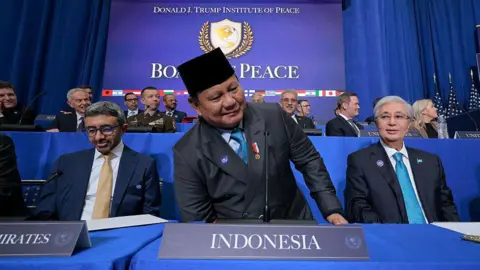
Deal Cuts U.S. Tariff to 19% and Opens Indonesian Market for 99% of American Goods The agreement lowers the United States tariff on Indonesian products from 32% to 19% and obliges Indonesia to remove barriers on more than 99% of U.S. imports, with the pact becoming effective within 90 days [1][2]. Both governments announced that the deal will spur $38.4 bn of ancillary agreements signed the same day [1][2]. President Prabowo Subianto and Coordinating Minister Airlangga Hartarto highlighted that roughly 90% of Indonesia’s tariff requests were accepted, promising mutual economic prosperity [1].
Companies Sign $38.4 B of Bilateral Contracts Across Agriculture and Technology Eleven agreements were signed covering U.S. soybeans, corn, cotton, wheat, critical‑minerals cooperation, oil‑field recovery, and joint ventures in computer chips, totaling $38.4 bn [1][2]. The contracts aim to secure Indonesian purchases of 1 million t soybeans, 1.6 million t corn, 93,000 t cotton and up to 5 million t wheat through 2030 [2]. Critical‑minerals cooperation is designed to reduce U.S. reliance on China by removing export limits on rare earths and other key elements [2].
Indonesia Gains Exemptions for 1,700 Products and Aligns with U.S. Standards The deal grants tariff exemptions for more than 1,700 Indonesian items, including coffee, spices, chocolate, natural rubber and palm oil [1]. Indonesia will adopt U.S. standards on car safety, emissions, medical devices and pharmaceuticals, facilitating smoother market access for American firms [1]. Washington also offers exemptions for certain U.S. clothing and textiles made with U.S. cotton and man‑made fibers [1].
Indonesia Pledges 8,000 Troops to Gaza Stabilization Force and Expands Agricultural Purchases President Prabowo announced a commitment to send at least 8,000 troops, with the possibility of more, to support the international force overseeing Gaza reconstruction [2]. The trade pact includes large‑scale agricultural orders through 2030, reinforcing Indonesia’s role as a major buyer of U.S. farm products [2]. Regional partners Cambodia and Vietnam also joined the Board of Peace, signaling broader diplomatic outreach alongside the trade agreement [2].
Sources
-
1.
BBC: US‑Indonesia Trade Deal Lowers Tariffs to 19%: Details the tariff reduction, Indonesia’s market opening for 99% of U.S. goods, exemptions for 1,700 products, adoption of U.S. standards, and $38.4 bn ancillary agreements, emphasizing mutual prosperity .
-
2.
AP: U.S. and Indonesia Seal $38 B Trade Pact as Indonesia Commits Troops to Gaza: Highlights the reciprocal trade terms, $38.4 bn contracts, Indonesia’s pledge of 8,000 troops to Gaza, extensive agricultural purchase commitments through 2030, and involvement of Cambodia and Vietnam in the diplomatic initiative .
Timeline
Before Feb 2026 – The United States imposes a 32% tariff on Indonesian goods, limiting market access and contributing to a sizable trade surplus for Indonesia [1].
Feb 20, 2026 – The Trump administration and Indonesia finalize a trade agreement that cuts the U.S. tariff on Indonesian products from 32% to 19% while Indonesia eliminates tariffs on 99% of U.S. imports, opening its market to virtually all American goods [1][2].
Feb 20, 2026 – Indonesia secures exemptions for more than 1,700 items—including coffee, spices, chocolate, natural rubber, and palm oil—while the United States grants exemptions for certain cotton‑based clothing and man‑made‑fiber textiles, reflecting broad concessions on both sides [1].
Feb 20, 2026 – Both governments agree that Indonesia will adopt U.S. standards on vehicle safety, emissions, medical devices, and pharmaceuticals, and will cooperate with U.S. firms to develop rare‑earth infrastructure, aiming to reduce American reliance on China for critical minerals [1][2].
Feb 20, 2026 – Companies from the United States and Indonesia sign 11 contracts worth $38.4 billion across agriculture, mining, technology, and textiles, immediately creating ancillary agreements that span sectors from soybeans to computer chips [2].
Feb 20, 2026 – President Prabowo Subianto pledges to contribute at least 8,000 troops—potentially more—to the international stabilization force overseeing Gaza reconstruction, linking the trade pact to Indonesia’s broader security commitments [2].
Feb 20, 2026 – Indonesia commits to purchase up to 1 million tons of soybeans, 1.6 million tons of corn, 93,000 tons of cotton, and up to 5 million tons of wheat from the United States by 2030, establishing a long‑term agricultural supply pipeline [2].
Feb 20, 2026 – Cambodia and Vietnam join the Board of Peace alongside Indonesia, signaling a regional diplomatic outreach that complements the U.S. trade strategy in Southeast Asia [2].
By May 2026 (within 90 days of Feb 20, 2026) – The trade agreement becomes effective, triggering the removal of non‑tariff barriers and setting a timetable for future amendments, while both sides prepare to implement the new tariff schedule [1].
2026‑2030 (ongoing) – Indonesia proceeds with large‑scale U.S. agricultural purchases and rare‑earth export liberalization, while U.S. firms expand critical‑mineral supply chains, fulfilling the pact’s goal of “mutual economic prosperity,” a sentiment echoed by President Prabowo and Coordinating Minister Airlangga Hartarto who note that “about 90% of Indonesia’s tariff requests were accepted” [1].