Czech‑Korean Steering Committee Launches Dukovany Expansion Amid $18 Billion Deal
Updated (7 articles)
-
 Image: YonhapAndrej Babis (L), the newly appointed prime minister of the Czech Republic, shakes hands with Kim Jung-kwan, the South Korean minister of trade, industry and resources, during a meeting in Prague on Feb. 16, 2026, in this photo provided by Kim's office on Feb. 18. (PHOTO NOT FOR SALE) (Yonhap) Source Full size

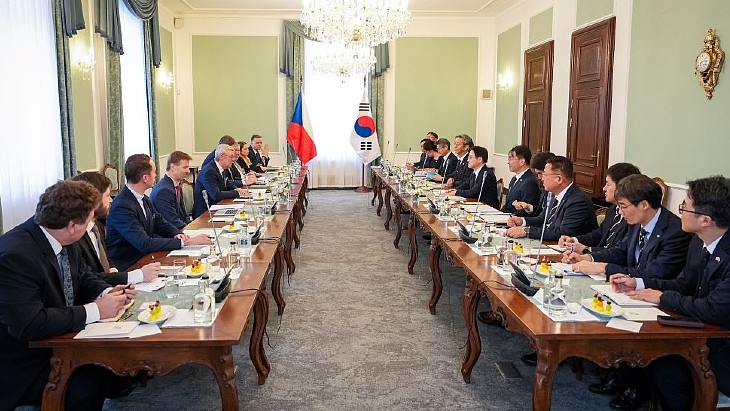
Steering Committee Established to Oversee Dukovany Expansion On 16 February 2026 Czech Industry Minister Karel Havlíček and South Korean Trade Minister Jung‑Kwan Kim created a ministerial steering committee to monitor preparation and construction of the two‑unit Dukovany project, pledging adherence to the approved timetable and budget while promoting strong Czech company involvement [1][2]. The body will coordinate with a newly‑created minister‑level consultation mechanism agreed during the same meeting, ensuring high‑level bilateral oversight [2]. Both governments emphasized that the committee will safeguard domestic job creation and technology transfer throughout the expansion [1].
EPC Contract Signed with Korean Consortium Valued at CZK 407 Billion The Czech government selected Korea Hydro and Nuclear Power (KHNP) as the preferred bidder in July 2024 and finalized an engineering‑procurement‑construction agreement in June 2025 for two APR‑1000 reactors, valued at CZK 407 billion [1]. Doosan Enerbility and Doosan Škoda Power will supply the turbine core, while Energoprojekt Praha will handle permitting and licensing, marking decisive steps toward execution [1]. Construction is slated to begin in 2029, aligning with the project’s original schedule [1].
South Korean Government Reinforces Political Backing with Presidential Letter During the 16 February 2026 meeting in Prague, Minister Kim presented Czech Prime Minister Andrej Babis with a handwritten note from President Lee Jae Myung, symbolizing high‑level political support for the nuclear collaboration [2]. The letter accompanied a reaffirmation that Seoul will provide “utmost support” for completing the Dukovany plant, and both sides agreed to establish a minister‑level consultation body to coordinate assistance in the final stages [2]. The $18 billion nuclear deal, concluded in June 2025, underpins this renewed commitment [2].
Broad Supplier Registration and Domestic Job Emphasis Highlighted Approximately 160 companies have registered as potential suppliers for the Dukovany expansion, reflecting a sizable emerging supply chain [1]. Czech officials, including Havlíček, pledged equal conditions and the highest possible Czech share in the project, while Doosan Škoda Power CEO Daniel Procházka stressed the importance of Czech‑engineered turbines for long‑term safe operation [1]. The existing nuclear fleet already provides about one‑third of the nation’s electricity, underscoring the strategic importance of the new units [1].
Sources
-
1.
World Nuclear News: Czech‑Korean Steering Committee Oversees Dukovany Nuclear Expansion: details the formation of the ministerial steering committee, EPC contract signing, turbine supply agreements, supplier registration drive, and emphasis on Czech job creation and technology share.
-
2.
Yonhap: South Korea Reaffirms Support for Czech Dukovany Nuclear Project: focuses on South Korea’s political backing, the handwritten presidential letter, establishment of a minister‑level consultation mechanism, and the $18 billion deal finalized in June 2025.
Timeline
July 2024 – The Czech government selects Korea Hydro & Nuclear Power (KHNP) as the preferred bidder for two APR‑1000 units at the Dukovany site, establishing the core partnership for the expansion of the Czech nuclear fleet [7].
June 2025 – Czech authorities sign a CZK 407 billion engineering‑procurement‑construction (EPC) contract with KHNP and Doosan partners for the Dukovany expansion, targeting construction start in 2029 [7].
June 2025 – A South Korean consortium led by KHNP finalizes an estimated US$18 billion agreement with the Czech government to build the Dukovany nuclear power plant, cementing the bilateral energy partnership [1].
Jan 8, 2026 – Climate, Energy and Environment Minister Kim Sung‑hwan tells a policy forum that the previous nuclear phase‑out “needs reevaluation” and that stable power for semiconductor factories “requires nuclear,” calling the export‑only stance “awkward” [6].
Jan 26, 2026 – Climate Minister Kim Sung‑whan announces that South Korea will build two large‑scale nuclear reactors by 2038 under the 12th electricity‑supply plan, linking the projects to carbon‑reduction goals and the nation’s 2050 neutrality target [5].
Jan 26, 2026 – The ministry says KHNP will launch a site‑selection bidding process for the new reactors by 2027, aiming for safety‑watchdog approval by 2031 and construction start in 2037‑2038 [5].
Jan 26, 2026 – Government‑commissioned surveys show an average of 80 % of respondents deem nuclear power necessary and 60 % support the new construction plan, indicating strong public backing for the shift [5].
Jan 26, 2026 – Defense Minister Ahn Gyu‑back meets U.S. Under Secretary of Defense for Policy Elbridge Colby, describing the alliance as at a “historic turning point” and seeking concrete cooperation on acquiring nuclear‑powered submarines within the year [3].
Jan 26, 2026 – Presidential chief of staff Kang Hoon‑sik departs for Toronto to lobby for South Korea’s bid in Canada’s up‑to‑US$40.9 billion submarine project, pitting Hanwha Ocean against Germany’s Thyssenkrupp Marine Systems [4].
Jan 26, 2026 – S‑Oil Corp. reports a fourth‑quarter profit of 265 billion won, reversing a loss thanks to a weaker won that improves export margins, highlighting the impact of currency swings on Korean industry [3].
Jan 27, 2026 – The KOSDAQ index closes above 1,000 points for the first time since 2022, a rally analysts attribute to recent market reforms favoring technology firms and to the government’s nuclear‑policy reversal boosting investor confidence [2].
Jan 27, 2026 – The government formally reverses its nuclear phase‑out, approving two new reactors—including one small‑modular reactor—as part of an “AI era” energy strategy to meet soaring electricity demand from AI and EV sectors [2].
Jan 27, 2026 – The National Pension Service raises its domestic equity allocation to 14.9 % for the year, aiming to strengthen local capital markets amid the broader push for domestic investment [2].
Jan 27, 2026 – Hyundai Motor Group’s chairman joins a diplomatic delegation to Canada to advance a submarine procurement agreement, underscoring South Korea’s broader defense‑export ambitions [2].
Feb 16, 2026 – South Korean Trade Minister Kim Jung‑kwan meets Czech Prime Minister Andrej Babiš in Prague, pledging “utmost support” for completing Dukovany, presenting a handwritten letter from President Lee Jae Myung, and agreeing to create a minister‑level consultation body to coordinate assistance for the project’s final stages [1].
Feb 18, 2026 – Czech Industry Minister Karel Havlíček and South Korean Trade Minister Jung‑Kwan Kim establish a ministerial steering committee to monitor Dukovany’s preparation and construction, ensuring adherence to schedule and budget while promoting Czech company participation [7].
2026 – The Czech nuclear fleet—four VVER‑440 units at Dukovany and two VVER‑1000 units at Temelín—already supplies roughly one‑third of national electricity, underscoring the strategic importance of expanding Dukovany’s capacity [7].
2027 (planned) – KHNP is set to begin a bidding process to select sites for the two new domestic reactors, a key step toward meeting the 2037‑2038 construction timeline outlined in the 12th power‑supply plan [5].
2029 (target) – Construction of the two APR‑1000 units at Dukovany is slated to commence, following the EPC contract signed in June 2025 and the steering committee’s oversight, marking a major expansion of Central Europe’s nuclear capacity [7].
2037‑2038 (target) – South Korea aims to complete construction of its two new large‑scale nuclear reactors, fulfilling the commitment made in early 2026 and supporting the nation’s goal of carbon neutrality by 2050 [5].
All related articles (7 articles)
-
World Nuclear News: Czech‑Korean Steering Committee Oversees Dukovany Nuclear Expansion
-
Yonhap: South Korea Reaffirms Support for Czech Dukovany Nuclear Project
-
Yonhap: South Korea’s Market Surge and Nuclear Policy Reversal Highlight Jan 27 Headlines
-
Yonhap: South Korea Announces Nuclear Expansion, Defense Talks, and Economic Shifts
-
Yonhap: South Korea Sets 2038 Nuclear Goal, Sends Official to Canada, and Reports Other Key Developments
-
Yonhap: South Korea Confirms Timeline for Two New Nuclear Reactors by 2038
-
Yonhap: Korean climate minister signals need for new nuclear reactors amid policy shift