Security Official Opens Fire as Iranians Mark 40‑Day Memorials Amid Growing Tensions
Updated (15 articles)
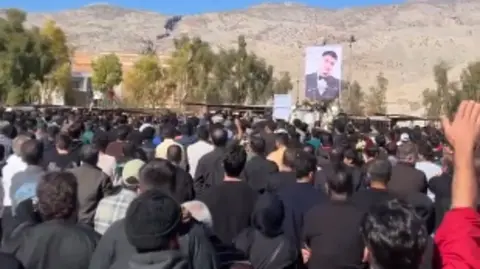

Memorials Mark 40‑Day Anniversary of Jan 8‑9 Crackdown Hundreds gathered in Abdanan, Mashhad and other towns on Feb 18‑19 to observe the chehelom, the traditional 40‑day remembrance for those killed during the Jan 8‑9 security operation [1][2]. Demonstrators shouted “Death to Khamenei” and “Death to America” from rooftops, balconies and cemetery grounds, echoing slogans first heard in Tehran’s affluent districts [1][2]. The gatherings attracted several hundred participants in each location, despite the presence of armored vehicles and tear‑gas deployments by security forces [1][2].
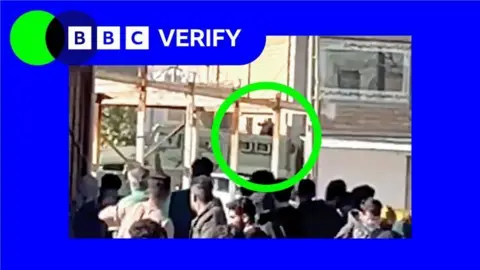
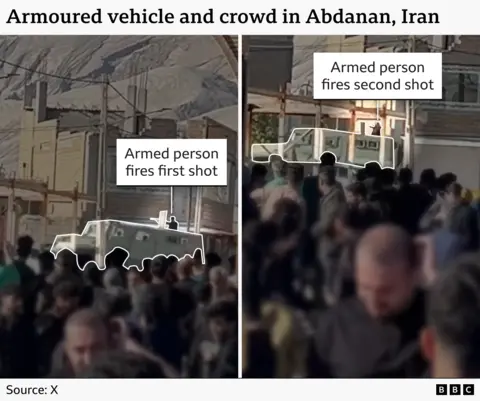
Security Forces Use Live Fire Against Mourners BBC‑verified video shows a uniformed security official firing two shots from an armored vehicle into a crowd at the Abdanan cemetery, producing smoke and prompting panic among mourners [2]. The incident occurred on Tuesday, Feb 18, and contradicts the state‑run IRIB’s claim that the event was peaceful and resulted in no injuries [2]. AP also reported that security forces fired from armored vehicles and used tear‑gas to disperse participants during the same memorials [1].
Death Toll and Arrest Figures Remain Disputed Iran’s official count lists 3,117 deaths from the Jan 8‑9 crackdown, while the Human Rights Activists News Agency (HRANA) documents more than 7,000 protest‑related deaths and over 53,000 arrests since the protests began in late December [1][2]. HRANA’s higher figures are cited by both outlets, highlighting the gap between government statistics and independent monitoring groups [1][2]. The discrepancy underscores ongoing uncertainty about the true human cost of the repression.
International Tension Rises as U.S. Naval Presence Grows The United States has positioned aircraft carriers and fighter jets in the Persian Gulf, publicly threatening strikes on Iran even as diplomatic talks over Tehran’s nuclear program continue [1]. This naval buildup follows the renewed public defiance in Iran’s memorials and adds a geopolitical dimension to the domestic unrest [1]. Analysts note that the combination of internal protests and external pressure could further destabilize the region.
Economic Hardship Fuels Public Despair and Calls for Regime Change Iranians report a collapsing currency, soaring prices and shortages that have turned everyday purchases into luxuries, contributing to a “mass depression” among citizens [1]. Some demonstrators expressed support for exiled Crown Prince Reza Pahlavi and voiced hopes that U.S. military action might end the violence [1]. The economic crisis, alongside political repression, appears to be widening the pool of opposition to the regime.
Sources
-
1.
AP: Iranians Hold Defiant 40‑Day Memorials Amid Crackdown and U.S. Pressure: Details rooftop chants, hundreds attending chehelom gatherings, death toll estimates, U.S. warship deployment, economic collapse, and a segment of protesters backing exiled crown prince Reza Pahlavi
-
2.
BBC: Security Official Fires on Mourners During 40‑Day Commemoration in Iran: Provides video evidence of a security official shooting at mourners in Abdanan, documents chants, notes state media denial, and cites HRANA’s higher death and arrest figures
Timeline
Late December 2025 – Protests erupt in Tehran’s bazaars over soaring inflation, quickly spreading to more than 100 cities and marking the largest sustained challenge to the regime since the 2022 Mahsa Amini uprising [12].
8 January 2026 – Exiled crown‑prince Reza Pahlavi urges nationwide demonstrations; thousands flood the streets and security forces open fire, creating the deadliest protest nights of the crackdown [3].
8‑9 January 2026 – Security forces launch a coordinated live‑fire operation ordered by Supreme Leader Ali Khamenei, killing at least 3 117 people according to official figures and over 7 000 according to HRANA, while “Death to America” and “Death to Khamenei” chants echo from rooftops [1][13].
9 January 2026 – Mortuary photos from Kahrizak Forensic Medical Centre later reveal 326 victims, many dated 9 January, underscoring the scale of the night‑long bloodshed [4].
10 January 2026 – Activist Vahid films inside the Kahrizak mortuary, capturing at least 186 bodies in a five‑minute clip and describing the scene as “the apocalypse” [6].
11 January 2026 – HRANA reports 116 protester deaths, 38 security‑force deaths and 2 638 arrests across 185 cities as the crackdown intensifies [12].
12 January 2026 – Kahrizak’s makeshift morgue holds roughly 250 bodies, families crowd the courtyard seeking identification while state media blames “rioters” for the deaths [10].
14 January 2026 – Tehran mortuary videos released by BBC Verify show nearly 200 bodies with visible wounds, confirming the “hundreds” of dead claim and highlighting victims as young as 16 [6].
15 January 2026 – Families are forced to pay exorbitant sums—up to 1 billion tomans—to retrieve protesters’ bodies, prompting some to break into mortuaries and hide the remains themselves [5].
17 January 2026 – Kurdish taxi driver Farzat recounts live‑bullet fire in Karaj that left three dead in minutes and notes “80‑plus” bodies arrived at a local hospital that night [9]; the same day, Robina Aminian’s mother spends seven hours searching morgue bags before burying her daughter in an unmarked grave [14].
18 January 2026 – Surgeon Nima works nonstop for 96 hours after the 8 January attacks, loading wounded protesters into his car and operating without sleep to save lives [2].
21 January 2026 – Leaked photographs from Kahrizak identify 326 victims, with over 100 stamped “9 January,” reinforcing independent death‑toll estimates that far exceed official numbers [4].
26 January 2026 – Verified footage shows rooftop snipers in Mashhad, protesters disabling CCTV cameras, and mass bodies in Tehranpars hospital mortuary, illustrating both armed repression and civilian resistance [3].
28 January 2026 – Protesters in Isfahan evade hospitals for fear of arrest; a doctor treats bird‑shot wounds at a private home, while medics risk detention for providing clandestine care [2].
3 February 2026 – Thousands gather at Tehran’s Behesht‑e Zahra cemetery for 40‑day memorials, bringing sweets and flowers while fearing state retaliation; hyper‑inflation fuels daily despair, and some attribute the protests to President Trump’s early‑January pledges of support [8].
18 February 2026 – A security official opens fire from an armored vehicle on mourners at a 40‑day commemoration in Abdanan cemetery, killing and scattering the crowd despite state media’s claim of a peaceful event [1].
19 February 2026 – Iranians resume defiant rooftop chants during 40‑day memorials, while U.S. aircraft carriers position near Iran and diplomats continue nuclear talks; protesters cite “death to the dictator” slogans and express hope for U.S. strikes to end the violence [13].
Dive deeper (6 sub-stories)
-
Iranian 40‑Day Memorials Met With Gunfire and Rooftop Defiance
(2 articles)
-
CNN: Families Gather at Tehran Cemetery Amid Ongoing Grief Over Protester Deaths
-
Iran Protesters Receive Secret Home Medical Care as Hospitals Targeted by Police
(8 articles)
-
CNN: Iranian taxi driver recounts deadly Karaj crackdown as protests intensify
-
Iranian Families Scramble for Protest Victims’ Bodies Amid Overcrowded Morgues and Payment Demands
(2 articles)
-
AP: AP relies on HRANA for Iran protest death toll as internet cut complicates tally
All related articles (15 articles)
-
AP: Iranians hold defiant 40‑day memorials amid crackdown and U.S. pressure
-
BBC: Security Official Fires on Mourners During 40‑Day Commemoration in Iran
-
CNN: Families Gather at Tehran Cemetery Amid Ongoing Grief Over Protester Deaths
-
BBC: Iran protesters receive secret medical care as hospitals become police targets
-
BBC: Iran videos expose hospital mortuary bodies, rooftop snipers and CCTV sabotage
-
BBC: Leaked photos reveal hundreds killed in Iran crackdown
-
CNN: Iranian taxi driver recounts deadly Karaj crackdown as protests intensify
-
AP: Family of Iranian protester searched for her body in a pile of corpses
-
BBC: Iran protests: families report authorities demand large sums for returning bodies
-
BBC: Tehran mortuary videos reveal brutality of Iran crackdown
-
AP: AP relies on HRANA for Iran protest death toll as internet cut complicates tally
-
CNN: Morgue Overload Highlights Toll of Iran's Crackdown on Dissent
-
CNN: Student, bodybuilder and father of three among those killed in Iran protests
-
CNN: Tehran protesters describe seeing bodies in hospitals as crackdown intensifies
-
BBC: Iranian hospitals overwhelmed as protests expand with dead and injured
External resources (2 links)
- https://www.amnesty.org/en/latest/news/2026/01/iran-massacre-of-protesters-demands-global-diplomatic-action-to-signal-an-end-to-impunity/ (cited 1 times)
- https://www.en-hrana.org/day-50-of-the-protests-intensification-of-security-prosecutions-and-uncertainty-regarding-the-status-of-detainees/ (cited 1 times)