Anthropic Interviewer Captures 1,250 Professionals’ Views on AI Use
Published Cached
-
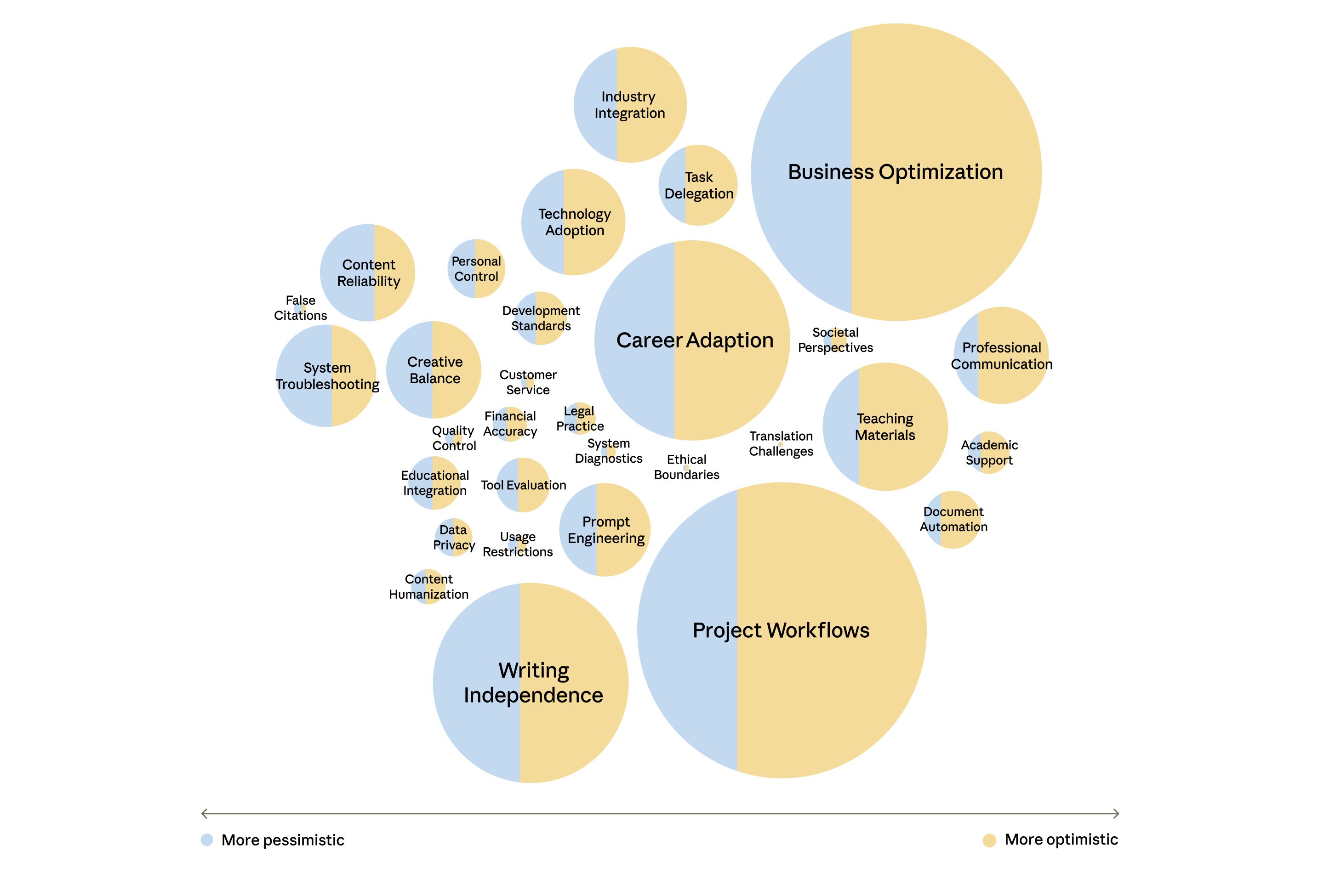 Image: AnthropicThe different topics people discussed in their interviews with Anthropic Interviewer. Across all three samples we studied—the general workforce, scientists, and creatives—participants expressed predominantly positive sentiments about AI’s impact on their professional activities. Certain topics did introduce pause, particularly around questions of personal control, job displacement, and autonomy. In this diagram, topics are roughly ordered from more pessimistic to more optimistic. (Anthropic) Source Full size
Anthropic Interviewer runs AI‑driven interviews at unprecedented scale – The new tool, built on Claude, planned, conducted, and helped analyze 1,250 real‑time interviews in 10‑15‑minute sessions, demonstrating that large‑scale qualitative research can be automated [1].
General workforce sees AI as a productivity boost but feels stigma and anxiety – 86% say AI saves time, 65% are satisfied, yet 69% report workplace stigma, 55% feel anxious about future impact, and 48% envision roles overseeing AI rather than performing routine tasks [1].
Creative professionals report major efficiency gains yet fear peer judgment and displacement – 97% say AI saves time, 68% claim quality improves; however, 70% mention managing stigma, and many voice concerns about market saturation, loss of income, and loss of creative control [1].
Scientists use AI mainly for support tasks and cite low trust as a barrier – Researchers rely on AI for literature review, coding, and writing; 79% point to trust and reliability issues, 27% note technical limits, while 91% desire AI that can generate hypotheses and design experiments [1].
Interview participants rated the experience highly, with >97% satisfaction – Post‑interview surveys show 97.6% gave a satisfaction rating of 5 or higher, 96.96% felt their thoughts were captured well, and 99.12% would recommend the format [1].
Anthropic released the full transcript dataset and highlighted study limitations – All interview data are publicly available on Hugging Face for further research [4]; the authors note selection bias, demand characteristics, self‑report versus objective discrepancies, and limited global generalizability as key constraints [1].
- Fact‑checker (general workforce): “A colleague recently said they hate AI and I just said nothing. I don’t tell anyone my process because I know how a lot of people feel about AI.” [1]
- Data‑quality manager (general workforce): “I try to think about it like studying a foreign language—just using a translator app isn’t going to teach you anything, but having a tutor who can answer questions and customize for your needs is really going to help.” [1]
- Interpreter (general workforce): “I believe AI will eventually replace most interpreters… so I’m already preparing for a career switch, possibly by getting a diploma and getting into a different trade.” [1]
- Pastor (general workforce): “…if I use AI and up my skills with it, it can save me so much time on the admin side which will free me up to be with the people.” [1]
- Voice actor (creative): “Certain sectors of voice acting have essentially died due to the rise of AI, such as industrial voice acting.” [1]
- Composer (creative): “Platforms might leverage AI tech along with their publishing libraries to infinitely generate new music, flooding markets with cheap alternatives to human‑produced music.” [1]
- Artist (creative): “The AI is driving a good bit of the concepts; I simply try to guide it… 60% AI, 40% my ideas.” [1]
- Information‑security researcher (scientist): “If I have to double check and confirm every single detail the [AI] agent is giving me to make sure there are no mistakes, that kind of defeats the purpose of having the agent do this work in the first place.” [1]
- Mathematician (scientist): “After I have to spend the time verifying the AI output, it basically ends up being the same [amount of] time.” [1]
- Medical scientist (scientist): “I wish AI could… help generate or support hypotheses or look for novel interactions/relationships that are not immediately evident for humans.” [1]
Links
- [1] https://www.anthropic.com/research/anthropic-interviewer
- [10] https://www.anthropic.com/news/claude-for-life-sciences
- [11] https://www.anthropic.com/news/introducing-the-anthropic-economic-advisory-council
- [12] https://www.anthropic.com/news/anthropic-higher-education-initiatives
- [13] https://www.anthropic.com/research/collective-constitutional-ai-aligning-a-language-model-with-public-input
- [14] https://www.las-art.foundation/programme/pierre-huyghe
- [15] https://www.mori.art.museum/jp/index.html
- [16] https://www.tate.org.uk/whats-on/tate-modern/electric-dreams
- [17] https://rhizome.org/events/rhizome-presents-vibe-shift/
- [18] https://www.socratica.info/
- [19] https://www.anthropic.com/news/model-context-protocol
- [2] https://www.anthropic.com/research/clio
- [20] https://www.anthropic.com/news/ai-for-science-program
- [21] https://www.aft.org/press-release/aft-launch-national-academy-ai-instruction-microsoft-openai-anthropic-and-united
- [22] http://claude.ai/redirect/website.v1.b23a11d4-c9ba-434c-83eb-082f855a0d87/interviewer
- [23] https://www.sciencedirect.com/science/article/pii/S277250302300021X
- [24] https://www.sciencedirect.com/science/article/pii/S2451958824002021
- [25] http://claude.ai/redirect/website.v1.b23a11d4-c9ba-434c-83eb-082f855a0d87
- [26] http://claude.ai/redirect/website.v1.b23a11d4-c9ba-434c-83eb-082f855a0d87
- [27] https://claude.ai/redirect/website.v1.b23a11d4-c9ba-434c-83eb-082f855a0d87/interviewer
- [28] https://www.anthropic.com/legal/privacy
- [29] https://privacy.claude.com/en/articles/12996960-how-does-anthropic-interviewer-collect-and-use-my-data
- [3] https://www.anthropic.com/economic-index
- [30] http://claude.ai/redirect/website.v1.b23a11d4-c9ba-434c-83eb-082f855a0d87
- [31] http://claude.ai/redirect/website.v1.b23a11d4-c9ba-434c-83eb-082f855a0d87
- [32] https://links.email.claude.com/s/c/cGkT1SXSNgcdo1m1Jg5ubLKEl9K6sdfmpEYqg1hKZUyGgcl4dwPfeO18GyKSSqXjh6VJYoL1jUZK6AD2BWJz4p6OxoEug7KO9W2Yl7UuTqBou7dHkuDUR9lSrGIwoWBHBu-wkEktomJDbUAT2u8a6E6foGoE2H3RIurvO9epWQ7AJsKe_0FNVxLk4ygbQL3j7y1jjTEiC2qM5p0y1YCjCVAFED8I6wYqldfi9BKBYq993W-nOs45JbAMQkT6sZUFTHhEwJTV__gENvsItJqLkEOWFL9lrz48UJTC33i6n3SqYgI6stnpAsjLF66P_qtdOX888L-0h2qzKpxlrtGvrvuqEtl5pLNkPQUulHsITd7MyVL3tf-Ubi3dJVc1h9rB7v04z5j16n5-Kbp-iwCpz3RIbNot86fAZNPdfMqyBxFRDZlAUH-iEQ7h8wY1x6k8mnegW7y77GhLsqTJiZxqIi9o511wHl1Ltu-XLpeOVd80/ql5MQfX8py3XUgI4Usb8PWvj6gyGGxly/16
- [4] https://huggingface.co/datasets/Anthropic/AnthropicInterviewer
- [5] https://www.anthropic.com/research/clio
- [6] http://claude.ai/redirect/website.v1.b23a11d4-c9ba-434c-83eb-082f855a0d87
- [7] https://www.anthropic.com/research/clio
- [8] https://arxiv.org/pdf/2503.04761
- [9] https://www.anthropic.com/research/economic-index-geography