Anthropic launches Clio to analyze Claude usage while preserving privacy
Published Cached
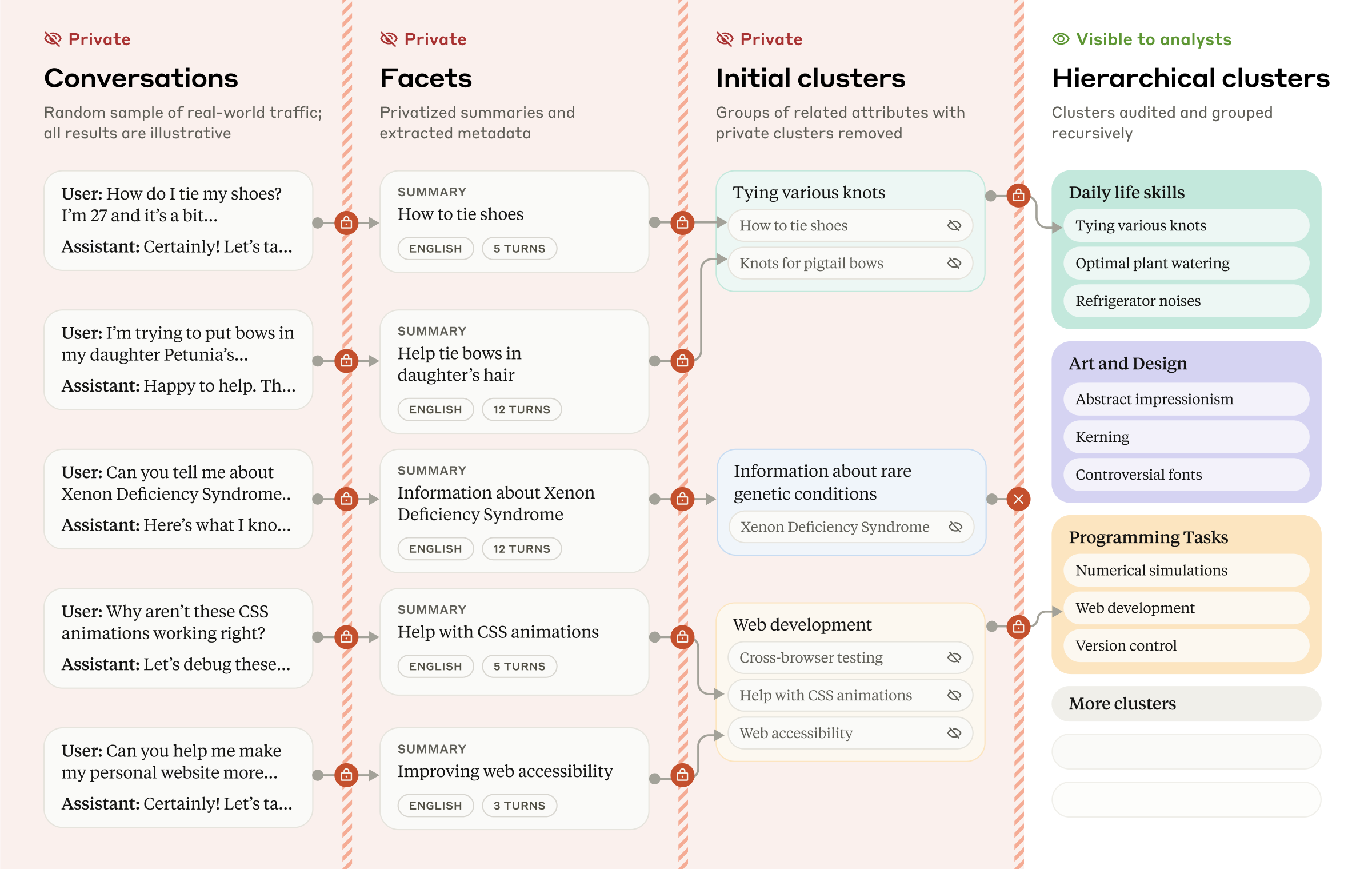
Clio enables privacy‑preserving analysis of Claude conversations – The system extracts conversation facets, clusters topics, and builds hierarchical summaries using Claude, while automatically anonymizing data and enforcing minimum‑user thresholds to prevent exposure of individual information [1].
Analysis of one million Claude chats reveals dominant use cases – Over 10 % of dialogs involve web and mobile app development, more than 7 % focus on education, and nearly 6 % pertain to business strategy, showing coding, learning, and professional tasks as the primary drivers of usage [1].
Clio uncovers diverse niche topics and language‑specific trends – Smaller clusters include dream interpretation, soccer match analysis, disaster preparedness, crossword hints, Dungeons & Dragons gaming, and counting the r’s in “strawberry”; language‑level analysis highlights topics that appear disproportionately in Spanish, Chinese, and Japanese conversations [1].
The system aids Trust and Safety by spotting coordinated abuse – In late September, Clio detected a network of automated accounts generating SEO‑spam prompts, leading to the removal of those accounts, and it also identified attempts to resell unauthorized Claude access [1].
Clio improves detection of false negatives and false positives – Compared with existing classifiers, Clio flagged missed harmful content such as illicit translations and highlighted benign queries—like resume advice or D&D statistics—that were incorrectly flagged, enabling refinement of enforcement thresholds [1].
Anthropic plans broader rollout and continuous privacy audits – Clio is being integrated into all enforcement tools, with ongoing audits, data‑minimization policies, and future upgrades using newer Claude models to maintain privacy and user trust [1].
Links
- [1] https://www.anthropic.com/research/clio
- [2] http://claude.ai/redirect/website.v1.b6923fba-26b4-4363-8e80-0cc1d883128d
- [3] https://arxiv.org/abs/2412.13678
- [4] https://arxiv.org/abs/2412.13678
- [5] https://claude.ai/redirect/website.v1.b6923fba-26b4-4363-8e80-0cc1d883128d
- [6] https://arxiv.org/abs/2405.01470
- [7] https://arxiv.org/abs/2309.11998
- [8] https://claude.ai/redirect/website.v1.b6923fba-26b4-4363-8e80-0cc1d883128d
- [9] https://claude.ai/redirect/website.v1.b6923fba-26b4-4363-8e80-0cc1d883128d
- [10] https://www.anthropic.com/legal/aup
- [11] https://arxiv.org/abs/2412.13678
- [12] https://www.anthropic.com/legal/aup
- [13] https://www.anthropic.com/legal/aup
- [14] https://www.anthropic.com/news/developing-computer-use
- [15] https://www.anthropic.com/news/elections-ai-2024
- [16] https://arxiv.org/abs/2412.13678
- [17] https://boards.greenhouse.io/anthropic/jobs/4251453008