AI‑driven productivity surge and growing pains at Anthropic
Published Cached
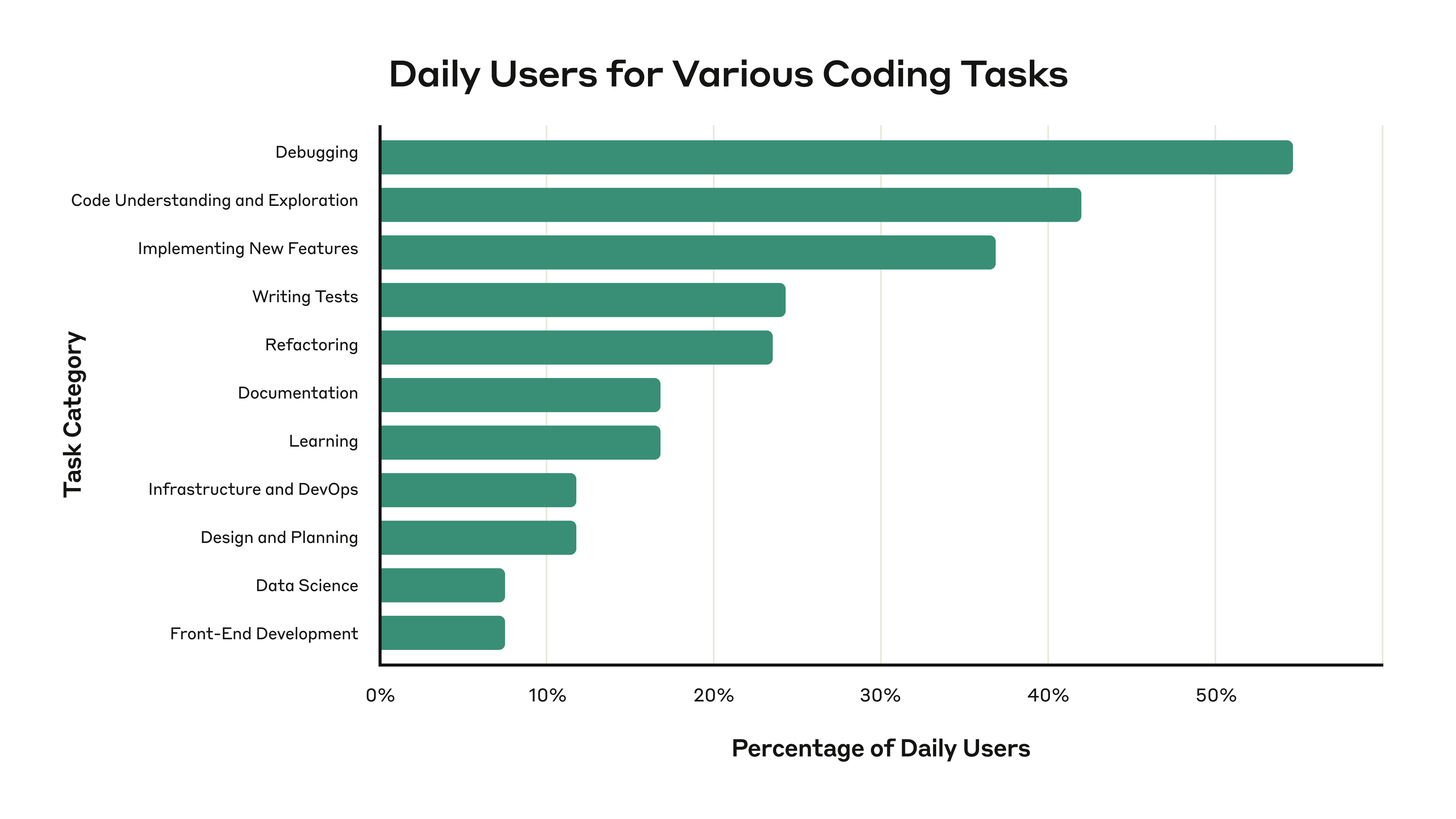
Claude usage jumped to 60 % of daily work, boosting self‑reported productivity by 50 % – In a survey of 132 engineers and researchers, respondents said they now rely on Claude for roughly three‑fifths of tasks, up from 28 % a year earlier, and claim a half‑again increase in output, a rise they attribute to faster iteration and higher output volume [1].
Engineers report becoming “full‑stack,” tackling tasks beyond prior expertise – Qualitative interviews reveal staff now feel capable of handling front‑end, database, and API work that they previously avoided, describing a shift toward broader skill application while also noting some fear of deeper skill erosion [1].
Claude Code handles more complex, autonomous workflows – Internal usage logs analyzed with Anthropic’s privacy‑preserving tool show average task complexity rose from 3.2 to 3.8, consecutive tool calls per transcript grew 116 % (9.8 → 21.2), and human‑turns fell 33 % (6.2 → 4.1), indicating reduced oversight for harder coding problems [13][1].
27 % of Claude‑assisted work would not have been done otherwise – Survey respondents estimate that AI enables scaling projects, building “nice‑to‑have” dashboards, and fixing minor “papercuts” (8.6 % of Claude Code tasks) that they would have postponed or omitted without AI assistance [1][11].
Collaboration patterns shift as Claude becomes the first point of contact – Engineers say routine questions now go to Claude 80‑90 % of the time, leading some junior staff to seek fewer mentor interactions and raising concerns about mentorship loss and social dynamics [1].
Long‑term career outlook remains uncertain despite short‑term optimism – While many staff feel AI accelerates learning and productivity, a notable share express anxiety that AI could eventually render their roles irrelevant, prompting discussions of new career pathways and policy responses [5][1].
- “I thought that I really enjoyed writing code, and I think instead I actually just enjoy what I get out of writing code.” – Engineer reflecting on shifting motivation after using Claude.
- “I like working with people and it's sad that I ‘need’ them less now…” – Engineer commenting on reduced reliance on colleagues for routine queries.
- “I feel optimistic in the short term but in the long term I think AI will end up doing everything and make me and many others irrelevant.” – Engineer expressing mixed feelings about AI’s future impact.
Links
- [1] https://www.anthropic.com/research/how-ai-is-transforming-work-at-anthropic
- [10] https://anthropic.com/research/how-ai-is-transforming-work-at-anthropic#ai-delegation-approaches
- [11] https://anthropic.com/research/how-ai-is-transforming-work-at-anthropic#fixing-papercuts
- [12] https://metr.org/blog/2025-07-10-early-2025-ai-experienced-os-dev-study/
- [13] https://www.anthropic.com/research/clio
- [14] https://www.anthropic.com/learn/claude-for-you
- [2] https://www.anthropic.com/economic-index
- [3] https://www.anthropic.com/claude-code
- [4] https://anthropic.com/research/how-ai-is-transforming-work-at-anthropic#appendix
- [5] https://www.anthropic.com/research/economic-policy-responses
- [6] https://assets.anthropic.com/m/6cd21f7d4f82afcb/original/Claude-at-Work-Survey.pdf
- [7] https://newsletter.pragmaticengineer.com/p/how-claude-code-is-built
- [8] https://anthropic.com/research/how-ai-is-transforming-work-at-anthropic#appendix
- [9] https://metr.org/blog/2025-07-10-early-2025-ai-experienced-os-dev-study/