Nuclear Leaders Call for Mindset Shift as 2025 Becomes Decisive Year for Future Capacity
Published Cached
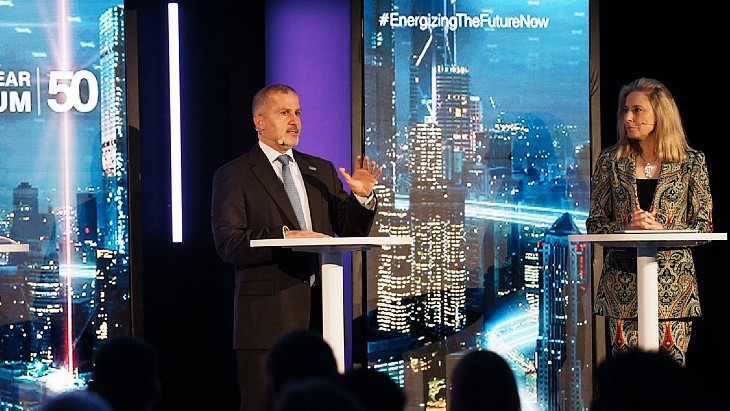
Leadership must pivot from planning to rapid execution – In 2025, sector heads argue the decade should be remembered for accelerating nuclear build‑out to meet 2050 clean‑energy goals, stressing that decisive action now will shape future outcomes[1].
Clean‑energy employment now outpaces fossil fuels – The International Energy Agency reports over 67 million global energy workers, with roughly 35 million jobs in renewables, nuclear, grids and efficiency, and 33 nations aiming to triple nuclear output[1].
Every gigawatt of nuclear adds thousands of jobs – A NICE Clean Energy Ministerial study notes each new gigawatt typically creates 4,000–5,000 direct, indirect and induced positions, linking Final Investment Decisions directly to long‑term livelihoods[1].
Senior leaders urge youth inclusion and shared responsibility – Chairman Mohamed Al Hammadi praises younger leaders for “innovating and thinking outside of tradition,” while Director‑General Sama Bilbao y León says leadership is “being responsible for those in your charge, empowering and enabling them”[1].
Rising electricity demand demands visionary leadership – Electrification, digitalisation and AI are driving sharp demand growth; leaders must adopt a mindset that asks “how do we make this happen now?” to sustain the sector’s transformation[1].
Success by 2050 will be judged on skill investment and knowledge sharing – The article warns that future assessments will focus on early skill development, clear career pathways for young professionals, and effective international platforms for sharing expertise, noting that technology and funding are increasingly available[1].
- Mohamed Al Hammadi, Chairman of the World Nuclear Association – Described younger leaders as “innovating and thinking outside of tradition” and emphasized the need to place them at key events and projects to build on existing expertise[1].
- Sama Bilbao y León, Director General of the World Nuclear Association – Stated that leadership is not about “being in charge” but about “being responsible for those in your charge, empowering and enabling them”[1].
- Callum Thomas, Chair of the Workforce and Talent Development Working Group – Facilitated the discussion on leadership mindset, though no direct quotation is provided in the article[1].