Canada Secures Men’s Curling Gold at Milan‑Cortina Games Amid Double‑Touch Controversy
Updated (3 articles)
-
 Image: NewsweekCORTINA D’AMPEZZO, ITALY – FEBRUARY 10: Silver medalists Korey Dropkin and Cory Thiesse of Team United States celebrate on the podium after the Mixed Doubles Gold Medal Game on day four of the Milano Cortina 2026 Winter Olympic games at Cortina Curling Olympic Stadium on February 10, 2026 in Cortina d’Ampezzo, Italy. (Photo by Ezra Shaw/Getty Images) Source Full size
 -
Image: NewsweekCORTINA D’AMPEZZO, ITALY – FEBRUARY 10: Silver medalists Korey Dropkin and Cory Thiesse of Team United States celebrate on the podium after the Mixed Doubles Gold Medal Game on day four of the Milano Cortina 2026 Winter Olympic games at Cortina Curling Olympic Stadium on February 10, 2026 in Cortina d’Ampezzo, Italy. (Photo by Ezra Shaw/Getty Images) Source Full size
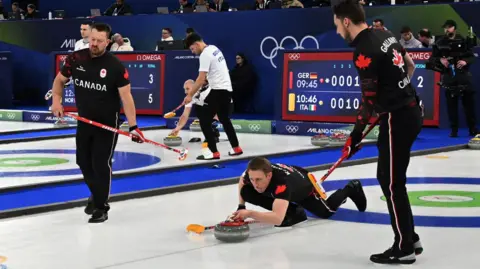
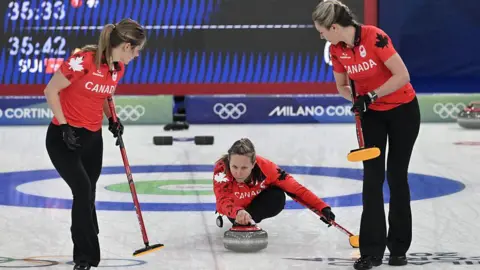
Canada Wins Men’s Curling Gold, First Since 2014 Canada defeated Great Britain 9‑6 in the men’s final, delivering the nation’s first Olympic‑style curling gold since the 2014 Sochi Games and its seventh overall in the sport [1]. Skip Brad Jacobs led veterans Marc Kennedy, Brett Gallant and Ben Hebert to the victory, while Rachel Homan’s women’s rink captured bronze after a comeback win over the United States [1]. The triumph raised Canada’s total curling medal count at the Milan‑Cortina Games to 14 [1].
Marc Kennedy Accused of Double‑Touch by Sweden Swedish skip Oskar Eriksson claimed Kennedy touched the stone a second time after release during round‑robin play, prompting a profanity‑filled outburst from Kennedy that went viral [1][3]. The same double‑touch allegation later surfaced against women’s skip Rachel Homan, who denied any breach and called the stone removal “insane” after Canada’s 8‑7 loss to Switzerland [3]. Great Britain’s men’s team also faced a similar accusation when curler Bobby Lammie had a stone removed, showing the issue extended beyond Canada [3].
World Curling Federation Responds with Rule Enforcement The World Curling Federation reiterated that any contact with the granite portion of a stone is prohibited and results in removal of the stone [3]. Kennedy received a verbal warning for his language, and officials were briefly stationed at the hog line before the federation reverted to traditional self‑policing [1][3]. No video‑review system was employed, and the federation stopped short of issuing a formal cheating charge [3].
U.S. Curler Korey Dropkin Defends Canadian Team Dropkin told CBS News the double‑touch controversy was “unfortunate” and overblown, emphasizing that such touches have been common among Olympians for years [2]. He praised Kennedy as “one of the greatest curlers of all time,” condemned the foul language used, and expressed empathy for athletes under intense scrutiny [2]. Dropkin’s comments highlighted a broader view that the incident does not reflect systemic cheating [2].
Canadian Public Reaction Mixes Disappointment and Optimism Social media users expressed disappointment, calling the episode a “sad day for Canadian sport,” while others suggested the publicity could boost interest in curling [3]. Commentators warned the allegations could damage Canada’s curling reputation and urged athletes to act as “bigger men and women” [3]. Nonetheless, some observers noted the nation’s strong performance may offset the negative attention [3].
Sources
-
1.
AP: Canada Wins Men’s Curling Gold Amid Cheating Allegations at Milan Cortina 2026: Reports Canada’s 9‑6 victory, details Kennedy’s double‑touch accusation, rule changes, and women’s bronze.
-
2.
Newsweek: U.S. Curler Korey Dropkin Defends Fellow Athletes Amid Olympic Double‑Touch Debate: Features Dropkin’s defense of Kennedy, notes double‑touch history, and World Curling rule clarification.
-
3.
BBC: Canadian Curling Team Faces Cheating Allegations Amid Public Outcry: Highlights Kennedy’s outburst, Homan’s allegation, public sentiment, and broader criticism of Canada’s curling reputation.
Related Tickers
Timeline
Feb 2014 – Canada wins men’s curling gold at the Sochi Winter Olympics, its last men’s gold before 2026 and a benchmark of the nation’s historic dominance in the sport [3].
Early Feb 2026 (round‑robin stage, Milan Cortina Games) – Swedish skip Oskar Eriksson alleges that Canadian skip Marc Kennedy double‑touches a stone after release, prompting a profanity‑filled outburst from Kennedy and igniting broader cheating accusations [3][1].
Feb 15‑16, 2026 (weekend) – Eriksson’s accusation spreads online; Kennedy refuses to apologise, hints at a “premeditated” attack by rivals, and the exchange goes viral [1].
Feb 17, 2026 – Canadian women’s skip Rachel Homan faces a double‑touch allegation, asserts a “zero percent chance” of any breach, and calls the stone removal “insane” after Canada’s 8‑7 loss to Switzerland [1].
Feb 17, 2026 – U.S. curler Korey Dropkin appears on CBS News, calls the controversy “unfortunate,” notes double‑touch is common among Olympians, defends Kennedy as “one of the greatest curlers of all time,” and condemns the foul language used in the dispute [2].
Feb 17‑18, 2026 – World Curling Federation issues a verbal warning to Kennedy for foul language, reiterates that any contact with the granite during forward motion is prohibited and results in stone removal, and dispatches officials to monitor releases, though it does not employ video review [1][2].
Feb 17‑18, 2026 – Canadian public reaction mixes disappointment and optimism, with commentators warning the scandal could damage Canada’s curling reputation while others suggest the publicity may boost interest in the sport [1].
Feb 21, 2026 – Canada defeats Great Britain 9‑6 in the men’s curling final at the Milan Cortina Games, securing its first men’s gold since 2014 and its seventh overall; skip Brad Jacobs says the cheating accusations “motivated us further” [3].
Feb 21, 2026 – Canada’s women’s team, led by Rachel Homan, wins bronze by beating the United States 10‑7 after a comeback, raising Canada’s total curling medal count to 14 at the Games [3].
Feb 21, 2026 – Jacobs urges officials to conduct a deeper review of a newly‑introduced rule he calls “a mess,” signalling an upcoming discussion on rule changes within World Curling [3].
External resources (2 links)
- https://www.youtube.com/olympics (cited 1 times)
- https://worldcurling.org/2026/02/statement-rules-violations/ (cited 1 times)