Trump’s AI Executive Order Deepens MAGA Split and Triggers Legal Battles
Updated (8 articles)
Executive Order Bars State AI Regulations President Trump signed the order in December 2025, prohibiting states from enforcing their own artificial‑intelligence rules and directing the administration to collaborate with Congress on a unified national framework [1]. The directive was crafted with input from White House AI czar David Sacks and longtime legal adviser Mike Davis [1]. Analysts anticipate immediate legal challenges to the preemption of state authority [1].
Internal Conflict Between AI Czar and Legal Adviser In a November meeting held in Vice President JD Vance’s office, Davis accused Sacks of attempting to sideline Congress and impose unchecked AI policies [1]. Sacks responded that he was executing Trump’s vision to unleash an AI boom, highlighting a growing fault line within the MAGA coalition [1]. The confrontation underscores divergent strategies on regulation versus rapid development [1].
Federal Moves on Chips and Tariffs Accelerate AI Race The administration secured a 10 % equity stake in Intel to boost domestic chip production and imposed a 25 % tariff on foreign semiconductor imports [1]. These actions complement a summer‑time framework that fast‑tracked AI projects and aim to outpace China’s technological advances [1]. The policy bundle signals a push for regulatory freedom for tech firms while tightening trade barriers [1].
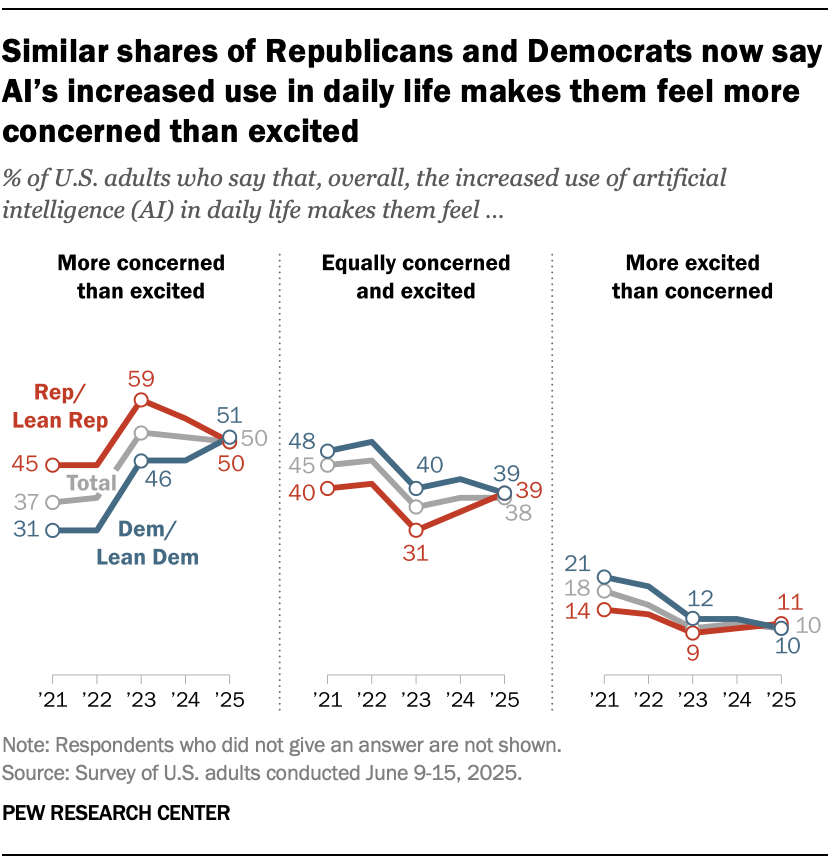
Public Sentiment Shows Growing AI Anxiety A September 2025 Pew Research Center poll found that 50 % of Americans are more concerned than excited about AI’s expanding role, while only 10 % feel more excitement than worry [1]. The data reflects rising voter backlash that could influence upcoming congressional debates on AI oversight [1]. Public unease aligns with criticism from within Trump’s base [1].
Funding Surge Fuels Political Fight Over AI OpenAI co‑founder Greg Brockman contributed $25 million to the pro‑Trump super PAC MAGA Inc., while the industry‑backed “Leading the Future” PAC has amassed roughly $100 million to target anti‑AI candidates [1]. Hundreds of lobbyists have been hired, and millions are being donated to congressional campaigns ahead of the 2026 midterms [1]. This financial influx intensifies the partisan battle over AI policy direction [1].
Primary Data (3)
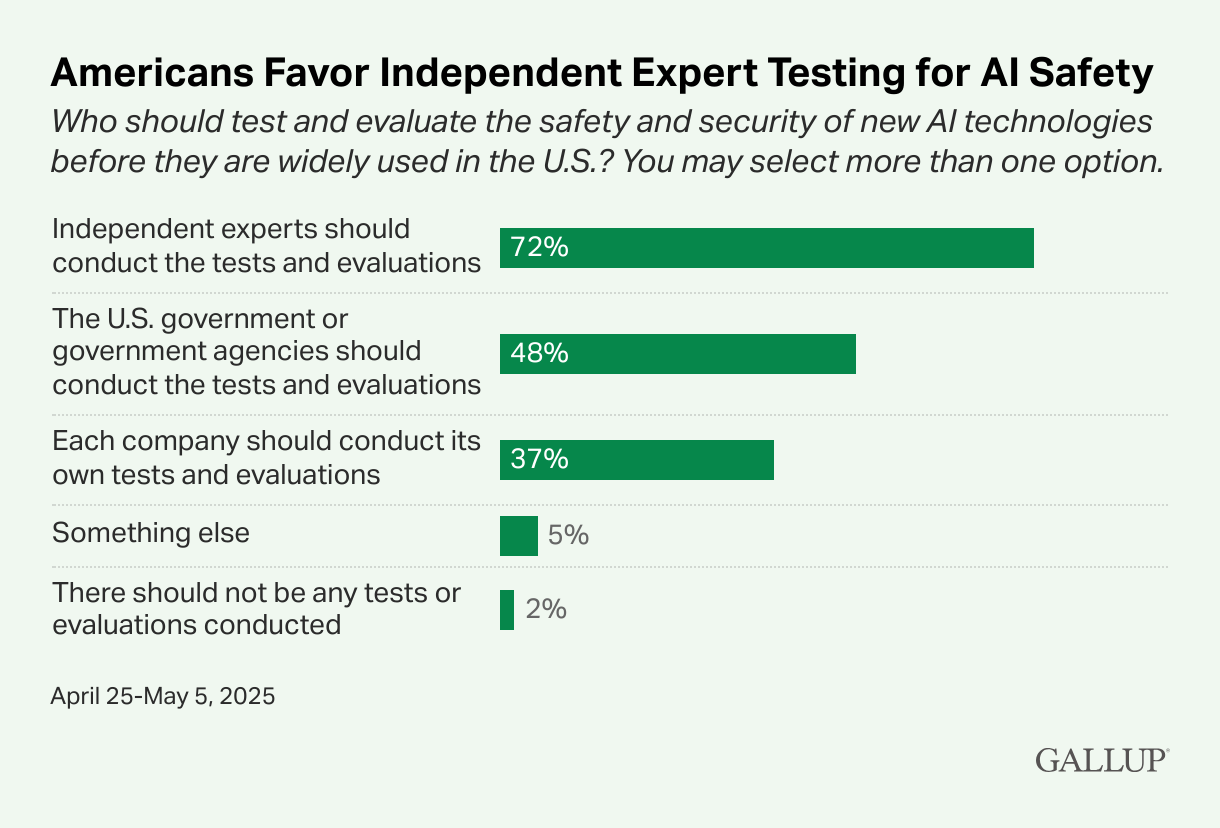
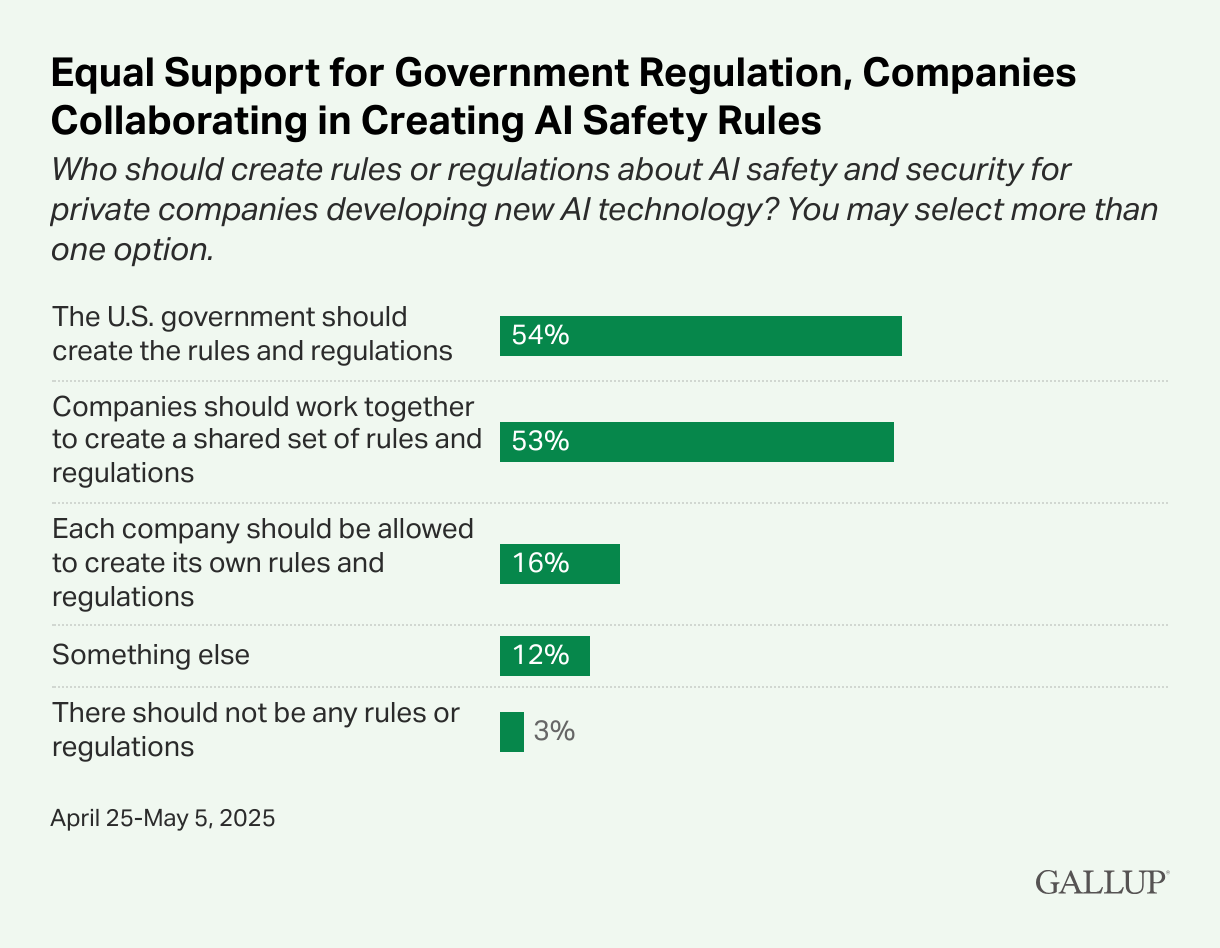
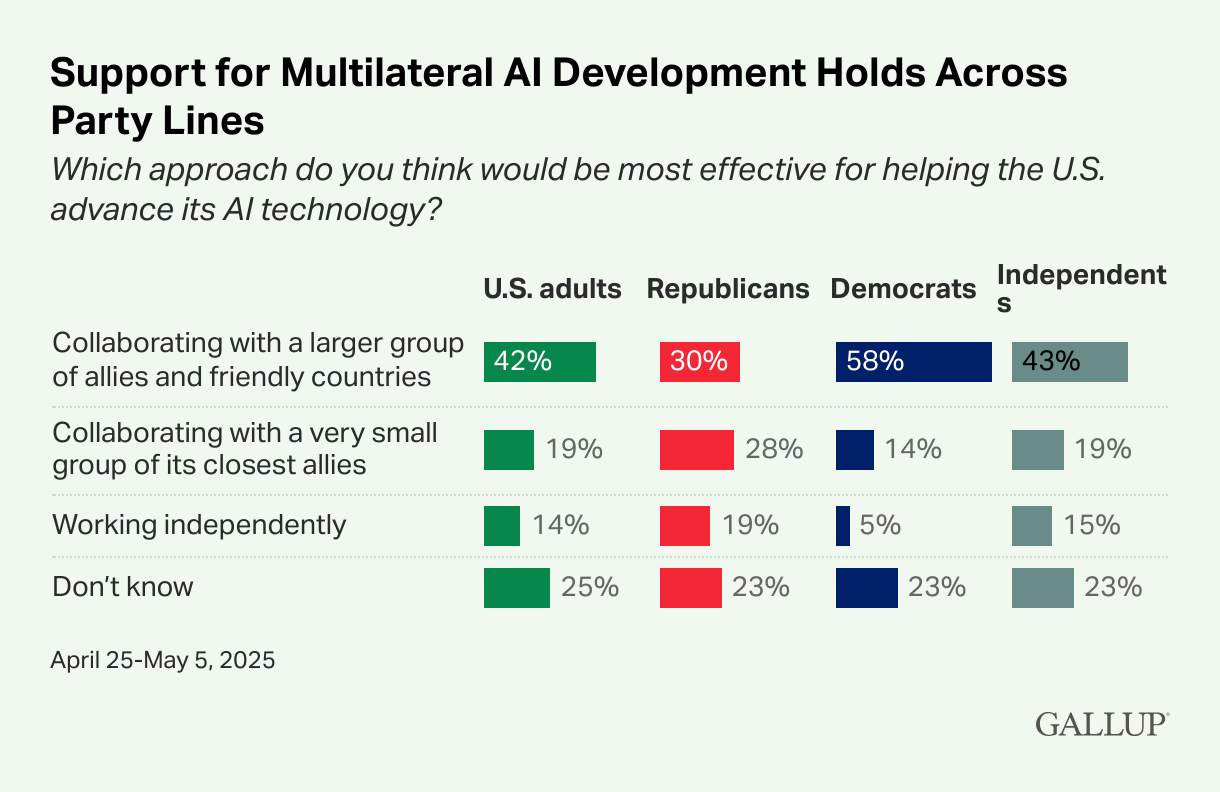
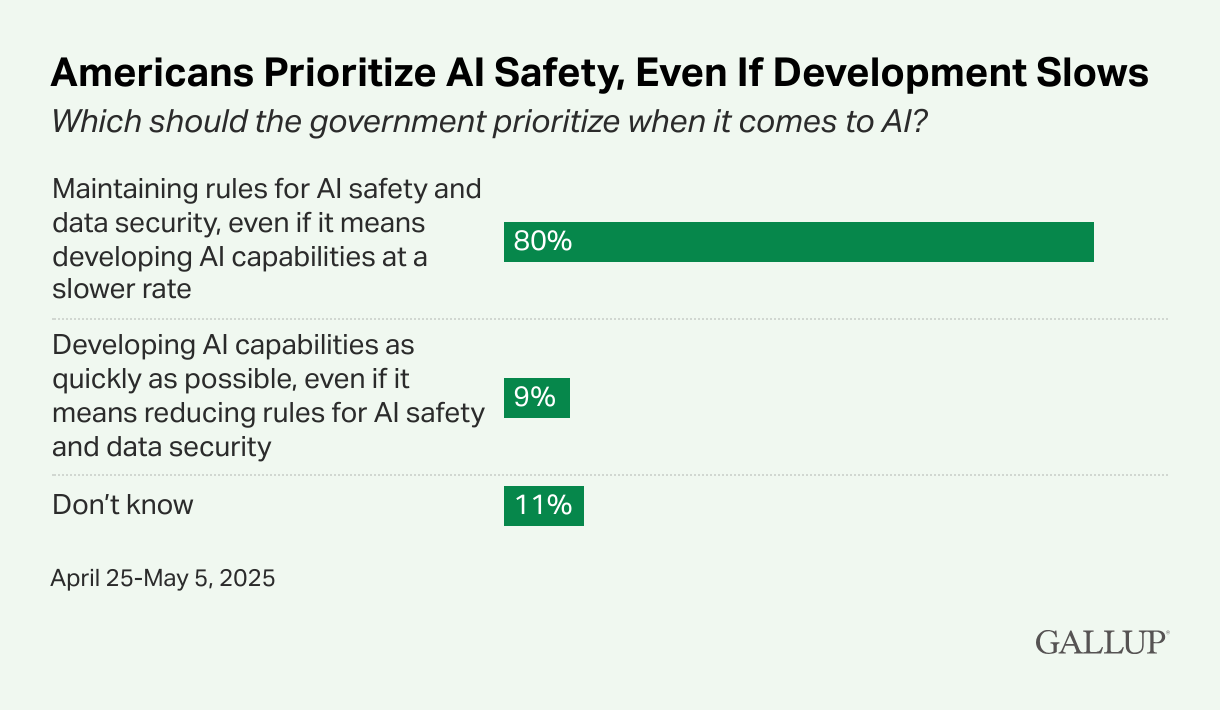
Gallup: Americans Prioritize AI Safety and Data Security
Published (5 tables/charts)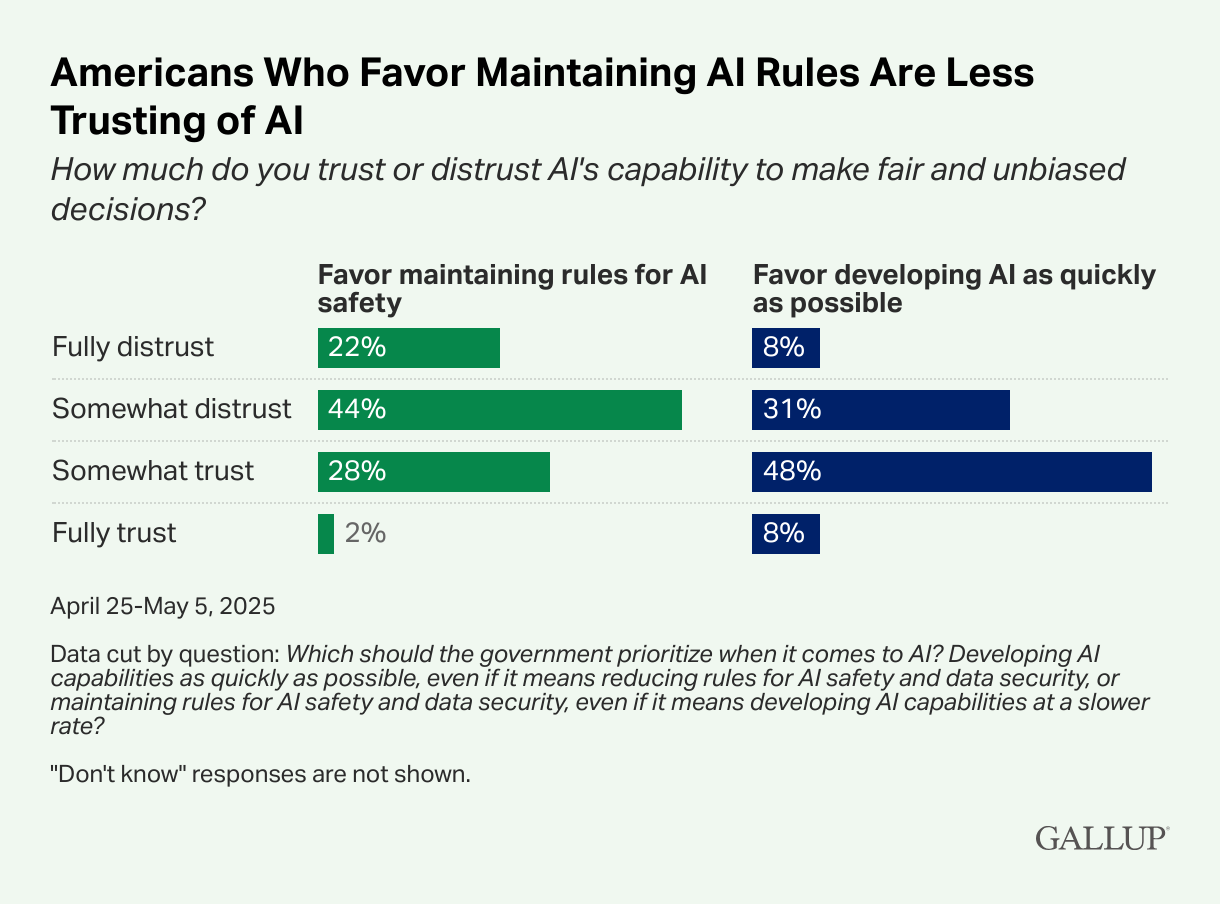


Videos (2)
Timeline
July 2025 – The Senate removes a 10‑year moratorium on state AI regulation from a Trump domestic policy bill and the National Defense Authorization Act also omits the moratorium, clearing the way for federal pre‑emption of state rules[3][7].
Summer 2025 – The administration takes a 10 % equity stake in Intel and imposes a 25 % tariff on foreign semiconductor imports to accelerate the AI race against China, complementing a fast‑tracked AI framework that favors regulatory freedom for tech firms[2].
September 2025 – A Pew Research Center poll finds that half of Americans feel more concerned than excited about AI’s growing role, while only 10 % say they are more excited than worried, highlighting rising voter anxiety ahead of congressional debates[2].
November 2025 – In Vice President JD Vance’s office, White House AI czar David Sacks clashes with longtime Trump adviser Mike Davis, who accuses Sacks of trying to run over Congress; Sacks replies he is carrying out Trump’s desire to unleash an AI boom, exposing a fault line within the MAGA coalition[2].
Dec 8, 2025 – Trump posts on Truth Social that he will sign an executive order pre‑empting state AI regulations, calling for “one rulebook” to boost America’s global AI dominance and directing the DOJ to form an AI Litigation Task Force to challenge state laws[5].
Dec 10, 2025 – The bipartisan super PAC “Leading the Future” launches its first TV ads for the 2026 midterms in Texas’s 10th and New York’s 12th districts, urging a federal AI regulatory framework and announcing a seven‑figure ad buy as the opening phase of a larger effort[4].
Dec 11, 2025 – Trump signs an executive order that blocks states from enforcing their own AI regulations, directs federal agencies to develop a unified national framework with Congress, and pledges not to challenge child‑safety AI laws[3].
Dec 12, 2025 – The order creates an AI Litigation Task Force at the DOJ and authorizes the Commerce Department to flag “onerous” state rules, tying compliance to the $42.45 billion BEAD broadband program; Texas, Florida, Arkansas and Montana risk losing billions in grant money if their AI laws trigger penalties[6].
Dec 12, 2025 – Former adviser Steve Bannon posts on GETTR that the executive order is “entirely unenforceable,” while Trump, in Oval Office remarks, declares the United States must stay unified to win the global AI race[7].
Dec 12, 2025 – Tech industry group NetChoice welcomes the pre‑emption, saying it will create clear nationwide standards for innovators, whereas critics such as Julie Scelfo and Gov. Gavin Newsom warn the order strips states of consumer‑protective safeguards[1].
2026 (upcoming) – Tech‑heavy super PACs pour roughly $100 million into races, with OpenAI co‑founder Greg Brockman donating $25 million to MAGA Inc.; hundreds of lobbyists and millions in campaign contributions target anti‑AI candidates ahead of the 2026 midterms[2].
2026 (midterms) – “Leading the Future” plans to expand its ad campaign in the weeks before the November elections, continuing its push for a federal AI rulebook across key congressional contests[4].
All related articles (8 articles)
-
CNN: Trump’s Executive Order Sparks AI Rift Within MAGA
-
Newsweek: Bannon Criticizes Trump’s AI Executive Order as Unenforceable
-
BBC: Trump signs order to block state AI regulations
-
Newsweek: Trump’s AI Order Threatens Broadband Funding for Red States
-
AP: Trump Signs Executive Order to Block State AI Regulations
-
CNN: Trump Signs Executive Order to Block State AI Regulations
-
CNN: Pro-AI super PAC launches first candidate ads
-
CNN: Trump to sign executive order preempting state AI regulations to establish a single national rulebook
External resources (19 links)
- https://www.youtube.com/watch?v=6XwUATxbipY (cited 1 times)
- https://www.youtube.com/watch?v=Rni7Fz7208c (cited 1 times)
- https://www.whitehouse.gov/presidential-actions/2025/12/eliminating-state-law-obstruction-of-national-artificial-intelligence-policy/ (cited 2 times)
- https://lofgren.house.gov/media/press-releases/leader-jeffries-announces-new-house-democratic-commission-ai-and-innovation (cited 1 times)
- https://news.gallup.com/poll/694685/americans-prioritize-safety-data-security.aspx (cited 1 times)
- https://www.pewresearch.org/science/2025/09/17/how-americans-view-ai-and-its-impact-on-people-and-society/ (cited 1 times)
- https://www.pewresearch.org/short-reads/2025/11/06/republicans-democrats-now-equally-concerned-about-ai-in-daily-life-but-views-on-regulation-differ/ (cited 1 times)
- https://www.stlouisfed.org/on-the-economy/2026/jan/tracking-ai-contribution-gdp-growth (cited 1 times)
- https://www.axios.com/2025/09/23/meta-superpac-ai-regulation (cited 1 times)
- https://truthsocial.com/@realDonaldTrump/posts/115573090200730933 (cited 1 times)
- https://truthsocial.com/@realDonaldTrump/posts/115684148454828379 (cited 1 times)
- https://x.com/RonDeSantis/status/1990850245832683816 (cited 1 times)
- https://x.com/elonmusk/status/2001361571407368589 (cited 1 times)
- https://x.com/jasonfurman/status/1971995367202775284 (cited 1 times)
- https://am.jpmorgan.com/us/en/asset-management/adv/insights/market-insights/market-updates/on-the-minds-of-investors/is-ai-already-driving-us-growth/ (cited 1 times)
- https://bit.ly/4aBNhyj (cited 1 times)
- https://civilrights.org/resource/leadership-conference-letter-50-signatures-senate-opposing-ban-state-local-ai-laws/ (cited 1 times)
- https://demandprogress.org/wp-content/uploads/2025/11/Letter-Opposing-AI-State-Preemption-November-19.pdf (cited 1 times)
- https://statescoop.com/state-ai-law-moratorium-omitted-2026-defense-bill-trump-eo/ (cited 1 times)