Tinubu Deploys Army and U.S. Intelligence Support After Kwara Massacre Claims Over 170 Lives
Updated (4 articles)
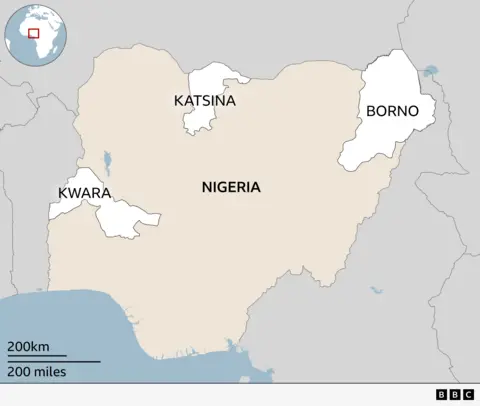
Massacre Details and Casualty Estimates: On Tuesday, militants attacked the villages of Woro and Nuku in Kwara State, killing at least 75 local Muslims according to Governor AbdulRahman AbdulRazaq, while a state lawmaker reported 78 bodies buried and warned the toll could rise to about 170 as more corpses are recovered [1]. The Red Cross cited 162 deaths, and Amnesty International said more than 170 people were killed, many shot at close range and some burned alive [1]. These varying figures underscore the difficulty of obtaining an exact death count amid ongoing recovery efforts [1].
Government Response and Military Deployment: President Bola Tinubu ordered an army battalion to the affected area, attributing the assault to Boko Haram [1]. The United States Africa Command confirmed that, at Nigeria’s request, a U.S. contingent was deployed to provide intelligence support, marking the first official acknowledgment of American troops operating in Nigeria [1]. Both national and international forces are now focused on stabilizing the region and investigating the massacre [1].
Nature of the Attack and Duration: Kwara State Assembly member Saidu Baba Ahmed described the raid as lasting three to four hours, beginning after 17:00 local time [1]. The attackers abducted 38 people, set shops and homes ablaze, and carried out systematic killings [1]. The coordinated nature of the assault suggests a high level of planning and execution by the militant group [1].
Regional Spillover of Violence: On the same day, Amnesty International reported 21 deaths in Doma village, Katsina State, and 17 deaths in a series of attacks in Borno State [1]. These incidents indicate a broader wave of Boko Haram‑linked violence across northern Nigeria [1]. Security officials warn that the attacks may continue unless comprehensive counter‑terrorism measures are implemented [1].
Timeline
May 3, 2023 – Ethnic violence erupts in Manipur’s Bishnupur district, igniting a two‑year Meitei‑Kuki‑Zo conflict that eventually kills more than 260 people and displaces roughly 62,000, providing the backdrop for later security operations [3][4].
December 2025 – The Manipur government rolls out a three‑phase resettlement plan targeting completion by December, while 389 internally displaced persons return to Bishnupur after 31 months in relief camps, highlighting ongoing humanitarian challenges [4].
December 16, 2025 – Gunfire rings out at night in Torbung and Phougakchao Ikhai, Bishnupur district, heightening tension in an area first hit by the May 2023 violence; authorities launch an inquiry into possible casualties [4].
January 2, 2026 – Security forces neutralise 27 homemade bombs near Monglham village in Imphal East and recover three arms caches in Langdum Nungjengbi, underscoring intensified counter‑insurgency under President’s Rule after CM N Biren Singh’s resignation, with the state assembly suspended until 2027 [3].
January 5, 2026 – Two blasts strike Bishnupur district—first at an abandoned house in Ngaukon at 5:45 am, then 200 m away at 8:45 am—injuring Sanatomba Singh and Indubala Devi; police inspect the sites, launch an investigation, and confront angry locals dismantling a makeshift bunker [2].
February 4, 2026 – Islamist militants attack Woro and Nuku in Kwara State, Nigeria, killing at least 75 Muslims according to Governor AbdulRahman AbdulRazaq, with death estimates climbing toward 170 as bodies are recovered; the three‑to‑four‑hour raid includes 38 abductions, arson of shops and homes, and widespread looting [1].
February 5, 2026 – President Bola Tinubu orders an army battalion to Kwara, blaming Boko Haram, while U.S. Africa Command confirms a troop‑level intelligence‑support deployment at Nigeria’s request—the first official U.S. troop presence in the country; Amnesty International calls for an investigation, noting over 170 killed and many burnt alive [1].
All related articles (4 articles)
External resources (6 links)
- http://bbcafrica.com/ (cited 1 times)
- https://twitter.com/BBCAfrica (cited 1 times)
- https://www.facebook.com/BBCnewsafrica/ (cited 1 times)
- https://www.facebook.com/share/p/1ByxxnJieE/ (cited 1 times)
- https://www.instagram.com/bbcafrica/ (cited 1 times)