United States Launches Critical Minerals Ministerial, Proposes Trading Bloc, and Announces $12 Billion Reserve
Updated (10 articles)


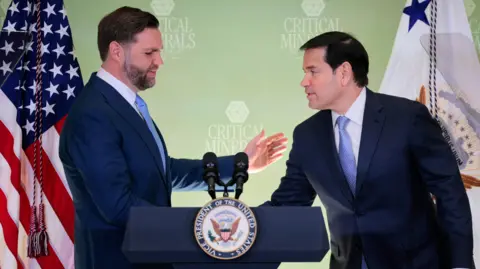


Inaugural Ministerial Mobilizes 56 Nations to Diversify Supply Chains On Feb 4‑5 2026, Secretary of State Marco Rubio hosted the first Critical Minerals Ministerial in Washington, drawing 56 countries—including the G7, Japan, Australia, Canada, India, and the Democratic Republic of Congo—to discuss securing minerals for chips and EV batteries and reducing reliance on China’s dominance [1][3][7][8]. High‑level officials such as Vice President JD Vance, Trade Representative Jamieson Greer, and South Korean Foreign Minister Cho Hyun attended, underscoring the diplomatic weight of the gathering [1][7]. Participants pledged to cooperate on mining, refining, and manufacturing to build resilient supply chains for high‑tech military and consumer products [3][8].
Vance Pushes Preferential Trade Zone with Price Floors and Adjustable Tariffs Vice President JD Vance used the ministerial platform to call for a “critical minerals trading bloc” that would set reference prices at each production stage and enforce price floors through adjustable tariffs [4][5]. The proposed preferential trade zone aims to shield U.S. industries from “external disruptions,” guarantee American access to industrial minerals, and stabilize market prices [1][4]. Vance highlighted that the bloc’s members represent roughly two‑thirds of global GDP, positioning it to counter Beijing’s leverage without naming China directly [4].
FORGE Initiative Rebranded, South Korea Chairs Through June The meeting rebranded the Minerals Security Partnership as the Forum on Resource Geostrategic Engagement (FORGE), appointing South Korea as chair until June [2][3]. Cho Hyun pledged expanded cooperation and concrete projects, while the forum will coordinate “bold and decisive action” among 54 participating nations and the European Commission [2][3]. FORGE builds on earlier U.S.–led frameworks to deepen economic‑security collaboration and diversify critical‑minerals supply channels [2].
Project Vault Reserve and Massive Capital Commitments Target Mining Expansion President Donald Trump announced a $12 billion “Project Vault” strategic mineral reserve, praised by industry leaders as essential for U.S. mineral security [1]. Vice President Vance and special assistant David Copley disclosed that the administration will deploy “hundreds of billions of capital” into domestic mining, already backing firms such as MP Materials and Lithium Americas [1]. These investments aim to accelerate production capacity and reduce vulnerability to foreign supply shocks [1].
China’s Export Restrictions Remain a Strategic Lever A Chinese Foreign Ministry spokesperson urged adherence to market‑economy principles, while Beijing’s tightened export curbs in October 2025 dealt a “major blow” to U.S. industries before the measures were partially eased [1]. The United States continues to view China’s leverage over rare‑earth and other critical minerals as a central challenge in trade negotiations [1].
Sources
-
1.
BBC: US Pushes Trade Zone and Funding to Diminish China’s Grip on Critical Minerals: Details the ministerial launch, Vance’s tariff proposal, $12 bn Project Vault, and China’s export curbs, emphasizing the U.S. strategy to counter Beijing’s dominance .
-
2.
Yonhap: South Korea Leads New Critical‑Minerals Initiative Through June: Highlights South Korea’s chairmanship of FORGE, the ministerial’s broad participation, and Vance’s preferential trade zone concept .
-
3.
Yonhap: South Korea Chairs New FORGE Initiative After U.S.-Led Critical Minerals Meeting: Reports Cho Hyun’s attendance, the rebranding to FORGE, and his commitment to expanded cooperation .
-
4.
Yonhap: U.S. Vice President Vance Calls for Allies to Form Critical Minerals Trading Bloc: Focuses on Vance’s call for a trading bloc, price‑floor mechanisms, and the bloc’s potential to secure U.S. industrial access .
-
5.
Yonhap: U.S. Vice President Vance Proposes Critical Minerals Trading Bloc to Counter China: Mirrors the trading bloc proposal, emphasizing price floors, investment stability, and implicit aim to curb Beijing’s influence .
-
6.
Yonhap: South Korean and U.S. diplomats meet in Washington amid Trump’s tariff warning: Covers Cho Hyun’s one‑on‑one with Rubio, the backdrop of Trump’s 25 % tariff threat, and the pending $350 bn investment pledge .
-
7.
Yonhap: U.S. Holds First Critical Minerals Ministerial to Counter China: Announces the inaugural ministerial, its high‑level attendance, and the broader U.S. supply‑chain push .
-
8.
Yonhap: South Korean Foreign Minister Cho to Join First U.S.-Led Critical Minerals Summit: Previews Cho Hyun’s participation, expected bilateral talks on tariffs, and South Korea’s effort to honor a $350 bn investment commitment .
Timeline
2022 – The United States launches the Minerals Security Partnership (MSP) with Japan, Canada, France, the EU and other allies to coordinate investment and supply of lithium, cobalt, nickel and rare‑earth minerals, laying groundwork for later initiatives such as FORGE. [9]
Aug–Oct 2025 – At summits in August and October, President Trump and South Korean President Lee agree on a US$350 billion Korean investment package linked to a trade deal, but Trump later threatens to raise South Korean tariffs from 15 % to 25 % because of legislative delays, heightening pressure on Seoul. [7][8]
Oct 2025 – China tightens export restrictions on rare‑earth minerals, delivering a “major blow” to U.S. industries and prompting Washington to accelerate diversification efforts. [1]
Jan 12, 2026 – Treasury Secretary Scott Bessent hosts a finance ministerial in Washington with 20 + allies, warning that critical‑mineral supply chains are “highly concentrated and vulnerable” and urging coordinated derisking rather than decoupling. [10]
Jan 22, 2026 – Seoul signals that Foreign Minister Cho Hyun may attend the U.S.–led critical‑minerals meeting on Feb 4, emphasizing Korea’s role as chair of the MSP and its commitment to diversify supply chains away from China. [9]
Jan 29, 2026 – Cho Hyun travels to Washington for the inaugural Critical Minerals Ministerial, pledging to honor South Korea’s US$350 billion investment pledge and to discuss tariff disputes with Secretary of State Marco Rubio on the sidelines. [8]
Feb 2, 2026 – The United States launches the first Critical Minerals Ministerial, chaired by Secretary of State Marco Rubio, with Vice President JD Vance, David Copley and Cho Hyun in attendance, aiming to “strengthen and diversify supply chains for minerals essential to high‑tech military and consumer products.” [6]
Feb 2, 2026 – The U.S. unveils the “Pax Silica” coalition on AI and critical minerals, immediately adding South Korea, Japan and other allies to the partnership. [6]
Feb 3, 2026 – Cho Hyun meets one‑on‑one with Secretary of State Rubio in Washington, the first such encounter since Trump’s 25 % tariff threat, and discusses implementation of the August‑October 2025 joint fact sheet and pending trade‑deal legislation. [7]
Feb 4, 2026 – Vice President JD Vance calls on allies at the ministerial to form a “critical minerals trading bloc,” proposing a “preferential trade zone” with price floors and adjustable tariffs to guarantee U.S. industrial access and stable pricing. [4][5]
Feb 4, 2026 – Secretary of State Marco Rubio announces the Forum on Resource Geostrategic Engagement (FORGE) as the next‑generation framework succeeding the MSP, praising South Korea’s leadership and outlining plans for deeper economic‑security cooperation. [4]
Feb 5, 2026 – President Trump creates a $12 billion “Project Vault” strategic mineral reserve, hailed by industry leaders as “critical” for U.S. mineral security. [1]
Feb 5, 2026 – The United States proposes a coordinated trade mechanism with Japan and the EU to prevent future access problems for critical minerals, as announced by Trade Representative Jamieson Greer. [1]
Feb 5, 2026 – Vice President Vance warns that “foreign supply” flooding markets could depress prices and deter investment, pledging “hundreds of billions of capital” to mining projects such as MP Materials and Lithium Americas. [1]
Feb 5, 2026 – South Korea assumes the chairmanship of FORGE through June 2026, positioning Seoul to lead “bold and decisive action” on global critical‑minerals challenges and to expand concrete cooperative projects. [2][3]
Feb 5, 2026 – A “very positive” call between President Trump and Chinese President Xi occurs on the same day as the ministerial, reflecting a conciliatory tone despite ongoing tensions over mineral export controls. [1]
Feb 5, 2026 – The United States, Japan and the EU agree to develop coordinated trade policies on mineral access, aiming to establish mechanisms that safeguard supply‑chain stability for allies representing roughly two‑thirds of global GDP. [1]
June 2026 (planned) – FORGE’s chairmanship by South Korea is set to conclude, with expectations that the initiative will have launched multiple joint projects and solidified a diversified, resilient critical‑minerals network among its 54‑nation membership. [2]
All related articles (10 articles)
-
BBC: US Pushes Trade Zone and Funding to Diminish China’s Grip on Critical Minerals
-
Yonhap: South Korea Leads New Critical‑Minerals Initiative Through June
-
Yonhap: South Korea Chairs New FORGE Initiative After U.S.-Led Critical Minerals Meeting
-
Yonhap: U.S. Vice President Vance Calls for Allies to Form Critical Minerals Trading Bloc
-
Yonhap: U.S. Vice President Vance Proposes Critical Minerals Trading Bloc to Counter China
-
Yonhap: South Korean and U.S. diplomats meet in Washington amid Trump’s tariff warning
-
Yonhap: U.S. Holds First Critical Minerals Ministerial to Counter China
-
Yonhap: South Korean Foreign Minister Cho to Join First U.S.‑Led Critical Minerals Summit
-
Yonhap: S Korea weighs Cho Hyun attendance at US-led critical minerals meeting
-
Yonhap: US hosts finance ministerial talks on critical mineral supply chains with S. Korea, Japan and partners