Former President Yoon Suk‑Yeol Sentenced to Life for 2024 Martial‑Law Insurrection
Updated (9 articles)
-
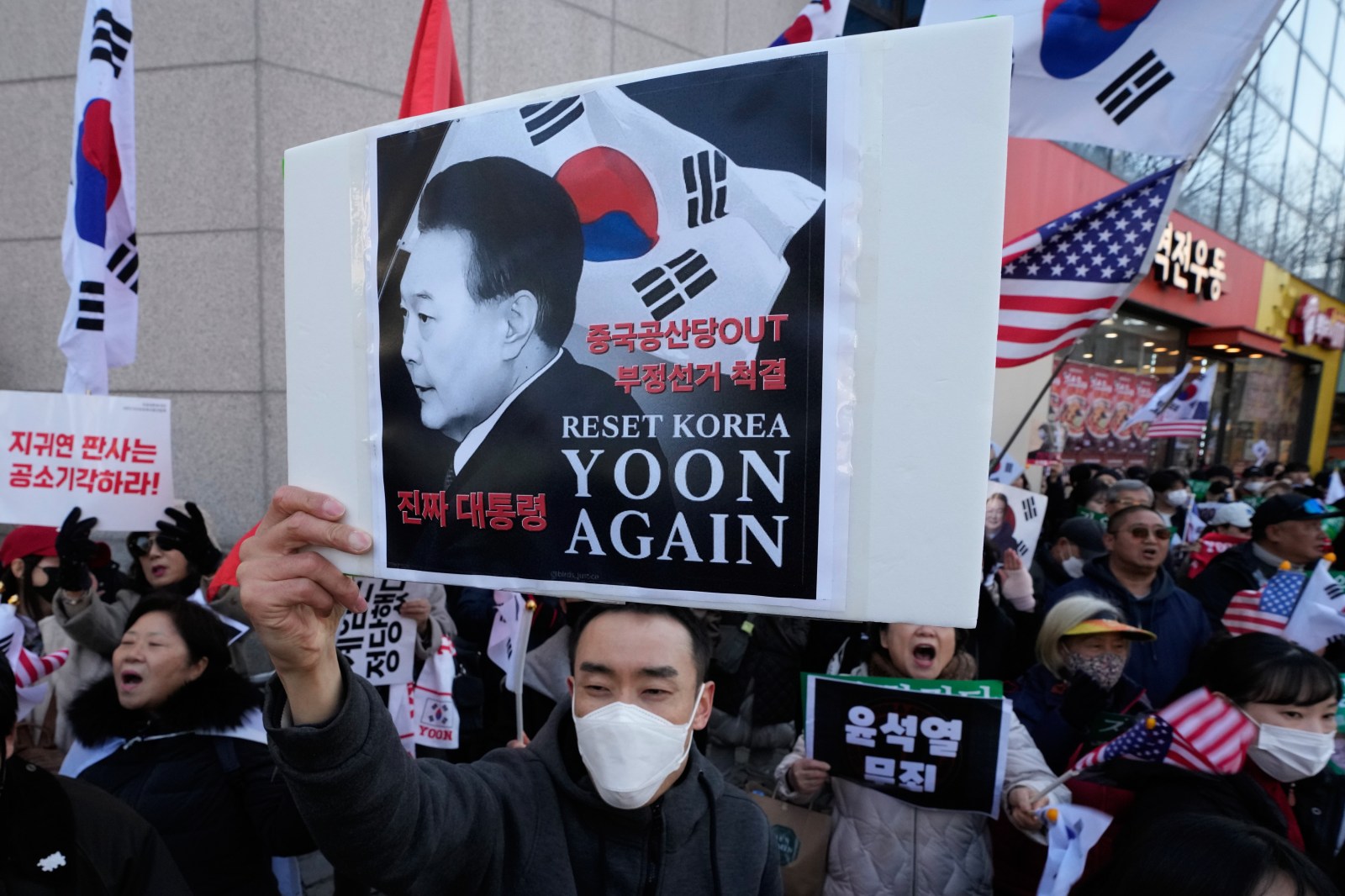
 Image: YonhapSupporters of former President Yoon Suk Yeol stage a rally near the Seoul Central District Court in the capital on Feb. 19, 2026, to proclaim his innocence as Yoon is set to receive the first verdict at the court the same day on whether his 2024 imposition of martial law constituted an insurrection following special prosecutors' recommendation of the death penalty. (Yonhap) Source Full size


Court Verdict Details and Legal Reasoning The Seoul Central District Court handed former President Yoon Suk‑yeol a life‑imprisonment sentence on 19 February 2026, concluding that his 3 December 2024 declaration of martial law and the deployment of troops to seal the National Assembly constituted an insurrection [1][4][6][8]. Judges rejected Yoon’s claim that the decree was a “warning‑and‑appeal‑type” measure, emphasizing the intent to paralyze a constitutional body [1][4]. The bench opted for life rather than the death penalty, citing limited pre‑meditation, minimal actual violence, Yoon’s age of 65, and the restraint shown by rank‑and‑file troops [1][6][8].
Scope of the Martial‑Law Attempt and Immediate Fallout In a televised address, Yoon accused opposition lawmakers of colluding with North Korean communists and ordered soldiers to descend on the parliament, suspending political activity, media, and permitting warrantless arrests [2][3][5][7]. The decree lasted roughly six hours before a quorum of legislators broke the military blockade and voted to lift it [2][3][5][7]. Yoon was suspended on 14 December 2024, removed by the Constitutional Court in April 2025, and has remained in custody since July 2024/2025 [5][7].
Sentences for Co‑defendants and Related Convictions Former Defense Minister Kim Yong‑hyun received a 30‑year term, former intelligence commander Noh Sang‑won 18 years, former police chief Cho Ji‑ho 12 years, former Seoul police chief Kim Bong‑sik 10 years, and former Prime Minister Han Duck‑soo 23 years for their roles in the scheme [1][3][4][5][6][7]. Additional officials were sentenced to terms ranging from three to eighteen years, while two were acquitted for lack of evidence [1]. Yoon is already serving a separate five‑year sentence for obstruction of justice, adding to his cumulative penalties [5][6].
Political Reactions and Broader Implications The People Power Party faced calls to sever ties with Yoon, while the Democratic Party noted the absence of a death sentence despite prosecutors’ request [1][2]. Yoon’s lawyers denounced the ruling as politically motivated and pledged an appeal [1][5]. Analysts warned the verdict would not bring national closure and highlighted the damage to South Korea’s democratic credibility and international standing [2][7].
Sources
-
1.
Yonhap: Seoul Court Sentences Ex‑President Yoon to Life for Martial‑Law Insurrection: details the life sentence, judges’ reasoning, co‑defendants’ terms, and political reactions .
-
2.
Newsweek: Former South Korean President Yoon Suk Yeol Sentenced to Life for 2024 Coup Attempt: emphasizes the coup characterization, six‑hour martial law, televised accusations, and analysts’ perspectives .
-
3.
CNN: Former South Korean President Yoon Suk Yeol Sentenced to Life for Insurrection: reports the verdict, Yoon’s procedural objections, broader prosecutions, and family sentencing .
-
4.
Yonhap: Former South Korean President Yoon Sentenced to Life for 2024 Martial‑Law Attempt: highlights the judge’s distinction between martial law and insurrection, mitigating factors, appeal expectations, and historic courtroom .
-
5.
AP: Former South Korean President Yoon Suk Yeol Sentenced to Life for 2024 Martial‑Law Rebellion: outlines the rebellion charge, Yoon’s removal, senior officials’ sentences, lawyer’s claim of predetermined verdict, and historical comparison .
-
6.
Yonhap: Former South Korean President Yoon Sentenced to Life for 2024 Martial‑Law Attempt: defines insurrection based on intent, lists seven co‑defendants’ terms, and notes Yoon’s existing five‑year term .
-
7.
The Hindu: Former South Korean President Yoon Sentenced to Life for 2024 Martial Law Coup: reports death‑penalty demand rejection, senior officials’ jail terms, timeline of suspension and removal, and death‑penalty moratorium .
-
8.
Yonhap: Former President Yoon Suk Yeol Sentenced to Life for 2024 Martial Law Attempt: describes the live‑broadcast trial, court’s finding of insurrection, sentencing lighter than prosecutors’ request, and public observation .
Timeline
July 2024: Yoon Suk‑yeol is taken into custody after a weeks‑long standoff at his home, beginning his detention while multiple criminal investigations proceed[3].
Dec 3, 2024: In a televised address Yoon declares martial law, accusing opposition parties of colluding with “North Korean communists” and orders troops to descend on the National Assembly by helicopter, suspending political activity, media, and permitting warrantless arrests[2][3].
Dec 3, 2024 (≈ 6 hours later): A quorum of lawmakers breaks the military blockade, votes unanimously to lift the martial‑law decree, and restores parliamentary functions, ending the brief six‑hour crisis[3].
Dec 14, 2024: The National Assembly votes to impeach Yoon for abuse of power and insurrection, initiating constitutional proceedings against the former president[3].
April 2025: South Korea’s Constitutional Court formally removes Yoon from office, confirming the impeachment and ending his presidency[3].
1996‑1997 (historical context): Former military dictator Chun Doo‑hwan receives a death sentence in 1996 that is later commuted to life imprisonment and pardoned in 1997, the last time a South Korean leader faces a capital‑punishment‑level sentence[3].
1997 (historical context): South Korea enforces a de facto moratorium on executions, with no death carried out since 1997, shaping expectations that Yoon will not face capital punishment despite prosecutors’ request[5].
Jan 16, 2026: A Seoul court hands Yoon a five‑year prison term for defying detainment and creating the martial‑law proclamation, the first verdict among eight criminal cases tied to the 2024 crisis; the judge cites Yoon’s lack of remorse and “hard‑to‑comprehend” excuses[4].
Feb 19, 2026: The Seoul Central District Court sentences Yoon to life imprisonment for insurrection, with Judge Jee Kui‑youn stating Yoon deliberately tried to paralyze the National Assembly by sealing it with troops; special prosecutors had sought the death penalty, but the court opts for life due to limited premeditation and Yoon’s age[7][6].
Feb 19, 2026 (quote): Yoon denounces the verdict as “a delusion and a work of fiction,” claiming his martial‑law decree was merely a warning to the public about parliamentary gridlock[1]; Judge Ji Gwi‑yeon warns the episode caused “incalculable” damage to South Korea’s democratic fabric[6].
Feb 19, 2026 (co‑defendants): Former Defense Minister Kim Yong‑hyun receives a 30‑year term, former Prime Minister Han Duck‑soo 23 years, and other senior officials receive sentences ranging from 10 to 18 years for enforcing the illegal decree[5][6].
Feb 19, 2026 (political reaction): The People Power Party is urged to sever ties with Yoon, while the Democratic Party expresses regret that the death penalty was not imposed, highlighting ongoing partisan rifts[6].
Later 2026 (future): Yoon’s legal team announces plans to appeal the life‑sentence, indicating that higher‑court proceedings will extend the judicial saga into the remainder of 2026[7].
All related articles (9 articles)
-
Yonhap: Seoul Court Sentences Ex‑President Yoon to Life for Martial‑Law Insurrection
-
Newsweek: Former South Korean President Yoon Suk Yeol Sentenced to Life for 2024 Coup Attempt
-
CNN: Former South Korean President Yoon Suk Yeol Sentenced to Life for Insurrection
-
Yonhap: Former South Korean President Yoon Sentenced to Life for 2024 Martial‑Law Attempt
-
AP: Former South Korean President Yoon Suk Yeol Sentenced to Life for 2024 Martial‑Law Rebellion
-
Yonhap: Former South Korean President Yoon Sentenced to Life for 2024 Martial‑Law Attempt
-
The Hindu: Former South Korean President Yoon Sentenced to Life for 2024 Martial Law Coup
-
Yonhap: Former President Yoon Suk Yeol Sentenced to Life for 2024 Martial Law Attempt
-
AP: South Korea ex-president Yoon Suk Yeol gets five-year prison term over martial law case