US Military Strike Kills Two on Alleged Drug Boat, Raising Legal and Political Controversy
Updated (2 articles)
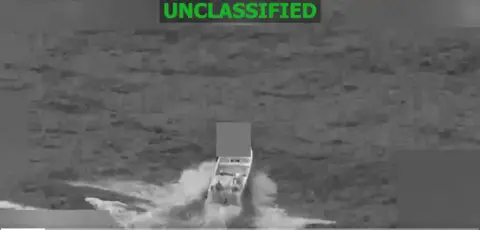
Strike on Alleged Drug Vessel Results in Two Fatalities On February 6, U.S. Southern Command confirmed an Eastern Pacific attack on a boat it identified as operated by designated terrorist groups involved in narco‑trafficking, killing two occupants while no U.S. personnel were injured [1]. The operation was presented as part of a broader effort to disrupt drug flows from Latin America [1]. Officials emphasized the target’s connection to known smuggling routes to justify lethal action [1].
Operation Southern Spear Accumulates Dozens of Lethal Hits Since September Since September 2025, the Southern Spear campaign has executed at least 38 lethal strikes against suspected drug‑smuggling vessels across the Caribbean and Eastern Pacific, resulting in approximately 128 deaths [1]. The U.S. frames the campaign as a non‑international armed conflict aimed at curbing narcotics trafficking [1]. The strike count reflects a sustained escalation in maritime interdiction tactics [1].
Strike Tempo Declines After Capture of Venezuelan President Maduro The February 6 attack marks only the second strike of 2026, a sharp slowdown following the U.S. seizure of Venezuelan President Nicolás Maduro in early January, an action the Trump administration links to trafficking collusion [1]. Over a four‑month span late last year, 36 strikes were recorded, illustrating the campaign’s previous intensity [1]. Analysts note the reduced tempo may signal strategic recalibration after the high‑profile capture [1].
Legal Challenges and Family Lawsuits Intensify Scrutiny of Campaign Legal scholars argue the strikes may breach international law by targeting civilians without due process, highlighting a controversial “double‑tap” follow‑up strike on 2 September [1]. Relatives of two Trinidadian men killed in a 14 October strike have filed a lawsuit accusing the U.S. of “lawless killings” and demanding release of operational files [1]. The lawsuit adds to bipartisan congressional inquiries into the campaign’s legality [1].
U.S. Administration Defends Campaign Amid Political Backlash Defence Secretary Pete Hegseth defended the effort as removing “narco‑terrorists,” while the White House claimed the actions have done “more for the victims than Democrats ever did” [1]. President Joe Biden, speaking ahead of negotiations, referenced the broader geopolitical context, noting Iran’s interest in a deal [1]. Minnesota’s Bureau of Criminal Apprehension reported the FBI will not provide evidence to the plaintiffs, underscoring ongoing resistance to transparency [1].
Timeline
Sep 2025 – Operation Southern Spear launches an intensified campaign, logging at least 38 lethal strikes on suspected drug‑smuggling vessels in the Caribbean and eastern Pacific and causing 128 deaths by early 2026 [1].
Sep 2, 2025 – The U.S. conducts a “double‑tap” follow‑up strike on a vessel, later cited by legal scholars as part of controversy over targeting civilians without due process [1].
Oct 14, 2025 – A U.S. strike kills two Trinidadian men; their families later file a lawsuit accusing the United States of “lawless killings in cold blood; killings for sport and killings for theatre” [1].
Dec 2025 – The U.S. carries out its 30th strike against a drug‑boat in the eastern Pacific, killing two people; Southern Command posts a video showing two explosions [2].
Dec 2025 – President Trump calls the boat attacks “a necessary escalation against cartels,” framing the campaign as an armed confrontation with drug cartels [2].
Dec 2025 – U.S. forces seize two sanctioned oil tankers off Venezuela and pursue a third, while several tankers divert, intensifying pressure on President Nicolás Maduro, who is charged with narcoterrorism in the United States [2].
Jan 2026 (early) – U.S. forces capture Venezuelan President Nicolás Maduro, prompting a marked slowdown in strike tempo after 36 strikes in the preceding four‑month span [1].
Feb 6, 2026 – U.S. Southern Command strikes an alleged drug vessel in the Eastern Pacific, killing two and injuring no U.S. personnel; the operation is presented as targeting “narco‑terrorists” [1].
Feb 2026 (ongoing) – Defense Secretary Pete Hegseth defends the campaign, saying it removes “narco‑terrorists,” while legal scholars warn the strikes may breach international law by targeting civilians without due process [1].
Feb 2026 (ongoing) – The White House asserts it has done “more for the victims than Democrats ever did,” and the President, speaking ahead of negotiations, says Iran wants a deal, indicating upcoming diplomatic talks [1].
Feb 2026 (ongoing) – Minnesota’s Bureau of Criminal Apprehension notes the FBI will not hand over evidence to families suing over the Oct 14 strike, highlighting continued legal resistance [1].