Nearly Twenty Nations Condemn Israel’s West Bank Policies as De Facto Annexation
Updated (12 articles)




Broad International Coalition Condemns Israeli West Bank Measures On 23 Feb 2026 foreign ministers from Brazil, Saudi Arabia, France, Spain, several Scandinavian nations, Ireland, Portugal, Egypt, Turkey, Indonesia and others issued a joint statement denouncing Israel’s recent actions in the West Bank as “de facto annexation”[1]. The declaration followed an earlier 17‑Feb communiqué signed by 85 UN member states that also condemned settlement expansion and land‑registration policies[1]. India added its signature on 18 Feb, joining the 85‑country coalition and expanding diplomatic pressure ahead of a UN meeting[3]. The statements call on Israel to reverse the measures, respect international law, and halt any steps that alter facts on the ground[1][3].
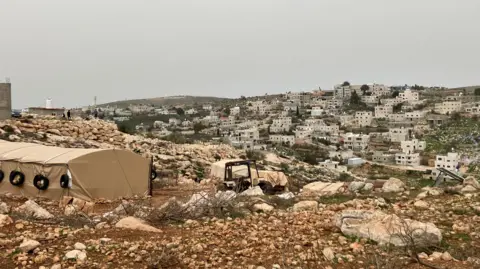
Israeli Government Enacts Laws Expanding West Bank Control The Netanyahu administration, described as the most right‑wing in Israeli history, passed Knesset legislation that removes restrictions on land acquisition in Areas A and B and tightens documentation checks for current residents[1][3]. Finance Minister Bezalel Smotrich publicly declared his intent to “kill” the idea of a Palestinian state and signaled willingness to cancel the Oslo accords if his party remains in power[2]. A new land‑registration process, warned by a senior UN official as “gradual, de facto annexation,” has been implemented alongside the legislative changes[2]. Settlement activity intensified after the Oct 7 2023 Gaza war, with new outposts emerging near villages such as al‑Mughayyir[1][2].
Palestinian Authority Faces Financial Collapse and Service Disruptions Following the Oct 7 attacks, Israel withheld tax transfers, leaving the PA with a $4 billion shortfall and paying only about 60 % of civil‑service salaries[2]. Over 600 000 Palestinian children now attend school only three days a week, and families in al‑Mughayyir report frequent closures when settlers or soldiers are present[2]. The PA’s inability to provide basic services has prompted former minister Sabri Saidam to question the Authority’s very existence, while Israeli officials label it “corrupt and morally bankrupt”[2]. Analysts warn that the power vacuum could push segments of the population toward more radical options[2].
Regional Diplomacy Shifts Amid Heightened Tensions The joint condemnation was backed by the Arab League, the EU, BRICS founders, Quad partners and several Asian nations, reflecting a broad coalition ahead of a UN session and a U.S.–led Board of Peace meeting[3]. The United States, while opposing annexation, stopped short of joining the condemnation, highlighting a divergence among major powers[2]. India’s delayed endorsement sparked criticism from former diplomats who accused New Delhi of aligning with Israel ahead of Prime Minister Modi’s planned visit, underscoring the interplay of diplomatic calculations[3]. The combined pressure occurs as Israel continues to expand settlements, a trend the international community views as undermining the two‑state solution[1][2].
Sources
-
1.
Le Monde: Near‑20 Nations Condemn Israel’s West Bank Moves as “De Facto Annexation” – Details the 23 Feb joint statement by nearly twenty states, references the earlier 85‑nation rebuke, notes settlement numbers and the post‑Oct 7 colonisation surge.
-
2.
BBC: Israel deepens hold on West Bank as Palestinian Authority teeters – Highlights settler incursions at al‑Mughayyir, the PA’s $4 billion fiscal gap, school closures, Smotrich’s anti‑state rhetoric, and UN warnings of de facto annexation.
-
3.
The Hindu: India Joins Global Criticism of Israel’s West Bank Moves – Reports India’s 18 Feb signing of the 85‑nation declaration, the coalition of Arab League, EU, BRICS and Quad partners, Knesset land‑control measures, and diplomatic context surrounding Modi’s planned Israel visit.
Timeline
1967 – Israel occupies the West Bank after the Six‑Day War, establishing a military administration that persists for decades and later underpins settlement expansion and the Oslo‑Accord‑based Palestinian Authority. [4]
Oct 7, 2023 – Hamas launches a large‑scale attack on Israel, sparking a Gaza war that intensifies Israeli security measures and fuels a sharp deterioration in West Bank conditions, later cited by UN reports as a turning point. [2][9]
Dec 2022 – UN observers record a marked decline in Palestinian living conditions, noting increased restrictions on land, water, movement and services that set the stage for accusations of systemic discrimination. [2]
May 2025 – Israel’s security cabinet approves 22 new settlements in the West Bank, the largest expansion in decades, signaling an accelerated settlement policy that later leads to further approvals. [3]
Dec 11, 2025 – Israel’s cabinet authorizes 19 outposts across the West Bank, including the re‑establishment of two settlements dismantled in 2005, raising the total number of settlements to 210. [4][7]
Dec 21, 2025 – Israel’s security cabinet approves 19 new settlements, bringing the tally of settlements approved in the past three years to 69 and reinforcing the government’s goal of blocking a Palestinian state. [11]
Dec 21, 2025 – The cabinet’s broader approval legalizes retroactive status for several outposts and lifts the West Bank settlement total to 210, while former U.S. President Donald Trump warns annexation would end U.S. support. [7][11]
Dec 22, 2025 – Finance Minister Bezalel Smotrich announces 11 new settlements and formalizes eight additional ones, stating the moves address security threats and “block the establishment of a Palestinian terror state.” [10]
Dec 25, 2025 – Foreign Minister Gideon Saar denounces a joint condemnation by 14 countries as “morally wrong” and “discriminatory against Jews,” asserting Israel’s right to settle the land. [10]
Dec 25, 2025 – Twelve European states, Canada and Japan issue a joint statement condemning the 19‑settlement plan as a violation of international law that jeopardizes a two‑state solution. [4]
Dec 2025 – The United Nations reports that West Bank settlement expansion reaches its highest level since 2017, with about 160 settlements housing roughly 700,000 Israelis alongside 3.3 million Palestinians. [2][4]
Jan 7, 2026 – The UN Human Rights Office publishes a thematic report declaring Israel’s West Bank policies an “apartheid system,” saying they have an “asphyxiating impact” and breach the International Convention on the Elimination of All Forms of Racial Discrimination. [2][9]
Jan 7, 2026 – UN High Commissioner Volker Türk warns the policies “resemble the kind of apartheid system we have seen before,” marking the first time a UN rights chief uses the term for the West Bank. [2]
Jan 7, 2026 – Israel’s Geneva mission rejects the UN report as “absurd and distorted,” accusing it of ignoring Israel’s security concerns and of being politically motivated. [2][9]
Jan 21, 2026 – The outpost Yatziv near Beit Sahour becomes fully legalized after two decades, with Smotrich proclaiming settlers are “standing stable here” and that Israel “will never allow a Palestinian state there.” [6]
Jan 21, 2026 – Beit Sahour mayor Elias Isseid warns that Yatziv’s land was owned by local families for generations and cautions against further land loss. [6]
Feb 17, 2026 – Eighty‑five UN member states issue a joint declaration condemning Israel’s unilateral settlement expansions and land‑registration policies as “de facto annexation.” [12]
Feb 18, 2026 – India signs the same statement, joining the coalition of Arab League, EU, BRICS founders and Quad partners in denouncing Israel’s actions as unlawful. [8]
Feb 19, 2026 – India’s endorsement sparks criticism from former diplomats who call the move “regrettable” and warn against compromising strategic autonomy. [8]
Feb 21, 2026 – Israel deepens its hold on the West Bank as the Palestinian Authority teeters, with settler incursions targeting al‑Mughayyir village, PA salaries cut to 60 % of obligations, schools limited to three days a week, and Finance Minister Smotrich declaring his goal is “to kill” the idea of a Palestinian state and to cancel the Oslo accords. [1]
Feb 21, 2026 – A mother of eight in al‑Mughayyir tells reporters that schools shut whenever settlers or soldiers are nearby, leaving children unable to read beyond fourth grade and forcing families to hire private teachers. [1]
Feb 21, 2026 – Former PA minister Sabri Saidam warns the Authority’s existence is “now questionable,” while an Israeli official labels it “corrupt and morally bankrupt,” raising fears of a power vacuum. [1]
Feb 21, 2026 – A top UN official warns that Israel’s new land‑registration process amounts to “gradual, de facto annexation,” prompting condemnation from over 80 UN member states, the EU and the Arab League. [1]
Feb 23‑24, 2026 – Nearly 20 nations, including Brazil, Saudi Arabia, France and several European and Asian states, issue a joint communiqué calling Israel’s recent control measures an “attack on a two‑state solution” and urging reversal of steps that tighten authority over Areas A and B. [12]
Feb 24, 2026 – The statement notes that more than 500,000 Israeli settlers now live in settlements the UN deems illegal, while settlement activity surged after the Oct 7 2023 Gaza war. [12]
Dive deeper (3 sub-stories)
All related articles (12 articles)
-
Le Monde: Near‑20 Nations Condemn Israel’s West Bank Moves as “De Facto Annexation”
-
BBC: Israel deepens hold on West Bank as Palestinian Authority teeters
-
The Hindu: India Joins Global Criticism of Israel’s West Bank Moves
-
AP: Yatziv becomes newly legalized West Bank settlement near Beit Sahour
-
BBC: UN rights chief says Israeli policies in West Bank 'resemble apartheid' in new UN report
-
The Hindu: U.N. rights office says Israel enforces 'apartheid' in West Bank; Israel rejects charge
-
CNN: Europe, Canada and Japan condemn Israel's West Bank settlements approval
-
The Hindu: Israel says condemnation of West Bank settlements is morally wrong
-
BBC: Israel approves 19 new settlements in West Bank
-
Newsweek: Israel approves new West Bank settlements as Gaza peace plan stalls
-
AP: Israel approves 19 new West Bank settlements, lifting total to 210
-
The Hindu: Israel's security cabinet approves 19 new West Bank settlements, bringing total to 69
External resources (7 links)
- https://t.co/A8wstsvxYJ (cited 1 times)
- https://x.com/IsraelinGeneva/status/2008851026791760141 (cited 1 times)
- https://x.com/bezalelsm/status/2002662564610654640?s=20 (cited 1 times)
- https://x.com/gidonsaar/status/2003942593931960603 (cited 1 times)
- https://www.diplomatie.gouv.fr/en/country-files/israel-palestine/news/2025/article/joint-declaration-approval-of-the-creation-of-19-new-settlements-in-the (cited 1 times)
- https://www.ohchr.org/sites/default/files/documents/countries/israel/20260105-thematic-report-israel-discrimin.pdf (cited 1 times)
- https://www.unrwa.org/resources/reports/unrwa-situation-report-201-situation-gaza-strip-and-west-bank-including-east-jerusalem (cited 1 times)