Iran and Russia Conduct Joint Naval Drills as Strait of Hormuz Temporarily Closed
Updated (5 articles)
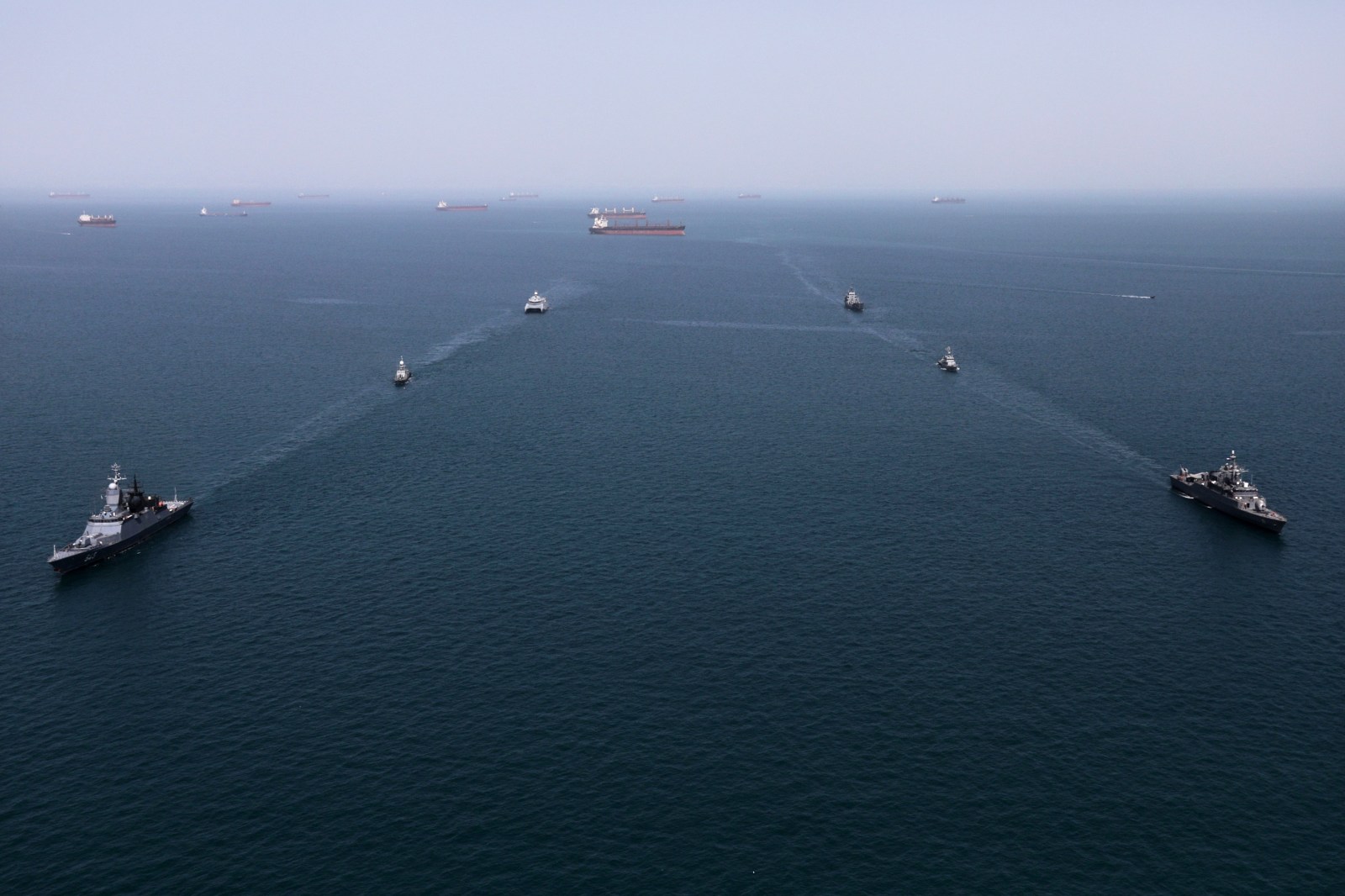
Joint Iran‑Russia Exercise Simulates Hijacked‑Ship Rescue On 19 Feb 2026 Iranian and Russian warships carried out a coordinated drill off southern Iran and in the Indian Ocean, deploying at least one Iranian destroyer, helicopters and special‑operations teams to practice a mock rescue of a hijacked vessel, while missile‑launching ships fired live rounds [1].
Strait of Hormuz Closed Briefly for Live‑Fire Drills Iran announced a temporary shutdown of sections of the Strait of Hormuz on 17‑18 Feb 2026 for safety during live‑fire exercises, firing missiles toward the waterway and halting traffic for several hours; the strait carries roughly 20 % of global oil shipments [2][3].
U.S. Carrier Strike Groups Position Near Region Amid Tensions The U.S. moved two aircraft carriers, USS Gerald R. Ford and USS Abraham Lincoln, along with dozens of warships and fighter jets, toward the Persian Gulf; the Ford group later redirected to the mid‑Atlantic, delaying its arrival by more than a week [1][3].
Geneva Nuclear Negotiations Continue but No Immediate Breakthrough Diplomatic talks in Geneva proceeded with Iranian foreign minister Abbas Araghchi expressing optimism, while U.S. envoys Steve Witkoff and Jared Kushner led the American side; President Donald Trump affirmed participation but did not reference the drills, and no strike authorization has been granted [1][3].
Supreme Leader Khamenei Issues Stark Warning to U.S. Forces Ayatollah Ali Khamenei warned that even the world’s strongest army could receive a “slap” that prevents it from recovering, pledging retaliation against U.S. bases if attacked; the same rhetoric appears in all three reports [1][2][3].
Oil Market Reacts Moderately to Regional Moves Following the Geneva talks and the brief Hormuz closure, U.S. crude fell 1.3 % to $62.06 per barrel and Brent slipped 2.3 % to $67.03 per barrel, tempering earlier price gains linked to the U.S. military buildup [3].
Sources
-
1.
Newsweek: Iran and Russia Conduct Joint Naval Drills Amid Growing U.S. Military Presence – Details the joint Iran‑Russia naval exercise, the brief Hormuz closure, U.S. carrier deployments, stalled Geneva talks, and Khamenei’s warning .
-
2.
AP (Feb 18): Iran’s Temporary Closure of the Strait of Hormuz Raises Global Oil Concerns – Focuses on the Hormuz shutdown, its impact on oil flow, recent U.S.‑Iran incidents, and Khamenei’s threat, while noting CENTCOM’s silence .
-
3.
AP (Feb 17): Iran Temporarily Closes Strait of Hormuz Amid Geneva Nuclear Talks – Highlights the closure’s timing with Geneva negotiations, Trump’s statement, oil price dip, and the delayed movement of the Gerald R. Ford carrier group .
Related Tickers
Timeline
June 2025 – The United States conducts F‑35 strikes on Iranian nuclear facilities, which Tehran condemns as a violation of sovereignty and which heightens regional tensions ahead of later naval exercises [3].
Dec 4‑5, 2025 – The Islamic Revolutionary Guard Corps launches the two‑day “Shahid Mohammad Nazeri” naval drill across the Persian Gulf, Strait of Hormuz and Sea of Oman, showcasing missile, drone, surveillance and electronic‑warfare systems; during the exercise IRGC units issue a direct warning to nearby U.S. warships, threatening decisive action if they interfere [3].
Dec 5, 2025 – The Gulf Cooperation Council summit backs the United Arab Emirates’ claims to Greater Tunb, Lesser Tunb and Abu Musa, prompting Tehran to warn Gulf states against testing its red lines and to use the naval drill to reassure regional allies [3].
Jan 31, 2026 – U.S. Central Command publicly warns Iran’s IRGC that any “unsafe behavior” near American forces in the Strait of Hormuz could trigger escalation, citing overflights, low‑altitude armed flights and high‑speed boat approaches as prohibited [2].
Feb 1‑2, 2026 – Iran carries out a two‑day live‑fire naval exercise in the Strait of Hormuz, firing missiles and conducting drills in a corridor that handles roughly one‑fifth of global oil shipments; IRGC Army Chief Amir Hatami affirms a high level of defensive readiness, while Foreign Minister Seyed Abbas Araghchi urges the United States to “set aside their threats” and resume negotiations [2].
Feb 4, 2026 – A U.S. Navy fighter shoots down an Iranian drone that approaches the aircraft carrier USS Abraham Lincoln in the Strait of Hormuz, marking a sharp escalation in aerial confrontations between the two sides [5].
Feb 17, 2026 – Iran announces a brief closure of the Strait of Hormuz for live‑fire drills, firing missiles into the waterway and shutting it for several hours; Geneva nuclear talks continue with Iran’s foreign minister Abbas Araghchi expressing optimism about a “new window” for agreement, while President Donald Trump, speaking on Air Force One, reiterates that Iran “remains fully prepared to defend itself” without mentioning the closure [4].
Feb 17, 2026 – Supreme Leader Ayatollah Ali Khamenei warns the United States that even “the strongest army in the world might sometimes receive such a slap that it cannot get back on its feet,” cautioning against premature military pressure in the negotiations [4].
Feb 17, 2026 – U.S. oil markets react modestly to the talks, with U.S. crude falling 1.3% to $62.06 / bbl and Brent dropping 2.3% to $67.03 / bbl, reversing earlier gains tied to the U.S. military buildup [4].
Feb 17, 2026 – The carrier strike group centered on USS Gerald R. Ford departs the Caribbean for the mid‑Atlantic, delaying its arrival to the Persian Gulf by more than a week after earlier deployments aimed at deterring Iran [4].
Feb 18, 2026 – Iran temporarily shuts parts of the Strait of Hormuz, a route that moves about 20% of world oil, marking a rare escalation; the move echoes limited closures during the 1980s Iran‑Iraq war and the 12‑day Iran‑Israel‑U.S. conflict but represents the first announced full‑scale shutdown since recent U.S. threats [5].
Feb 18, 2026 – Supreme Leader Khamenei repeats his warning that the world’s strongest army could receive a crippling “slap,” underscoring Tehran’s readiness to target U.S. interests if pressed [5].
Feb 19, 2026 – Iran and Russia conduct joint naval drills off southern Iran and in the Indian Ocean, simulating a hijacked‑ship rescue with missile‑launching warships, helicopters and special‑operations teams, demonstrating deepening military cooperation [1].
Feb 19, 2026 – Earlier in the week Iran briefly closes the Strait of Hormuz for safety during the joint drills, highlighting the waterway’s strategic importance for global oil flow [1].
Feb 19, 2026 – The United States positions two aircraft carriers, USS Gerald R. Ford and USS Abraham Lincoln, along with dozens of warships and advanced fighter jets, near the region, signaling readiness for possible operations [1].
Feb 19, 2026 – Diplomatic talks in Geneva stall; White House Press Secretary Karoline Leavitt notes President Trump still prefers diplomacy but acknowledges “many reasons and arguments that one could make for a strike against Iran” [1].
Feb 19, 2026 – Supreme Leader Khamenei warns that any U.S. force could be hit so hard it “cannot even get back on its feet,” pledging retaliation against American bases if attacked [1].
Feb 19, 2026 – Russian Foreign Minister Sergey Lavrov cautions that the situation is “playing with fire,” while Kremlin spokesperson Dmitry Peskov describes the tension as “unprecedented” but expresses hope for a U.S.–Iran agreement [1].
All related articles (5 articles)
-
Newsweek: Iran and Russia Conduct Joint Naval Drills Amid Growing U.S. Military Presence
-
AP: Iran’s Temporary Closure of the Strait of Hormuz Raises Global Oil Concerns
-
AP: Iran Temporarily Closes Strait of Hormuz Amid Geneva Nuclear Talks
-
Newsweek: U.S. Warns Iran’s IRGC Over Live‑Fire Drills in Strait of Hormuz
-
Newsweek: Iran Issues Final Warning to U.S. Warships as Naval Drill Concludes
External resources (8 links)
- https://www.iranintl.com/en/liveblog/202601258930 (cited 1 times)
- https://x.com/IranObserver0/status/1996871455900946913 (cited 1 times)
- https://x.com/araghchi (cited 1 times)
- https://www.bcaresearch.com/marketing/matt-gertken (cited 2 times)
- https://www.fdd.org/team/behnam-ben-taleblu/ (cited 2 times)
- https://outrider.org/ (cited 1 times)
- https://tasnimnews.ir/en/news/2026/02/19/3521035/iranian-russian-naval-forces-conduct-mock-hijacked-ship-rescue-in-joint-drills (cited 1 times)
- https://www.carnegie.org/ (cited 1 times)