Trump Signs $1.2 Trillion Funding Bill, Ends Partial Shutdown, Limits DHS Funding
Updated (2 articles)
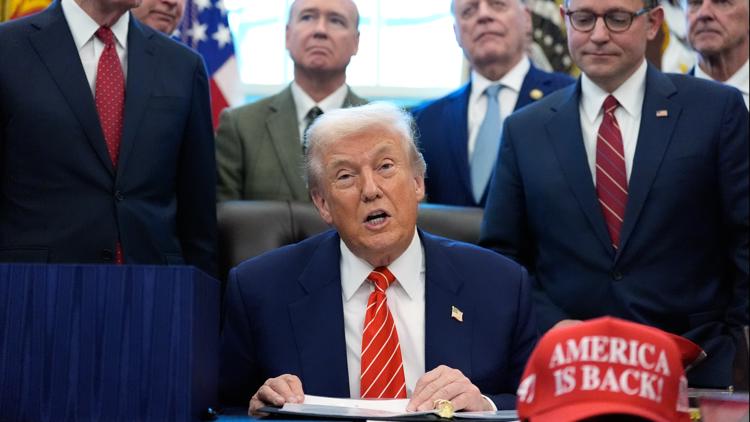
Bill Passage Ends Partial Shutdown President Donald Trump signed the $1.2 trillion funding measure on Tuesday, Feb 3, 2026, ending the partial federal shutdown that began Saturday [1][2]. The House approved the bill by a 217‑214 vote, funding all agencies through Sept 30 and leaving only 4 % of the government unfunded [1][2]. This partial pause is far less severe than the 43‑day shutdown earlier that year, with 96 % of operations remaining funded [1][2].
DHS Funding Cut to Mid‑February The legislation limits Department of Homeland Security appropriations to Feb 13, a concession demanded by Democrats after the Minneapolis shootings of Alex Pretti and Renee Good by federal officers [1][2]. The DHS funding restriction was a key bargaining point that allowed the broader bill to pass [1][2]. Lawmakers view the short‑term DHS funding as “very important” while negotiating longer‑term immigration reforms [1][2].
Democratic Conditions for Further Funding House Democratic Leader Hakeem Jeffries warned that no additional temporary DHS money will be supported without “dramatic change” to ICE and other DHS components [1][2]. This stance sets up a new political fight over immigration policy and agency oversight [1][2]. Jeffries’ warning raises the prospect of another shutdown if reforms are not secured [1][2].
Leadership Reactions and Outlook Speaker Mike Johnson said negotiations should finish by the funding deadline and urged good‑faith talks between parties [1][2]. Senate Majority Leader John Thune expressed doubt, replying, “There’s always miracles, right?” indicating skepticism about reaching a longer‑term deal [1][2]. Both leaders acknowledge the narrow window for further DHS funding and the need for bipartisan compromise [1][2].
Legislative Dynamics and Party Split Republicans rejected a large omnibus bill, opting for a narrower package that secured near‑unanimous GOP backing [1][2]. An hour‑long roll call saw 21 Republicans vote against the measure while 21 Democrats crossed party lines to support it [1][2]. The vote pattern highlights the deep partisan divide on immigration and DHS funding, even as the bill passed overall [1][2].
Sources
-
1.
WBNS: Trump Signs $1.2 Trillion Funding Bill, Ends Partial Shutdown and Sets Up New Immigration Fight – Details the bipartisan vote breakdown, notes 21 Republicans opposing and 21 Democrats supporting, and compares the shutdown’s severity to the prior 43‑day impasse .
-
2.
King5: Trump signs $1.2 trillion bill, ending partial shutdown and sparking new immigration fight – Emphasizes the DHS funding limit tied to the Minneapolis shootings and repeats the party‑split voting pattern, focusing on the emerging immigration conflict .
Timeline
2023 (Dec 2022 – Jan 2023) – The United States experiences a record 43‑day federal shutdown, the longest in modern history, underscoring the political stakes of future funding battles and providing a benchmark for the partial shutdown that follows [1].
2025 – Two Minneapolis residents, Alex Pretti and Renee Good, are killed by federal officers, prompting Democrats to demand tighter limits on Department of Homeland Security (DHS) funding in any new appropriations [1].
Feb 1, 2026 – A partial federal shutdown begins on Saturday, leaving roughly 4 % of government operations unfunded as Congress fails to agree on a full funding package [1].
Feb 3, 2026 – President Donald Trump signs a $1.2 trillion funding bill, ending the partial shutdown that began two days earlier; the measure passes the House 217‑214 [1].
Feb 3, 2026 – The new law funds DHS only through Feb 13, 2026, a concession demanded by Democrats in response to the Minneapolis shootings of Pretti and Good [1].
Feb 3, 2026 – House Democratic Leader Hakeem Jeffries warns, “Democrats will not back any additional temporary DHS money without dramatic change to ICE and other DHS agencies,” signaling a possible future shutdown if reforms are not enacted [1].
Feb 3, 2026 – Speaker Mike Johnson urges “good‑faith negotiations” and expects both chambers to reach a deal by the funding deadline, emphasizing bipartisan cooperation [1].
Feb 3, 2026 – Senate Majority Leader John Thune expresses skepticism, quipping, “There’s always miracles, right?” as he doubts a swift resolution [1].
Feb 3, 2026 – The bill secures funding for all federal agencies through Sept 30, 2026, but the narrow DHS window creates a looming fiscal cliff that could trigger another shutdown if Congress does not act [1].
Feb 13, 2026 – DHS funding expires, setting a critical deadline that could force a renewed shutdown unless Congress approves additional appropriations tied to immigration and ICE reforms [1].