Pentagon Laser Takes Down CBP Drone Near Fort Hancock, Prompting Expanded FAA Restrictions and Congressional Outcry
Updated (5 articles)
-
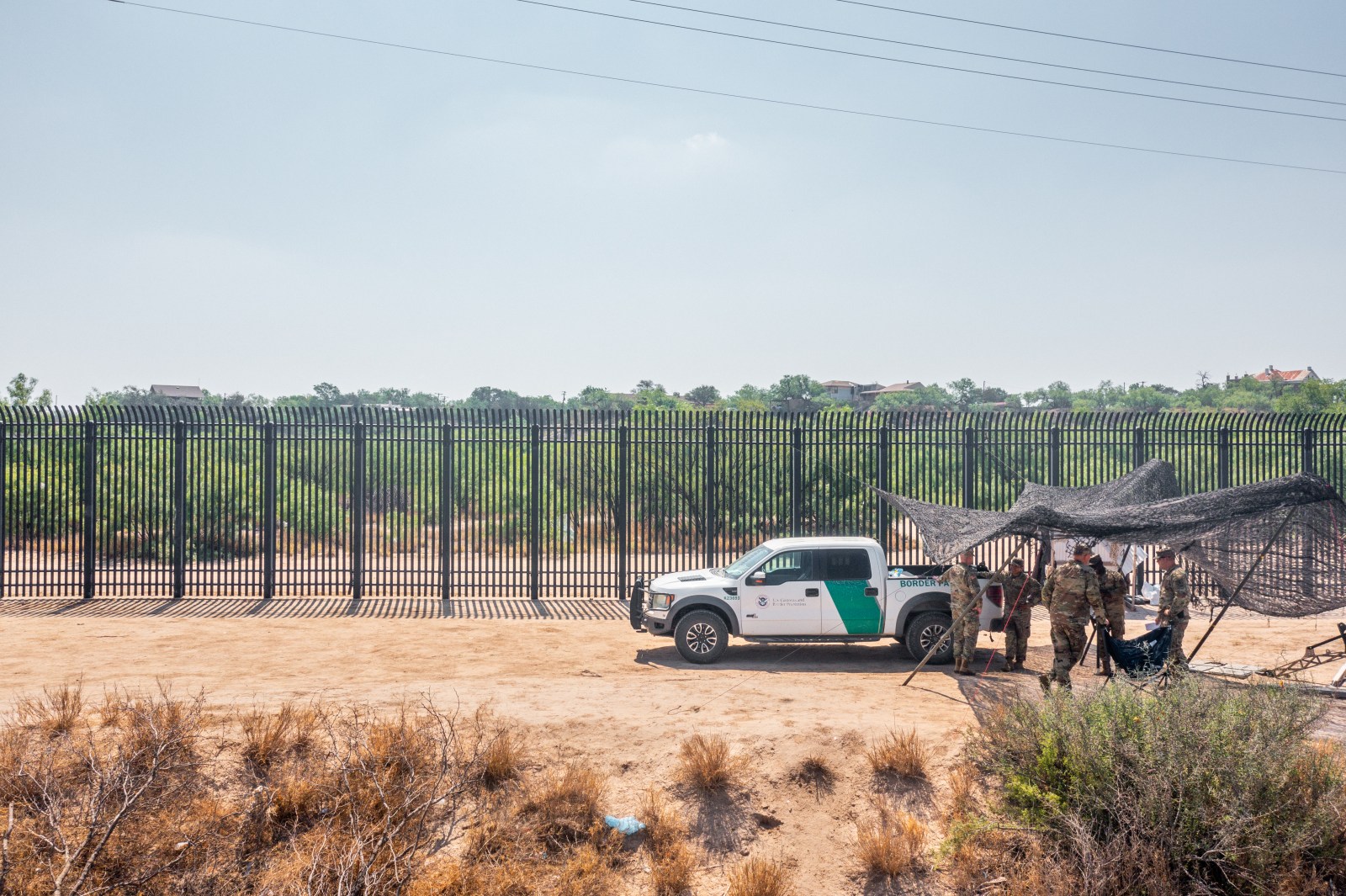 Image: NewsweekEAGLE PASS, TEXAS – JUNE 04: In an aerial view, National Guard members stand under shade while on patrol near the banks of the Rio Grande river on June 04, 2024 in Eagle Pass, Texas. President Biden is expected to sign an executive order that would prohibit migrants who illegally cross the southern border from claiming asylum in the U.S. The move comes after the collapse of a bipartisan Senate agreement on securing the border. (Photo by Brandon Bell/Getty Images) Source Full size
 -
Image: NewsweekEAGLE PASS, TEXAS – JUNE 04: In an aerial view, National Guard members stand under shade while on patrol near the banks of the Rio Grande river on June 04, 2024 in Eagle Pass, Texas. President Biden is expected to sign an executive order that would prohibit migrants who illegally cross the southern border from claiming asylum in the U.S. The move comes after the collapse of a bipartisan Senate agreement on securing the border. (Photo by Brandon Bell/Getty Images) Source Full size
Laser Counter‑UAS System Destroys CBP Drone Near Fort Hancock On February 27 2026 the Department of Defense employed a directed‑energy laser to shoot down a Customs and Border Protection drone operating near Fort Hancock, Texas, marking the first confirmed use of a military‑grade laser against a federal border‑patrol aircraft [1][2][3][4][5]. The strike occurred without disrupting commercial air traffic, and Border Protection declined to comment on the incident [3][4]. Officials described the laser as a high‑risk counter‑unmanned aircraft system (C‑UAS) designed for rapid neutralization of rogue drones [5].
FAA Expands Temporary Flight Restriction Around Fort Hancock The Federal Aviation Administration issued a Special Security Reasons temporary flight restriction (TFR) covering the Fort Hancock area, effective through June 24, 2026, and expanded the restricted zone to prevent further incidents [1][2][3][4][5]. The TFR applies to all non‑commercial aircraft while explicitly exempting scheduled airline flights, which continued to operate normally [1][5]. FAA officials referred all inquiries to the agency’s safety office and indicated the restriction is a precautionary measure rather than a response to an immediate hazard [3][4].
Congressional Leaders Condemn Pentagon Action and Bypass of Training Bill Rep. Rick Larsen, Rep. Bennie Thompson and Rep. André Carson publicly denounced the laser strike, saying “our heads are exploding” and accusing the White House of sidestepping a bipartisan tri‑committee bill on C‑UAS operator training and inter‑agency coordination [1][2][3][4][5]. Senate Aviation Subcommittee chair Tammy Duckworth announced she will request a joint Inspector General investigation of the Fort Hancock and earlier El Paso incidents [5]. The lawmakers’ statements underscore growing tension between defense, transportation, and homeland‑security agencies over drone‑countermeasure authority.
Second Laser Deployment Follows Unsuccessful Fort Bliss Attempt This incident is the second laser deployment in the El Paso region within two weeks; the first, near Fort Bliss, failed to hit a target and forced the FAA to shut down El Paso International Airport airspace for several hours, though commercial flights were later restored [1][3][4]. The recent Fort Hancock strike triggered only a limited, non‑commercial closure, reflecting adjustments in operational protocols after the earlier mishap [1][4]. Both events highlight the rapid escalation of directed‑energy use along the southern border.
Legislation Expands Drone‑Kill Authority and Allocates $500 Million in Grants Two months earlier Congress passed a law authorizing additional state and local law‑enforcement agencies to engage rogue drones, extending powers previously limited to federal entities [1][3][4]. The legislation earmarked $250 million in grants for drone‑defense programs this year, with a matching $250 million slated for later 2026, funding technologies such as high‑powered microwaves and lasers [1][3][4]. Homeland Security reported more than 27,000 drones detected within 1,600 feet of the southern border in late 2024, while the DHS estimates 1.7 million registered drones nationwide, underscoring the perceived need for expanded counter‑UAS capabilities [1][3][4].
Sources
-
1.
AP: Military laser downs CBP drone, FAA expands El Paso airspace restrictions: Reports the DoD laser shot down a CBP drone near Fort Hancock, expands FAA restriction, notes congressional shock and recent drone‑countermeasure legislation.
-
2.
Newsweek: Democrats accuse Pentagon of shooting down CBP drone with laser: Highlights Democratic accusations, TFR through June 24, prior FAA turmoil, podcast report, and former press secretary comment on strategic significance.
-
3.
WBNS: U.S. Military Laser Takes Down CBP Drone Near El Paso, Prompting New Airspace Restrictions: Details laser use, second deployment, lawmakers’ criticism, FAA expansion, and funding for drone‑defense programs.
-
4.
King5: U.S. Military Uses Laser to Down Border Patrol Drone Near El Paso: Emphasizes laser strike, earlier failed attempt, lawmakers’ alarm, FAA enlarged zone, and high border‑area drone activity.
-
5.
CNN: Pentagon Uses Laser to Down CBP Drone Over Fort Hancock, Texas: Notes Pentagon laser, congressional notification, TFR, prior El Paso incident, Senate call for IG investigation, and criticism of White House C‑UAS training bypass.
Timeline
Late 2024 – Homeland Security reports more than 27,000 drones detected within 1,600 ft of the southern border and notes that roughly 1.7 million drones are registered nationwide, underscoring the growing aerial threat environment [3][4][5].
2025 – Congress passes legislation expanding drone‑interdiction authority to additional state and local law‑enforcement agencies and earmarks $250 million in grants for drone‑defense programs, with a matching $250 million slated for later 2026 [3][4][5].
Early Feb 2026 – CBP fires a directed‑energy laser near Fort Bliss (El Paso) that misses its target, prompting the FAA to close El Paso airport airspace up to 18,000 ft for ten days before reopening after eight hours, marking the first laser use in the region in weeks [1][3][4][5].
Feb 27, 2026 – The Department of Defense employs a high‑risk C‑UAS laser to down a Customs and Border Protection drone near Fort Hancock, Texas, marking the second laser deployment in the area within two weeks [1][2][3][4][5].
Feb 27, 2026 – The FAA issues a temporary flight restriction for “Special Security Reasons” over Fort Hancock, effective through June 24, while confirming that commercial flights remain unaffected [1][2].
Feb 27, 2026 – House Transportation Committee members Rick Larsen, André Carson and Bennie Thompson receive briefings, issue a joint statement condemning the shoot‑down, and quote “our heads are exploding,” criticizing the White House for bypassing a bipartisan C‑UAS training bill [1][2][3][4][5].
Feb 27, 2026 – Senate Aviation Subcommittee chair Tammy Duckworth announces she will request a joint Inspector General investigation of the Fort Hancock and El Paso laser incidents, labeling the situation “alarming” [1].
Feb 27, 2026 – Defense and Transportation officials defer further questions to the FAA; Transportation Secretary Sean Duffy pledges to brief Congress and defends the FAA’s airspace decision as appropriate [3].
Later 2026 – The government plans to release the second $250 million tranche of drone‑defense grants, expanding state and local capabilities to counter rogue drones with lasers, microwaves and jamming technologies [3][4].
External resources (3 links)
- https://www.dhs.gov/science-and-technology/counter-unmanned-aircraft-systems-c-uas (cited 3 times)
- https://tfr.faa.gov/tfr3/?page=detail_6_1113 (cited 1 times)