NASA Administrator Declares Starliner Test a “Type A” Mishap, Blames Boeing Leadership
Updated (7 articles)

NASA Elevates Starliner Incident to Highest Severity Level
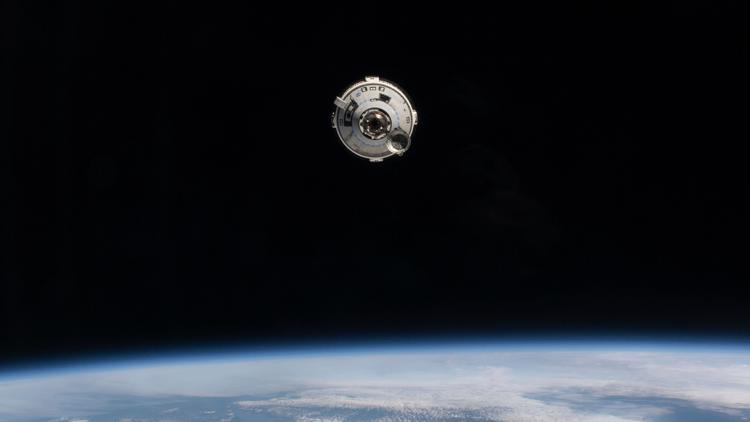
The agency classified the June 2024 crewed Starliner flight as a “Type A” mishap, the most severe category reserved for events that could endanger crew lives and cause major loss [1][2][3][4][5]. Administrator Jared Isaacman announced the rating at a press conference, equating it with the Challenger (1986) and Columbia (2003) disasters [2][3][4]. The 312‑page investigation report, released concurrently with a delayed Artemis moon‑rocket hydrogen‑fueling rehearsal, details the technical failures and oversight gaps [1][5].
Leadership Failures at Boeing and NASA Cited for Mishap
Isaacman blamed poor decision‑making at Boeing and a failure of NASA managers to intervene promptly, describing the launch as “incompatible with human spaceflight” [2][4][5]. He highlighted cultural problems within Boeing’s engineering organization and insufficient NASA oversight as root causes [1][3][4]. The report cites leadership missteps that allowed the mission to proceed despite known hardware concerns [1][3].
Helium Leak and Thruster Outages Extended Mission to Nine Months
Shortly after liftoff, the Starliner experienced helium leaks and multiple thruster failures that jeopardized its ability to dock with the International Space Station [4][5]. The propulsion anomalies forced the capsule into a prolonged orbit, turning an intended 8‑to‑14‑day flight into a months‑long ordeal [1][2]. NASA engineers continued technical analysis of the failures while the crew remained stranded aboard the ISS [1][3].
Astronauts Wilmore and Williams Returned via SpaceX After Extended ISS Stay
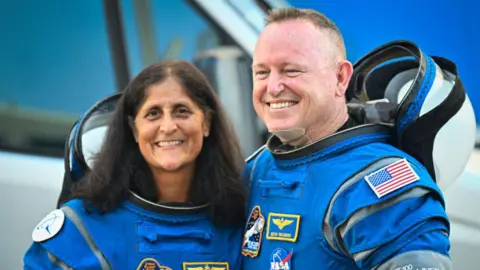
Retired test pilots Butch Wilmore and Suni Williams stayed aboard the ISS for more than nine months before boarding a SpaceX crew vehicle in March 2025 [1][2][3][4][5]. Their extended confinement resulted from the Starliner’s inability to complete its mission and highlighted the reliance on SpaceX as the sole U.S. crew‑transport provider [1][5]. Both astronauts have since retired from NASA [3].
Boeing Commits Fixes While SpaceX Remains Sole U.S. Crew Provider
Boeing announced a program of technical corrections and cultural reforms but gave no specific timeline for a future crewed Starliner flight [1][2][4][5]. NASA’s multi‑billion‑dollar contracts with Boeing and SpaceX, signed in 2014, continue, with SpaceX having completed 13 crewed missions since 2020 [1][5]. Isaacman affirmed that the Starliner issues will not affect the Artemis II lunar mission schedule [4].
Sources
-
1.
WBNS: NASA Administrator Calls Starliner Failure a “Type A” Threat to Crew Safety: Highlights Isaacman’s “Type A” classification, Boeing’s leadership blame, nine‑month ISS stay, and lack of a crewed flight timeline .
-
2.
King5: NASA chief calls Starliner a “Type A” safety threat: Mirrors WBNS details, adds comparison to Challenger and Columbia, and notes Artemis fueling test delays .
-
3.
BBC: NASA Declares Starliner Failure a “Type A” Mishap, Matching Columbia and Challenger Disasters: Adds Isaacman’s recent appointment after a second Trump nomination and his personal background .
-
4.
CNN: NASA Labels Boeing Starliner Test Flight a ‘Type A’ Mishap: Emphasizes helium leaks, thruster failures, and reassures Artemis II safety despite Starliner issues .
-
5.
AP: NASA Administrator Calls Starliner Failure a “Type A Mishap”: Focuses on internal pressure that delayed the classification and reiterates contract history with Boeing and SpaceX .
Related Tickers
Timeline
Oct 1986 – The Challenger disaster occurs, later serving as a benchmark for NASA’s “Type A” mishap classification, the highest severity level for crewed missions [1].
Feb 2003 – The Columbia disaster happens, also used as a reference point for “Type A” mishap designations [1].
2014 – NASA signs multi‑billion‑dollar commercial crew contracts with Boeing and SpaceX, establishing a two‑provider system for ISS crew transport after the shuttle era [4].
2020 – SpaceX completes its first crewed flight to the ISS and, by 2026, has delivered 13 crews, becoming the sole U.S. crew taxi after Starliner setbacks [4].
June 2024 – Boeing’s Starliner launches on its crewed test flight; helium leaks and thruster failures emerge, nearly preventing docking and initiating a nine‑month ISS stay [2][7].
June‑July 2024 – Faulty thrusters threaten crew safety; NASA Associate Administrator Amit Kshatriya describes the incident as “a really terrible day” [7].
June 2024 – Mar 2025 – Astronauts Suni Williams and Butch Wilmore remain aboard the International Space Station for over nine months because of Starliner problems, finally returning on a SpaceX vehicle in March 2025 [1].
Mar 2025 – Williams and Wilmore land safely on Earth aboard a SpaceX crew capsule, ending their extended ISS mission [1].
Summer 2025 – Test pilot Butch Wilmore retires from NASA, concluding his career after the Starliner incident [5].
Late 2025 – Jared Isaacman, a former commercial astronaut and jet pilot, is appointed NASA Administrator after a second Trump nomination and pledges accountability for the Starliner failure [1].
Jan 21 2026 – Veteran astronaut Suni Williams retires after a 27‑year NASA career, logging 608 days in space and nine spacewalks; she thanks colleagues and calls the ISS “awe‑inspiring” [3].
Feb 19 2026 – NASA releases a 312‑page Starliner investigation, classifying the June 2024 flight as a “Type A” mishap and stating the vehicle “should not have flown with astronauts aboard,” a judgment delivered by Administrator Isaacman [2][4].
Feb 20 2026 – Isaacman declares the mishap a “Type A” safety threat, saying poor Boeing leadership and NASA oversight “turned the Starliner debut into a Type A mishap” and vows “situations like this never reoccur” [6][7].
Feb 20 2026 – The report is issued amid a second Artemis lunar‑rocket hydrogen‑fueling rehearsal that suffers leaks, pushing back the Artemis II crewed lunar mission slated for later 2026 [4][6][7].
2026 (later this year) – Boeing schedules an uncrewed cargo‑only Starliner flight to validate thruster and system fixes before any future crewed launch [5].
2026 (planned) – Artemis II targets a 2026 launch, using NASA‑developed “cost‑plus” contracts and multiple safety layers, and Isaacman assures the mission is unaffected by Starliner issues [2][4].
All related articles (7 articles)
-
WBNS (Columbus, OH): NASA Administrator Calls Starliner Failure a “Type A” Threat to Crew Safety
-
King5 (Seattle, WA): NASA chief calls Starliner a “Type A” safety threat
-
BBC: NASA Declares Starliner Failure a “Type A” Mishap, Matching Columbia and Challenger Disasters
-
CNN: NASA Labels Boeing Starliner Test Flight a ‘Type A’ Mishap
-
AP: NASA Administrator Calls Starliner Failure a “Type A Mishap”
-
CNN: NASA astronaut Suni Williams retires after Starliner mission
-
AP: NASA astronaut Suni Williams retires after nine-month Starliner mission.
External resources (3 links)
- https://nodis3.gsfc.nasa.gov/npg_img/N_PR_8621_001D_/N_PR_8621_001D__Chapter1.pdf (cited 1 times)
- https://www.nasa.gov/international-space-station/space-station-astronaut-record-holders/ (cited 1 times)
- https://www.nasa.gov/wp-content/uploads/2026/02/nasa-report-with-redactions-021926.pdf?emrc=76e561 (cited 1 times)