U.S. Deploys Second Carrier Group as Trump Pushes Tougher Iran Missile Deal
Updated (13 articles)
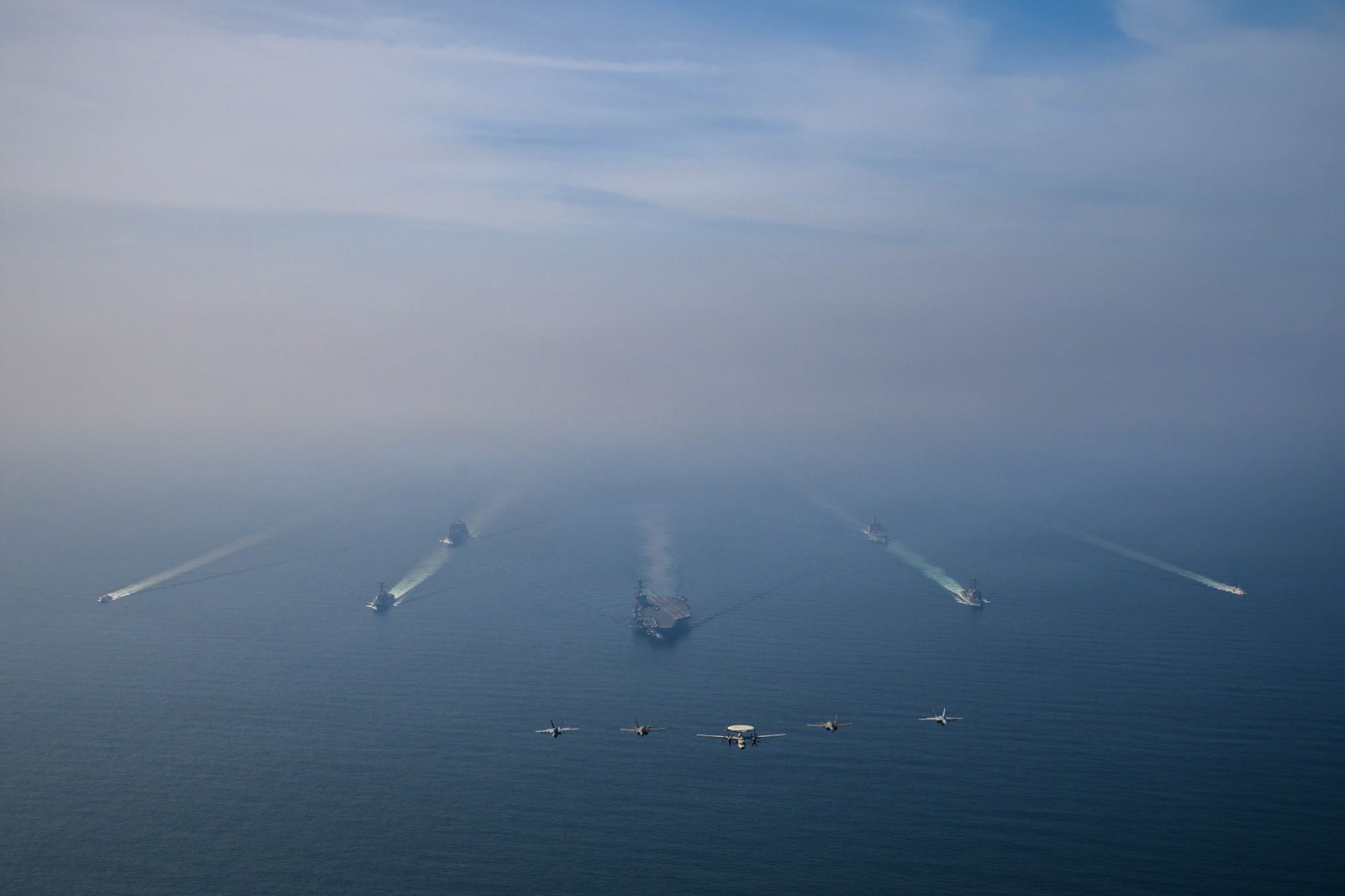
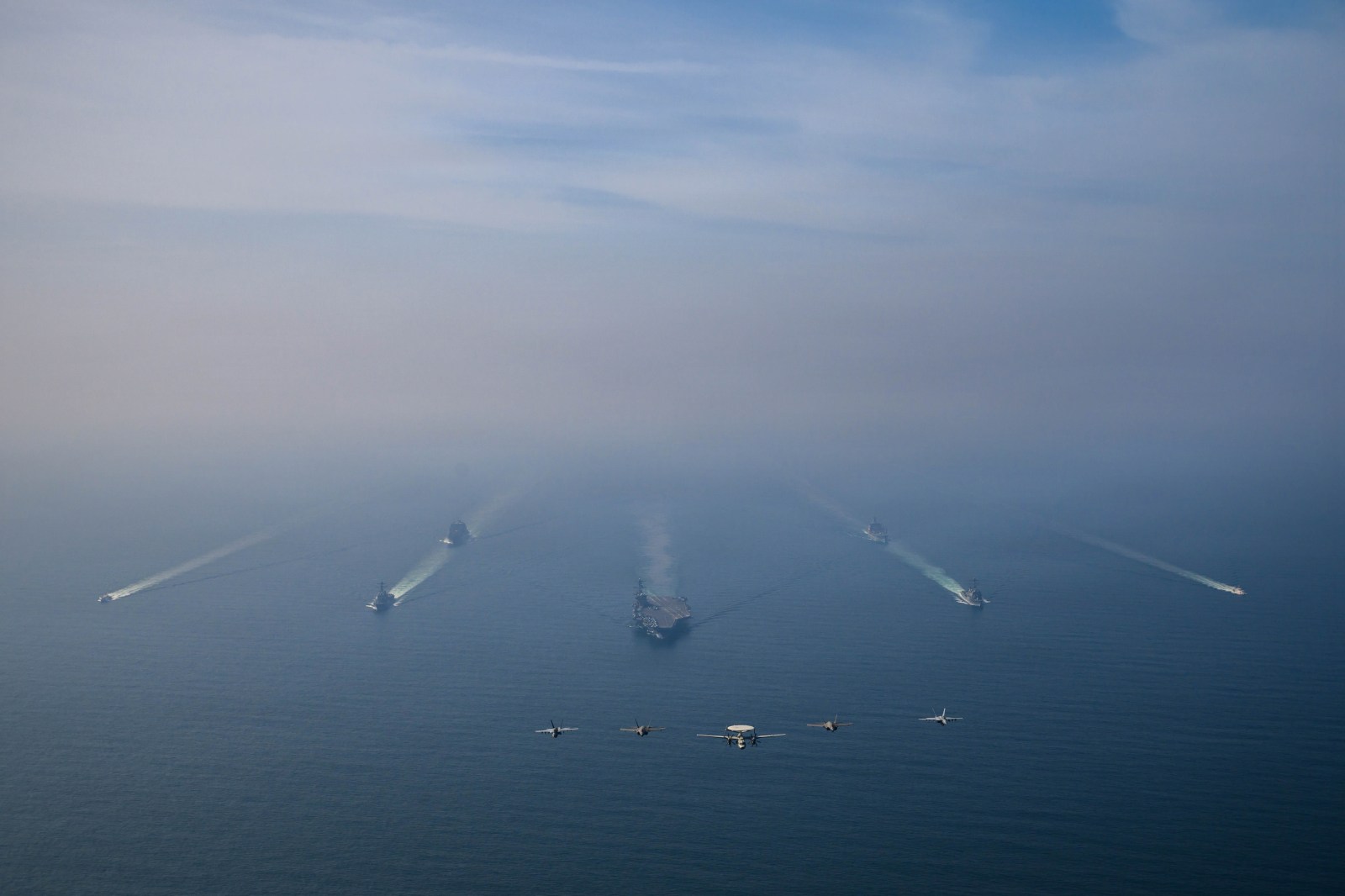
U.S. Military Buildup Intensifies in Gulf The United States has moved a second aircraft carrier strike group into the Persian Gulf, joining an existing carrier presence as of February 19, 2026 [1]. The deployment aims to maintain pressure on Tehran while diplomatic negotiations continue in Geneva on Iran’s nuclear program [1]. Officials say the additional naval force signals readiness for potential action without committing to a specific timeline [1].
Trump Demands Expanded Nuclear‑Missile Restrictions President Donald Trump has publicly called for a new nuclear‑missile agreement that exceeds the 2015 JCPOA, insisting on tighter limits for Iran’s ballistic‑missile arsenal [1]. Administration officials note that Tehran remains “very far apart” from U.S. expectations on key missile issues [1]. The demand reflects a broader strategy to curb Iran’s ability to strike targets up to 2,000 km away [1].
White House Issues Direct Warning to Iran Press Secretary Karoline Leavitt told reporters that Iran would be “very wise” to negotiate a deal and warned that the United States expects more detailed proposals in the coming weeks [1]. The statement underscores the administration’s willingness to combine diplomatic pressure with the newly positioned military assets [1]. Leavitt’s remarks were delivered amid ongoing talks in Geneva, linking diplomatic timelines to the visible force buildup [1].
Defense Officials Outline Contingency Options Former Deputy Assistant Secretary of Defense Mick Mulroy said the United States is prepared for “significant military action” against Iranian nuclear facilities and missile sites if negotiations fail [1]. He added that U.S. forces could continuously degrade Iran’s missile and drone capabilities as part of a sustained campaign [1]. Mulroy’s comments outline a range of options from targeted strikes to broader degradation of Iran’s strategic assets [1].
Regional Allies Call for Restraint Amid Escalation Saudi Arabia and other Gulf Arab states have publicly urged the United States to avoid a direct confrontation with Iran, warning that escalation could destabilize regional energy flows [1]. These partners stress that a war would threaten global oil markets and broader Middle‑East security [1]. Their statements highlight a divergence between U.S. pressure tactics and regional preferences for diplomatic de‑escalation [1].
Related Tickers
Timeline
1979 – Iran endures its most severe protest crackdown since the 1979 revolution, a historical benchmark that frames the scale of the 2025‑2026 unrest and the regime’s willingness to use lethal force against dissent[1].
1980s – During the “Tanker War,” Iran mines the Persian Gulf and nearly sinks the USS Samuel B. Roberts in 1988, later implicated in 2019 Gulf of Oman tanker strikes, demonstrating a long‑standing capacity to threaten maritime trade routes[4].
2015 – The Joint Comprehensive Plan of Action (JCPOA) is signed, establishing the baseline nuclear agreement that U.S. officials now demand a stricter nuclear‑missile deal to replace[6].
2020 – After the U.S. killing of Quds Force commander Qassem Soleimani, Iran issues a warning before striking the U.S. Ain al‑Asad base, causing injuries but no deaths, illustrating Tehran’s pattern of symbolic, pre‑warned retaliation[1].
Dec 28, 2025 – Protests erupt across Iran over a soaring rial‑to‑dollar rate, quickly spreading nationwide; the crackdown begins, leading to thousands of deaths, mass detentions and an internet blackout lasting over two weeks[8].
June 21‑22, 2025 – The United States conducts bunker‑buster strikes on three Iranian nuclear enrichment sites, setting the program back roughly two years; Iran fires missiles at Qatar’s Al Udeid Air Base the next day, warning in advance that allows most missiles to be intercepted with no casualties[1][12].
June 23, 2025 – Iran targets Al Udeid Air Base in Qatar, prompting U.S. personnel there to be advised to leave, underscoring heightened regional tension[12].
Jan 20, 2026 – Iran’s Gen. Abolfazl Shekarchi warns Trump that any aggression toward Supreme Leader Khamenei will be met with decisive response, saying Tehran will “set fire to their world”; the USS Abraham Lincoln carrier group moves west through the Indian Ocean toward the Middle East[11].
Jan 29, 2026 – Former security‑council secretary Ali Shamkhani posts that any U.S. attack will trigger “immediate, comprehensive, and unprecedented” retaliation against the U.S., Israel and supporters, calling a limited strike an “illusion”[10].
Jan 29, 2026 – President Trump revives his “massive Armada” threat on Truth Social, ordering the USS Abraham Lincoln‑led carrier group to move toward the Middle East and announcing upcoming drills[10].
Jan 29, 2026 – U.S. Secretary of State Marco Rubio tells a Senate hearing that 30,000‑40,000 American troops are within range of Iranian missiles and drones, highlighting the risk to U.S. forces in the region[4].
Jan 29, 2026 – Iran’s foreign minister Abbas Araghchi declares that Iran’s armed forces have “fingers on the trigger” and stand ready to respond “immediately and powerfully” to any aggression against Iranian territory, airspace or sea[10].
Jan 30, 2026 – The USS Abraham Lincoln carrier enters the Indian Ocean ahead of scheduled drills, placing U.S. forces within striking distance of Iran and enabling rapid protection of regional allies[9].
Jan 30, 2026 – President Trump warns Tehran that “time is running out” and that a future strike would be “far worse” than the summer 2025 attacks, intensifying diplomatic pressure on Iran[9].
Jan 30, 2026 – Iranian officials, including senior IRGC commanders, state that any U.S. strike will be treated as an act of war, raising alarms in Gulf states hosting U.S. forces and Israel[1].
Jan 30, 2026 – Iran endures its most severe protest crackdown since 1979, with several thousand deaths, mass detentions and an internet blackout; authorities blame “terrorist groups” and Israel for the unrest[1].
Jan 30, 2026 – Iranians fear a U.S. attack would deepen economic hardship; Professor Ali Bagheri Dolatabadi says war would be “similar to Afghanistan, Iraq, Syria and Yemen” and that diplomatic negotiation is the only viable path[8].
Jan 31, 2026 – President Trump has signaled a possible Iran strike for roughly 19 days, and the U.S. naval presence shifts from two carrier groups (June 2025) to a single carrier group plus other assets, altering the calculus for a potential attack[3].
Feb 3, 2026 – Iran orders its foreign minister to open U.S. negotiations, ending a long‑standing refusal, as Tehran feels cornered by internal unrest, economic strain and U.S. threats[7].
Feb 3, 2026 – Republican officials back Trump’s hard line while Democrats raise constitutional concerns; Senate leaders call for a debate under the War Powers Act, reflecting domestic political constraints on any U.S. strike[7].
Feb 19, 2026 – The United States deploys a second aircraft carrier strike group to the Gulf, maintaining pressure on Iran while nuclear talks continue in Geneva; officials say the buildup signals readiness for “significant military action” against nuclear facilities and missile sites if Tehran rejects the deal[6].
Feb 2026 (weeks ahead) – U.S. officials expect to present more detailed nuclear‑missile proposals to Iran in the coming weeks, while regional partners such as Saudi Arabia urge restraint to avoid destabilizing energy flows[6].
Future (unspecified) – Analysts warn Iran could close the Strait of Hormuz in retaliation, a move that would affect over a fifth of global oil and LNG trade and could trigger a worldwide economic downturn[4].
All related articles (13 articles)
-
Newsweek: Trump’s Military Options as Iran War Looms
-
Newsweek: Trump’s Nuclear Pressure Prompts Iran to Seek Talks
-
CNN: Trump’s Iran Options Remain Limited Amid Naval Buildup and Regime Weakness
-
Newsweek: U.S. Carrier Deploys as Trump Issues Final Warning to Iran
-
Newsweek: Iranians Brace for Possible U.S. Attack Amid Rising Tensions
-
BBC: Iran’s heightened risk of escalation as US carrier group arrives
-
CNN: Iran’s Options to Respond if Trump Orders a Strike
-
Newsweek: Iran Threatens Unprecedented Retaliation After Trump Revives Strike Threat
-
BBC: Trump warns Iran “time is running out” as US forces surge in Gulf
-
Newsweek: Iran warns Trump with threat to set fire to their world
-
CNN: Arab states help de-escalate US-Iran tensions as US moves carrier group to Middle East
-
Newsweek: US weapons stockpile examined amid potential war with Iran
-
Newsweek: Iran could retaliate more aggressively if U.S. intervenes, experts warn
External resources (12 links)
- https://www.eia.gov/international/analysis/country/irn (cited 2 times)
- https://x.com/ifrc/status/2011790950574531015 (cited 2 times)
- https://x.com/netblocks/status/2011838716562542678 (cited 2 times)
- https://www.bing.com/ck/a?!&&p=8b801433ae68c44f5453de72e45c10b1e846f1ca098dafb67ed046fcab4f8c53JmltdHM9MTc2OTY0NDgwMA&ptn=3&ver=2&hsh=4&fclid=31294c2b-4a98-6c6c-3c6d-5ac24bca6d43&psq=USS+Abraham+Lincoln+Newsweek&u=a1aHR0cHM6Ly93d3cubmV3c3dlZWsuY29tL21hcC1zaG93cy11c3MtYWJyYWhhbS1saW5jb2xuLXBhdGgtdG93YXJkLWlyYW4tcHJvdGVzdHMtY29udGludWUtMTEzNzE4MDQ (cited 2 times)
- https://www.fmprc.gov.cn/wjbzhd/202601/t20260115_11813505.shtml (cited 2 times)
- https://www.ifrc.org/article/ifrc-mourns-killing-one-iranian-red-crescent-colleague (cited 2 times)
- https://www.newsguardrealitycheck.com/p/ai-videos-fill-void-amid-iran-internet-blackout (cited 2 times)
- https://www.opec.org/assets/assetdb/asb-2025.pdf (cited 2 times)
- https://assets.newsweek.com/wp-content/uploads/2025/08/2691909-how-israel-could-exploit-irans-ethnic-divides.jpg (cited 1 times)
- https://www.bing.com/ck/a?!&&p=302e892761936c6d391ff9b80cbb4cf3e55326a7a8dbaf2ac23ca6e3831d2c8aJmltdHM9MTc2ODM0ODgwMA&ptn=3&ver=2&hsh=4&fclid=24c05a7b-dba0-6e8d-1f70-4e79da6b6f70&psq=Al+Udeid+Air+Base+in+Qatar+Newsweek+June+23&u=a1aHR0cHM6Ly93d3cubmV3c3dlZWsuY29tL2lyYW4tdHJ1bXAtc3RyaWtlcy1hbC11ZGVpZC1haXItYmFzZS1xYXRhci0xMTM1NzA0NQ (cited 1 times)
- https://www.bing.com/ck/a?!&&p=65e0516d046020389640ccff0832ad6b9bf7e11b7dc1521552dea5cc311b1a05JmltdHM9MTc2OTY0NDgwMA&ptn=3&ver=2&hsh=4&fclid=31294c2b-4a98-6c6c-3c6d-5ac24bca6d43&psq=Iran+drills+Newsweek&u=a1aHR0cHM6Ly93d3cubmV3c3dlZWsuY29tL2lyYW4tdXBkYXRlLXVzLW1pbGl0YXJ5LXRvLXBlcmZvcm0tc2hvdy1vZi1zdHJlbmd0aC1pbi1taWRkbGUtZWFzdC0xMTQyNzg4OQ (cited 1 times)