Polar Vortex Stretch and Warm Gulf Drive Late‑January 2026 U.S. Winter Storm
Updated (5 articles)
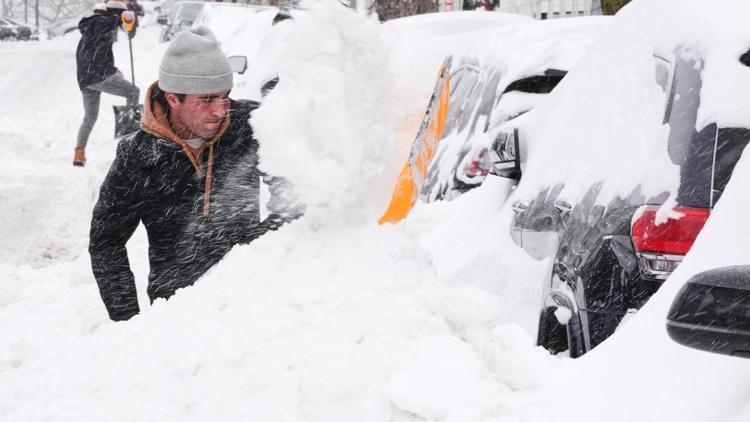
Widespread Ice, Snow, and Power Outages Across the Nation The storm that erupted on Jan 24‑27 2026 blanketed an arc from New Mexico to New England with freezing rain, sleet and heavy snow, leaving hundreds of thousands without electricity as ice‑laden branches snapped power lines [1][2]. Snow accumulations exceeded a foot in parts of the Midwest and Northeast, while temperatures plunged for several days after the system passed [1][2]. The event disrupted travel, closed schools, and prompted emergency declarations in multiple states [1][2].
Southward Stretch of the Stratospheric Vortex Amplified the Jet Stream deep southward dip of the jet stream overlapped a stretched segment of the stratospheric polar vortex that extended unusually far over the United States [1][2]. Vertical atmospheric waves transmitted vortex energy back into the troposphere, intensifying north‑south jet swings and creating the dynamic lift needed for the storm’s severe precipitation [1][2]. This coupling of stratospheric and tropospheric flows is identified as a key driver of the event’s intensity [1][2].
Unusually Warm Gulf of Mexico Supplied Moisture Surge Sea‑surface temperatures in the Gulf of Mexico were markedly above seasonal norms, providing abundant moisture that the storm ingested as it moved eastward [1][2]. The sharp temperature contrast between the Arctic air mass and the warm Gulf air accelerated condensation, producing heavy rain, sleet and snow rates far above climatological averages [1][2]. Moisture fluxes from the Gulf were essential to the storm’s record‑breaking snowfall totals in the Midwest and Northeast [1][2].
Climate Change Offers Mixed Signals for Future Storms Research cited by both outlets notes that while global warming is reducing average snow totals, disruptions to the polar vortex and warmer oceans may make the most extreme winter storms stronger [1][2]. Rapid Arctic warming appears linked to the vortex stretching that amplified this storm, and the warm Gulf acts as a moisture reservoir for future events [1][2]. Scientists caution that predicting average storm strength remains uncertain amid these competing influences [1][2].
Federal Research Labs Remain Critical Amid Funding Threats The National Center for Atmospheric Research (NCAR) and other federal facilities supplied the models, instruments and data that enabled real‑time forecasting and post‑event analysis [1][2]. Recent political actions targeting NCAR’s budget have raised concerns about the continuity of high‑resolution atmospheric research [1][2]. Both articles stress that sustained investment is vital for understanding and predicting similar extreme weather episodes [1][2].
Sources
-
1.
WBNS: How a Polar Vortex Stretch and Warm Gulf Fueled the Late‑January 2026 U.S. Winter Storm: Provides a detailed meteorological breakdown of the vortex‑jet interaction, Gulf moisture influx, and notes funding pressures on NCAR .
-
2.
King5: Polar vortex stretch and warm Gulf boost Jan 2026 U.S. winter storm: Highlights the same dynamics, adds quotes from scientists Matthew Barlow and Judah Cohen, and emphasizes political threats to federal research funding .
Timeline
Jan 2019 – A polar‑vortex outbreak drives record‑low temperatures across the United States, with Chicago hitting –23 °F, wind‑chill below –50 °F, causing frozen pipes, power outages, hypothermia deaths and widespread travel disruptions[3].
July 2025 – A MIT‑led study co‑authored by Judah Cohen links an increased frequency of stretched polar‑vortex events to severe central and eastern U.S. winter weather, providing a mechanistic basis for recent extreme storms[1].
2025 – Climate scientists note that polar‑vortex outbreaks occur roughly every one to three years and can last one to two weeks; the coldest days are brief but the downstream impacts—frozen infrastructure, energy spikes and travel chaos—can linger for weeks[3].
Jan 21, 2026 – Forecasters warn a stretched polar vortex will blanket roughly two‑thirds of the United States, exposing about 230 million people to temperatures of 20 °F or colder and 150 million to snow or ice; Arctic sea‑ice extent hits a record low for the season, and the vortex center is projected to settle near Duluth, Minnesota, by Friday, potentially freezing Lakes Erie and Ontario and curbing lake‑effect snow[1][1].
Jan 24, 2026 – The vortex center sits near Duluth, delivering prolonged brutal cold with lows of –25 °F to –30 °F and average lows around 11‑12 °F across the North and Midwest, while the Great Lakes begin to freeze, limiting lake‑effect snowfall in some regions[1].
Jan 28, 2026 – A deep southward dip in the jet stream overlaps the stretched stratospheric vortex, and unusually warm Gulf‑of‑Mexico sea‑surface temperatures feed abundant moisture into a powerful winter storm that blankets the U.S. from New Mexico to New England with freezing rain, sleet and more than a foot of snow in parts of the Midwest and Northeast, knocking out power to hundreds of thousands and leaving bitter cold for days[2][2].
Jan 28, 2026 – Researchers Matthew Barlow and Judah Cohen explain that atmospheric waves transmitted vortex energy back to the troposphere, amplifying the jet‑stream swing and intensifying the storm, and they note that “while the planet is unequivocally warming, research indicates the most intense storms may be becoming stronger,” highlighting mixed climate‑change signals for future winter weather[4][4].
Late Jan 2026 (future) – Federal research labs such as NCAR continue to provide essential data and models for storm prediction, even as recent political moves threaten their funding, underscoring concerns about future forecasting capability[4].
All related articles (5 articles)
-
WBNS (Columbus, OH): How a Polar Vortex Stretch and Warm Gulf Fueled the Late‑January 2026 U.S. Winter Storm
-
King5 (Seattle, WA): Polar vortex stretch and warm Gulf boost Jan 2026 U.S. winter storm
-
AP: Stretched polar vortex to deliver brutal winter across much of the U.S.
-
WBNS (Columbus, OH): Polar Vortex Outbreaks and Their Impact on North America
-
King5 (Seattle, WA): Polar Vortex: How a Stratospheric Whirlpool Drives Record‑Cold Outbreaks
External resources (29 links)
- https://svs.gsfc.nasa.gov/3864 (cited 2 times)
- https://www.noaa.gov/jetstream/global/jet-stream (cited 2 times)
- https://www.weather.gov/source/crh/snowmap.html (cited 2 times)
- https://doi.org/10.1007/s00382-025-08011-0 (cited 2 times)
- https://doi.org/10.1038/s43247-023-01008-9 (cited 2 times)
- https://doi.org/10.1073/pnas.2510029122 (cited 2 times)
- https://doi.org/10.1126/sciadv.adq9557 (cited 2 times)
- https://doi.org/10.1126/science.abi9167 (cited 2 times)
- https://web.archive.org/web/20250117041847/https://www.climate.gov/news-features/understanding-climate/understanding-arctic-polar-vortex (cited 2 times)
- https://www.ap.org/about/standards-for-working-with-outside-groups/ (cited 1 times)
- https://www.ap.org/discover/Supporting-AP (cited 1 times)
- https://bsky.app/profile/nws.noaa.gov/post/3md7cjvzq5f2o (cited 2 times)
- https://climatereanalyzer.org/clim/sst_daily/?dm_id=gomex (cited 2 times)
- https://journals.ametsoc.org/view/journals/bams/98/1/bams-d-15-00212.1.xml (cited 2 times)
- https://s.yimg.com/ny/api/res/1.2/DIFG4P.m2dfKLvlCXPcS.A--/YXBwaWQ9aGlnaGxhbmRlcjt3PTEyNDI7aD02NzQ-/https://media.zenfs.com/en/aol_fox_weather_976/800e35006a051604981dc7910e23158f (cited 2 times)
- https://scholar.google.com/citations?user=kc2doosAAAAJ&hl=en (cited 2 times)
- https://scholar.google.com/citations?user=qWV-WIQAAAAJ&hl=en (cited 2 times)
- https://theconversation.com/how-the-polar-vortex-and-warm-ocean-intensified-a-major-us-winter-storm-274243 (cited 2 times)
- https://theconversation.com/the-western-us-is-in-a-snow-drought-and-storms-have-been-making-it-worse-272549 (cited 2 times)
- https://weather.com/news/weather/news/2026-01-25-live-updates-january-25-winter-storm-fern (cited 2 times)
- https://www.denverpost.com/2026/01/15/colorado-ncar-funding-john-hickenlooper-michael-bennet-senate/ (cited 2 times)
- https://www.ipcc.ch/report/ar6/syr/ (cited 2 times)
- https://www.ipcc.ch/report/ar6/wg1/chapter/chapter-11/ (cited 2 times)
- https://www.ipcc.ch/report/ar6/wg1/chapter/chapter-9/ (cited 2 times)
- https://www.nature.com/articles/ngeo2783 (cited 2 times)
- https://www.nature.com/articles/s41612-018-0054-4 (cited 2 times)
- https://agupubs.onlinelibrary.wiley.com/doi/full/10.1029/2024GL108195 (cited 1 times)
- https://nsidc.org/data/seaice_index/images/daily_images/N_iqr_timeseries.png (cited 1 times)
- https://www.science.org/doi/10.1126/sciadv.adq9557 (cited 1 times)