President Lee Secures 270 Trillion Won Pledge From Chaebols for Regional Growth
Updated (2 articles)
-
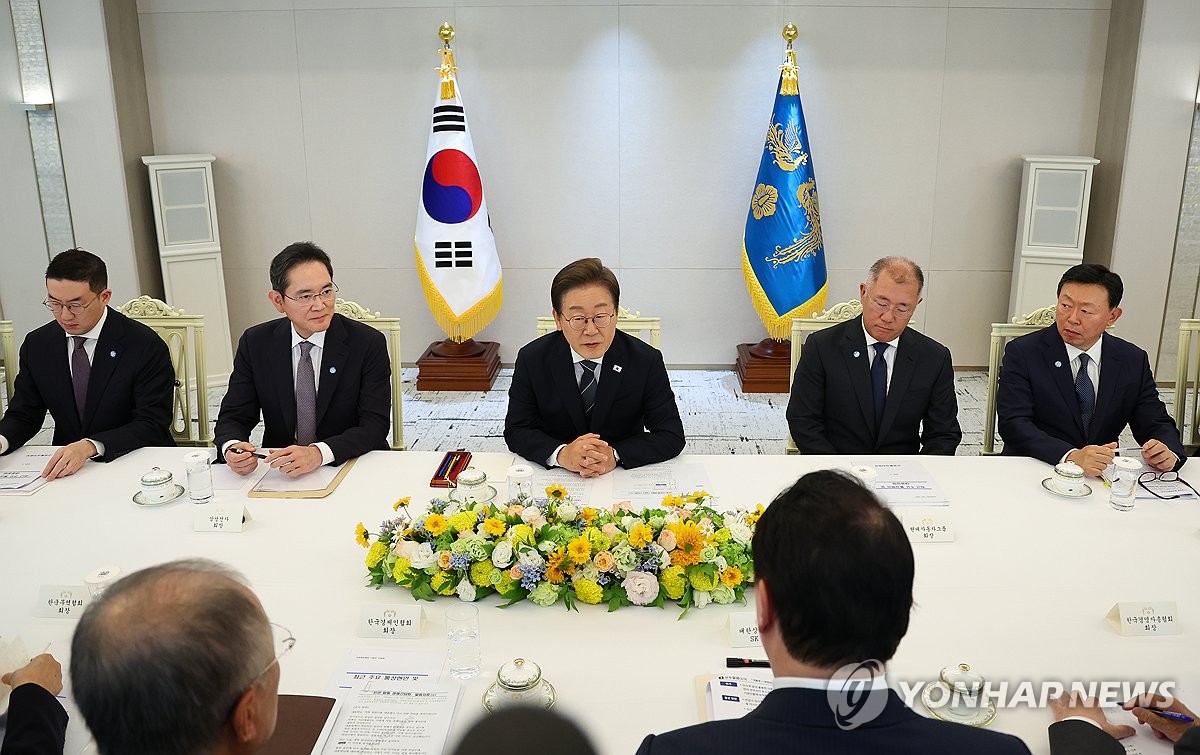 Image: YonhapIn this file photo, President Lee Jae Myung (C) attends a meeting with a group of business leaders at the presidential office in Seoul on June 13, 2025. Also at the meeting were LG Group Chairman Koo Kwang-mo (L), Samsung Electronics Co. Chairman Lee Jae-yong (2nd from L), Hyundai Motor Group Executive Chair Euisun Chung (2nd from R) and Lotte Group Chairman Shin Dong-bin. (Pool photo) (Yonhap) Source Full size
-
Image: YonhapIn this file photo, President Lee Jae Myung (C) attends a meeting with a group of business leaders at the presidential office in Seoul on June 13, 2025. Also at the meeting were LG Group Chairman Koo Kwang-mo (L), Samsung Electronics Co. Chairman Lee Jae-yong (2nd from L), Hyundai Motor Group Executive Chair Euisun Chung (2nd from R) and Lotte Group Chairman Shin Dong-bin. (Pool photo) (Yonhap) Source Full size

Pledge Amount and Five‑Year Timeline: President Lee Jae Myung announced that the nation’s ten largest conglomerates have committed a total of 270 trillion won (≈US$186 billion) to be invested in regional projects over the next five years, marking the largest private‑sector pledge for balanced development to date[1]. The commitment was formalized during a high‑level meeting at Cheong Wa Dae on February 4, 2026, and is intended to flow into designated regional hubs and special self‑governing provinces[1].
Key Executives Gathered at Cheong Wa Dae: The summit brought together Samsung Electronics Chairman Lee Jae‑yong, Hyundai Motor Group Executive Chair Euisun Chung, LG Group Chairman Koo Kwang‑mo, and Lotte’s Shin Dong‑bin, among others, reflecting broad chaebol participation[1][2]. Their presence underscores the government’s strategy of direct engagement with private‑sector leaders to align corporate investment plans with national regional‑growth objectives[2].
Policy Focus on Youth Employment and Regional Hubs: Lee urged the conglomerates to expand hiring for young workers and to locate new factories outside Seoul, linking job creation to the development of five major regional hubs and three special self‑governing provinces[1][2]. The administration also highlighted plans for renewable‑energy industrial complexes and “energy cities” to stimulate sustainable growth in distant areas[1].
Rationale and Legislative Backing: Citing land, electricity and water shortages in the capital, Lee argued that improved transport and communications now make regional sites more viable for expansion[1]. The government will introduce legislation to support renewable‑energy zones and to give greater fiscal weight to non‑Seoul regions, ensuring the pledged funds are channeled effectively[1].
Sources
-
1.
Yonhap (Article 1): President Lee Secures 270 trillion‑won Pledge from Conglomerates for Regional Growth – Details the February 4 meeting, the exact pledge amount, participating CEOs, and the government’s plan for regional hubs, self‑governing provinces, and renewable‑energy legislation.
-
2.
Yonhap (Article 2): President Lee to Convene Top Conglomerate Heads on Youth Jobs and Regional Investment – Announces the February 3 scheduled meeting, lists attending chaebol leaders, and emphasizes the administration’s priority on youth hiring and investment outside Seoul.
Timeline
June 13, 2025 – A photo shows President Lee Jae Myung standing with LG Chairman Koo Kwang‑mo, Samsung Chairman Lee Jae‑yong, Hyundai Executive Chair Euisun Chung and Lotte Chairman Shin Dong‑bin, underscoring an ongoing dialogue between the government and the nation’s biggest chaebols on regional development and youth employment [2].
Early Feb 2026 (the week before Feb 3) – President Lee convenes a meeting with foreign business chambers at Cheong Wa Dae, urging overseas firms to expand youth hiring and increase investment outside Seoul, setting the stage for a domestic summit with Korean conglomerates [2].
Feb 3, 2026 – The presidential office announces that President Lee will meet the heads of the top ten Korean conglomerates on Wednesday to press for more jobs for young workers and greater capital spending in non‑capital regions, signalling a high‑level policy push on youth employment [2].
Feb 4, 2026 – President Lee meets Samsung, Hyundai, LG and other CEOs at Cheong Wa Dae and secures pledges totaling 270 trillion won (US$186 billion) for regional investment over the next five years, marking a major private‑sector commitment to balanced growth [1].
Feb 4, 2026 – Lee outlines a plan to develop five major regional hubs and three self‑governing provinces, urging companies to align future investment with these growth centres to decentralise economic activity from Seoul [1].
Feb 4, 2026 – Federation of Korean Industries Chairman Ryu Jin states that the nation’s ten largest conglomerates will allocate the pledged 270 trillion won to regional cities and provinces within five years, confirming the scale of corporate participation [1].
Feb 4, 2026 – Lee cites resource constraints in Seoul—limited land, electricity and water for new production lines—as a key reason to shift factories and expansion projects to regional sites, highlighting logistical advantages of decentralisation [1].
Feb 4, 2026 – The administration announces plans to pass special legislation creating renewable‑energy industrial complexes and “energy cities,” and to give greater fiscal weight to distant regions when allocating resources, linking the investment pledge to a green‑energy agenda [1].