South Korean Foreign Minister Cho Meets U.S. Secretary Rubio as Trump Pushes 25% Tariff Threat
Updated (12 articles)
-
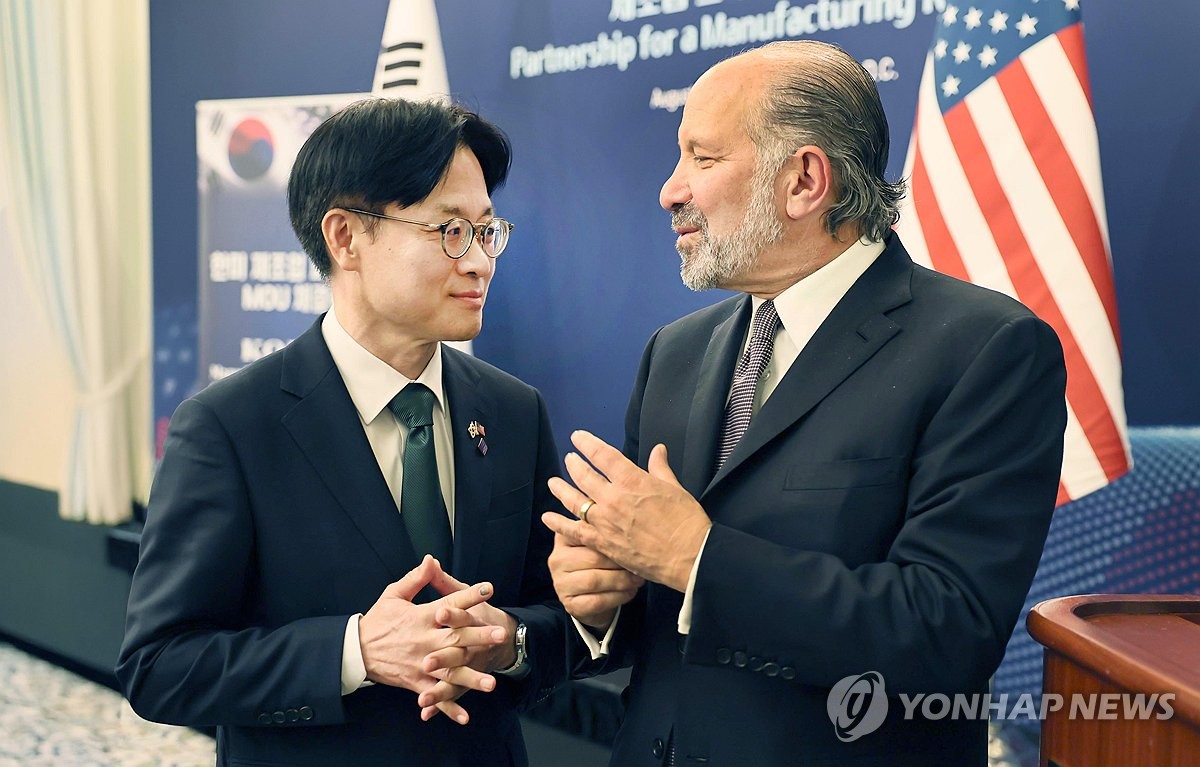 Image: YonhapIndustry Minister Kim Jung-kwan (L) and U.S. Commerce Secretary Howard Lutnick talk during the signing of a memorandum of understanding on a manufacturing partnership between South Korea and the United States at a hotel in Washington in this Aug. 25, 2025, file photo provided by the industry ministry. (PHOTO NOT FOR SALE) (Yonhap) Source Full size
-
Image: YonhapIndustry Minister Kim Jung-kwan (L) and U.S. Commerce Secretary Howard Lutnick talk during the signing of a memorandum of understanding on a manufacturing partnership between South Korea and the United States at a hotel in Washington in this Aug. 25, 2025, file photo provided by the industry ministry. (PHOTO NOT FOR SALE) (Yonhap) Source Full size


Cho Hyun and Rubio Hold One‑on‑One Talks in Washington On February 2, 2026, South Korean Foreign Minister Cho Hyun met U.S. Secretary of State Marco Rubio in Washington, the first high‑level dialogue since President Trump warned of raising South Korean tariffs from 15% to 25% [1]. Both officials reviewed the August and October summit agreements and prepared for a U.S.‑led critical‑minerals ministerial the next day [1]. The meeting underscored Washington’s demand for swift implementation of the bilateral trade framework.
$350 Billion Investment Package Remains Central to Tariff Reduction Seoul has pledged to invest US$350 billion in the United States, including US$200 billion in cash installments capped at US$20 billion per year, in exchange for keeping tariffs at 15% [1]. A special bill to approve the investment package is slated for introduction by late February or early March, and its passage is viewed as the decisive factor in averting the 25% tariff hike [1][2]. The investment pledge links Korean capital flows to U.S. market access across multiple sectors.
Parliamentary Delay Triggers U.S. Consideration of Higher Tariffs South Korea’s National Assembly has not yet ratified the trade‑deal legislation, prompting the United States to contemplate raising reciprocal tariffs to 25% [1][2]. President Trump framed the threat as a procedural response to Seoul’s lagging bill, while Korean officials stress that the delay is administrative, not a policy reversal [1][2]. Both sides acknowledge that legislative progress is critical to maintaining the agreed‑upon 15% tariff rate.
Earlier Industry‑Minister Talks Ended Without Deal but Clarified Misunderstandings Industry Minister Kim Jung‑kwan’s two‑day meetings with U.S. Commerce Secretary Howard Lutnick on January 30‑31, 2026, concluded without a formal agreement, though both parties reported a better mutual understanding [3][4][5]. The talks were followed by plans for video‑conference negotiations and highlighted lingering doubts in Washington about Seoul’s commitment [3]. Kim later asserted that “unnecessary misunderstandings” had been cleared, aiming to reassure both domestic and U.S. audiences [2][3].
Sources
-
1.
Yonhap: South Korea and U.S. diplomats meet in Washington as Trump threatens tariff hike: Cho Hyun and Marco Rubio discuss summit agreements and a $350 billion investment amid a 25% tariff warning .
-
2.
Yonhap: South Korean Industry Minister Claims Trade Misunderstandings Resolved After US Talks: Kim Jung‑kwan says misunderstandings cleared after meetings with Howard Lutnick, reiterates $350 billion pledge .
-
3.
Yonhap: South Korea and U.S. Commerce Secretary End Tariff Talks Without Agreement: Kim Jung‑kwan reports two‑day talks end inconclusively; future video talks planned .
-
4.
Yonhap: South Korean Industry Minister Holds Second Day of Talks with U.S. Commerce Secretary Over Trump’s Tariff Threat: Second‑day negotiations continue to avert a shift from 15% to 25% tariffs .
-
5.
Yonhap: South Korean Industry Minister and U.S. Commerce Secretary Conclude First Day of Tariff Talks Without Deal: First‑day talks end without resolution; extensive discussions continue .
-
6.
Yonhap: South Korean Industry Minister Meets U.S. Commerce Secretary Amid Trump Tariff Threat: Kim arrives in Washington, pledges to do his best to address tariff issue .
-
7.
Yonhap: South Korean Industry Minister to Meet U.S. Commerce Secretary Amid Trump Tariff Threat: Announcement of upcoming meeting to clarify legislative process and reaffirm cooperation .
-
8.
Yonhap: No Trade Deal Confirmed Until South Korean Parliament Ratifies It: Treasury Secretary Scott Bessent says deal pending parliamentary approval; Trump threatens 25% tariffs .
-
9.
Yonhap: South Korean Industry Minister Heads to Washington Amid U.S. Tariff Threat: Kim’s travel schedule and meeting plans outlined amid Trump’s tariff announcement .
-
10.
Yonhap: Trump says U.S. will work “something” out with South Korea on tariffs: Trump pledges negotiation after tariff threat; White House cites lack of progress .
-
11.
AP: Trump threatens to hike South Korean tariffs to 25%: President announces 25% tariff increase; Korean parliament still pending on trade framework .
-
12.
King5 (Seattle, WA): Trump Raises South Korean Tariffs Over Unapproved Trade Framework: Tariff hike announced; Korean ministers scheduled for U.S. talks; investment bill details .
Timeline
Jan 19, 2026 – Treasury Secretary Scott Bessent speaks at the World Economic Forum in Davos, underscoring his role in U.S. trade policy as tensions rise with South Korea over a pending investment‑linked deal [10].
Jan 26, 2026 – President Donald Trump announces via social media that the United States will raise reciprocal tariffs on South Korean autos, lumber and pharmaceuticals from 15 % to 25 % under an economic‑emergency declaration, citing Seoul’s failure to ratify the trade framework announced last year [1][2][12].
Jan 27, 2026 – Trump tells reporters the administration will “work something out” with South Korea on the tariff issue, while a White House official says Seoul has made no progress on its obligations under the bilateral pact [12].
Jan 28, 2026 – Treasury Secretary Bessent tells CNBC that no U.S.–South Korea trade agreement exists until the Korean National Assembly ratifies it, reinforcing the link between the $350 billion investment pledge and the 15 % tariff rate [10]; Industry Minister Kim Jung‑kwan departs Ottawa for Washington, scheduled to land at Dulles at 9:25 p.m. and meet Commerce Secretary Howard Lutnick the next day [11][9][7].
Jan 29, 2026 – Kim Jung‑kwan meets Lutnick at the Commerce Department for the first day of tariff talks, ends without a deal but agrees to reconvene, and tells reporters “I will do my best” as he seeks to clear “unnecessary misunderstandings” after Trump’s 25 % tariff threat [7][8][9].
Jan 30, 2026 – Kim and Lutnick hold a second‑day session that also ends without agreement; Kim repeats his pledge to do his best, while both sides acknowledge ongoing negotiations and plan a follow‑up video conference, as the $350 billion investment commitment remains the centerpiece of the dispute [6][5].
Jan 31, 2026 – Returning to Incheon, Kim declares that “unnecessary misunderstandings” are resolved and “our mutual understanding has deepened significantly,” while promising swift processing of the special bill needed to enact the investment package [3].
Feb 2, 2026 – Foreign Minister Cho Hyun meets U.S. Secretary of State Marco Rubio in Washington, the first ministerial dialogue since Trump’s tariff warning, and discusses implementation of August and October 2025 summit agreements, the upcoming critical‑minerals ministerial, and a special bill expected by late February or early March to approve the $350 billion investment [4].
Late Feb – early Mar 2026 (expected) – South Korean lawmakers aim to merge five pending bills into a single special bill and secure parliamentary approval of the $350 billion investment plan, a step the United States says is critical before any tariff increase takes effect [1][4].
2026 (ongoing) – The United States continues Section 232 investigations, prepares a renegotiation of its amended 2020 Canada‑Mexico trade pact, and faces a pending Supreme Court case on the president’s authority under the 1977 International Emergency Economic Powers Act, all of which could influence the outcome of the South Korean tariff dispute [1][2].