South Korean Foreign Minister Cho Meets U.S. Officials as Trump Threatens 25% Tariffs
Updated (93 articles)
-
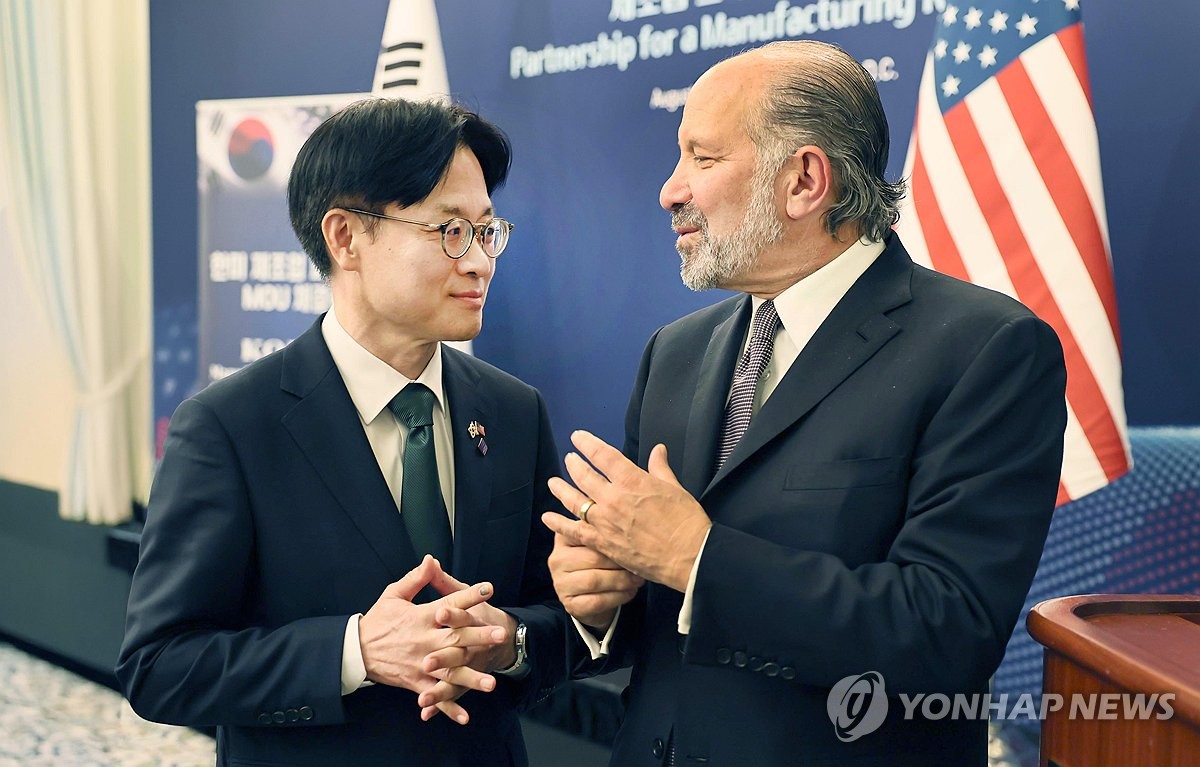 Image: YonhapIndustry Minister Kim Jung-kwan (L) and U.S. Commerce Secretary Howard Lutnick talk during the signing of a memorandum of understanding on a manufacturing partnership between South Korea and the United States at a hotel in Washington in this Aug. 25, 2025, file photo provided by the industry ministry. (PHOTO NOT FOR SALE) (Yonhap) Source Full size
-
Image: YonhapIndustry Minister Kim Jung-kwan (L) and U.S. Commerce Secretary Howard Lutnick talk during the signing of a memorandum of understanding on a manufacturing partnership between South Korea and the United States at a hotel in Washington in this Aug. 25, 2025, file photo provided by the industry ministry. (PHOTO NOT FOR SALE) (Yonhap) Source Full size


Tariff threat escalates over legislative delay President Donald Trump announced on Jan 28 2026 that the United States could raise reciprocal tariffs on South Korean autos, lumber and pharmaceuticals from 15 % to 25 % because Seoul has not yet passed the investment‑implementation bill, a move echoed in multiple briefings and press releases [2][3][13][14][15][17][19]. Trump added the administration would “work something out” but emphasized the increase could proceed if progress stalls [13]. South Korean officials repeatedly stressed the threat is a procedural lever, not a collapse of the underlying trade pact [1][5].
$350 billion investment pledge underpins tariff concessions The bilateral agreement, signed after summits in July and October 2025, obliges South Korea to invest US$350 billion in the United States, including US$200 billion in cash installments capped at US$20 billion per year [1][4][6][7][13][14][15]. In exchange, the United States agreed to lower tariffs on Korean exports from 25 % to 15 % once the investment package is enacted [1][5][6]. Finance Minister Koo Yun‑cheol warned a weakening won could delay cash flows, potentially affecting the rollout schedule [13].
Special bill faces tight parliamentary timetable South Korea’s ruling Democratic Party introduced a special bill in November 2025 to authorize the investment package, but the National Assembly has not yet approved it [4][17][19]. Lawmakers aim to schedule an extraordinary session for a plenary vote in late February or early March, with the DP pledging to push the bill through by then [4][17]. Both governments warned that failure to pass the legislation could trigger the 25 % tariff increase, heightening urgency on Capitol Hill [1][14][15].
High‑level diplomatic outreach seeks to defuse tension Prime Minister Kim Min‑seok established a direct hotline with U.S. Vice President JD Vance in January, which he says has clarified intentions and helped manage the tariff dispute [2][3]. On Feb 2 2026, Foreign Minister Cho Hyun met U.S. Secretary of State Marco Rubio in Washington, the first one‑on‑one since Trump’s warning, and attended a U.S.–led critical minerals ministerial [1][8]. Industry Minister Kim Jung‑kwan also held two‑day talks with Commerce Secretary Howard Lutnick, reporting that “unnecessary misunderstandings” were cleared, though no formal agreement was reached [5][6][7][10][12][18].
Both sides frame the issue as implementation, not renegotiation Cho emphasized that the tariff discussion is part of “broad consultations” to faithfully implement the joint fact sheet, not a renegotiation of the deal [1][13]. U.S. officials, including Treasury Secretary Scott Bessent, reiterated that no trade agreement is active until the Korean parliament ratifies it, reinforcing the legislative focus [14][15][16]. The combined diplomatic efforts, hotline usage, and upcoming legislative vote aim to keep the partnership intact while averting the proposed tariff hike.
Sources
-
1.
Yonhap: South Korea and U.S. diplomats meet in Washington as Trump threatens tariff hike – Details Cho Hyun’s meeting with Rubio, the $350 bn investment pledge, and the legislative deadline driving the tariff threat .
-
2.
Yonhap: South Korea, U.S. Make Headway on Tariff Dispute After Hotline Established – Highlights Prime Minister Kim’s hotline with Vice President Vance and its role in clarifying intentions after Trump’s announcement .
-
3.
Yonhap: South Korea‑U.S. tariff talks gain momentum after new hotline – Reiterates hotline benefits and Trump’s surprise tariff warning, noting rapid dispatch of Korean trade officials to Washington .
-
4.
Yonhap: DP Aims to Pass U.S. Investment Bill by Late February, Early March – Announces the Democratic Party’s plan for an extraordinary session to approve the special investment bill .
-
5.
Yonhap: South Korean Industry Minister Claims Trade Misunderstandings Resolved After US Talks – Reports Kim Jung‑kwan’s claim that misunderstandings were cleared in Washington and reiterates the $350 bn pledge .
-
6.
Yonhap: South Korea and U.S. Commerce Secretary End Tariff Talks Without Agreement – Notes the Jan 30 talks ended without a deal and the continuation of negotiations via video link .
-
7.
Yonhap: South Korean Industry Minister Holds Second Day of Talks with U.S. Commerce Secretary Over Trump’s Tariff Threat – Describes the second‑day talks, the 25 % tariff threat, and Kim’s pledge to do his best .
-
8.
Yonhap: South Korea Tackles Trade Talks, FX Scrutiny, Space Launch, and Domestic Probes – Mentions the first‑day tariff talks, FX monitoring, and unrelated domestic news .
-
9.
Yonhap: South Korean Industry Minister and U.S. Commerce Secretary Conclude First Day of Tariff Talks Without Deal – Summarizes the Jan 29 meeting outcome and the pending $350 bn investment .
-
10.
Yonhap: South Korean Industry Minister Meets U.S. Commerce Secretary Amid Trump Tariff Threat – Covers Kim’s arrival, his “do my best” remark, and the investment pledge .
-
11.
Yonhap: South Korean Trade and Industry Ministers Travel to Washington Amid U.S. Tariff Threats – Reports both Trade Minister Yeo Han‑koo and Industry Minister Kim’s Washington trips to explain legislative delays .
-
12.
Yonhap: South Korean Industry Minister to Meet U.S. Commerce Secretary Amid Trump Tariff Threat – Announces Kim’s scheduled Jan 29 meeting with Lutnick and the pending investment bill .
-
13.
Yonhap: Trump’s tariff warning seen as implementation step, not deal collapse – Features Cho’s framing of the tariff issue as implementation, not renegotiation, and notes the investment terms .
-
14.
Yonhap: U.S. Treasury Secretary Says Trade Deal With South Korea Awaits Ratification – States that the trade deal remains inactive until Korean parliament ratifies it, linking the tariff threat to legislative delay .
-
15.
Yonhap: No Trade Deal Confirmed Until South Korean Parliament Ratifies It – Repeats Bessent’s comment on the need for ratification and Trump’s 25 % tariff threat .
-
16.
Yonhap: Bessent Declares Trade Deal on Hold Until South Korea Ratifies It – Confirms Bessent’s stance that no agreement proceeds without Korean ratification .
-
17.
Yonhap: South Korea to Detail Investment Bill Amid U.S. Tariff Threat – Quotes senior aide Kim Yong‑beom on explaining the bill to the U.S. and accelerating its passage .
-
18.
Yonhap: South Korean Industry Minister Heads to Washington Amid U.S. Tariff Threat – Provides travel details for Kim’s Washington visit and the agenda with Lutnick .
-
19.
Yonhap: South Korea to Detail Investment Bill Amid U.S. Tariff Threats – Reiterates the government’s plan to detail and push the special bill, targeting a February vote .
-
20.
Yonhap: President Lee pledges to position South Korea as premier global investment hub – Highlights President Lee’s broader investment‑friendly agenda, unrelated to the tariff dispute but underscoring Korea’s investment focus .
Timeline
Oct 2025 – The United States and South Korea finalize a strategic trade and investment agreement that caps tariffs on Korean autos, lumber and pharmaceuticals at 15 % and secures a US $350 billion investment pledge, including shipbuilding and nuclear‑submarine support, while linking tariff cuts to the investment commitment [18][19].
Dec 1, 2025 – The U.S. Commerce Department lowers the reciprocal tariff on Korean automobiles to 15 % retroactive to Nov 1, citing the October pact and the $350 billion investment pledge; Commerce Secretary Howard Lutnick confirms the change on X and notes parallel cuts for aircraft parts and lumber [30].
Dec 3, 2025 – The Federal Register publishes the 15 % tariff reduction for Korean autos, lumber and aircraft, formally implementing the October deal and confirming the investment bill’s submission to Korea’s National Assembly on Nov 26 [28][29][27][26].
Jan 15, 2026 – The U.S. Commerce Department cuts tariffs on Taiwanese goods to 15 % after Taiwan pledges at least $250 billion in direct investments and up to $250 billion in financing, with TSMC accelerating its Arizona chip plant funded by $40 billion of U.S. subsidies [2][24].
Jan 14, 2026 – President Trump announces a 25 % tariff on Nvidia’s H200 and AMD’s MI325X advanced computing chips, invoking national‑security Section 232 and offering vague “exemption” criteria for chips used to build the U.S. tech supply chain [4].
Jan 16, 2026 – A senior U.S. official states the administration will negotiate semiconductor tariffs on a country‑by‑country basis, a policy shift prompted by the recent Taiwan chip‑levy deal [22][23].
Jan 22, 2026 – South Korean Prime Minister Kim Min‑seok lands at Dulles for a five‑day Washington visit, meeting Vice President JD Vance and U.S. officials to discuss trade, security and “memory‑chip” tariffs that could affect Korean manufacturers [21].
Jan 23, 2026 – During the same visit, Prime Minister Kim proposes that the United States send a special envoy to Pyongyang, arguing only President Trump can advance U.S.–North Korea relations and hinting at a possible Trump‑Kim Jong‑un summit in April [20].
Jan 26, 2026 – President Trump posts on Truth Social that the U.S. will raise “reciprocal” tariffs on South Korean autos, lumber and pharma from 15 % to 25 % because Seoul’s legislature has not ratified the July 2025 trade framework, invoking emergency powers and warning “Swift response” [18][19][15][13].
Jan 27, 2026 – South Korea’s Cheong Wa Dae announces a calm diplomatic response, noting the tariff hike only takes effect after a Federal Register notice and that a new U.S.–Korea hotline, set up by Prime Minister Kim Min‑seok and Vice President Vance, will help clarify intentions [16][6].
Jan 27, 2026 – Asian markets rally; the Kospi climbs 2.7 % as Samsung and SK Hynix surge, while Korean auto stocks dip after Trump’s tariff threat, underscoring investor anxiety over the dispute [14].
Jan 27, 2026 – South Korea’s Ministry of Economy and Finance says it will coordinate with Washington on the $350 billion investment bill, seeking U.S. feedback while the National Assembly debates the special legislation [17].
Jan 28, 2026 – Foreign Minister Cho Hyun tells the National Assembly that Trump’s tariff warning is unrelated to the Coupang data‑leak probe, emphasizing that “the nature of the U.S. administration” drives the policy shift [11].
Jan 28, 2026 – President Lee Jae Myung urges foreign firms to expand investment in Korea, stressing the market’s undervaluation and promising stability amid the tariff dispute [12].
Jan 28, 2026 – Yonhap’s Bessent reports that no trade deal will proceed until South Korea’s National Assembly ratifies the agreement, effectively putting negotiations on hold [9].
Jan 28, 2026 – Industry Minister Kim Jung‑kwan departs Ottawa for Washington, scheduled to meet Commerce Secretary Howard Lutnick on Jan 29 to clarify the legislative process and reaffirm the $350 billion pledge [10][8].
Jan 29, 2026 – Kim Jung‑kwan meets Lutnick at the Commerce Department, emphasizing that the pending Korean investment bill is “natural” for working‑level officials to prepare tariff‑adjustment paperwork [8].
Jan 30, 2026 – After two days of talks, Kim Jung‑kwan and Lutnick conclude without an agreement; both sides say they understand each other’s positions and will resume negotiations via video link, while the $350 billion investment commitment remains central [7].
Feb 2, 2026 – Prime Minister Kim Min‑seok credits the newly created U.S.–Korea hotline for accelerating tariff‑related talks and says the direct line, opened a month earlier, helps both sides “learn each other’s true intentions” [6].
Feb 2026 (expected) – South Korea’s $350 billion investment bill is slated to pass the National Assembly, a condition required for the U.S. to maintain the 15 % tariff rate on Korean goods [1].
Mid‑2026 (expected) – The U.S. Supreme Court is set to rule on the legality of Trump’s use of the 1977 International Emergency Economic Powers Act to impose country‑specific tariffs, a decision that could determine whether the 25 % Korean tariff ever takes effect [13][5].
Dive deeper (9 sub-stories)
-
South Korean Foreign Minister Cho Meets US Officials as Trump Threatens 25% Tariff
(57 articles)
-
Bessent Halts U.S.–Korea Trade Deal Until South Korean Ratification Confirmed
(3 articles)
-
President Lee Announces Record FDI and New Investment‑Friendly Policies at Cheong Wa Dae
(5 articles)
-
Yonhap: South Korea’s Cheong Wa Dae Says No Official Notice of Trump’s Tariff Increase
-
South Korean PM Kim Min‑seok Calls for U.S. Envoy to North Korea in New York
(8 articles)
-
U.S. Threatens 100% Tariffs on Korean Memory Chips, Seoul Pushes “No‑Less‑Favorable” Terms After Taiwan Deal
(15 articles)
-
CNN: Trump imposes 25% tariff on select advanced computing chips with exemption caveat
-
Yonhap: Korea charts Global Korea path through resilience, diplomacy and culture
-
South Korea and United States Advance Economic Security and Supply‑Chain Cooperation in Washington
(2 articles)
All related articles (93 articles)
-
Yonhap: South Korea and U.S. diplomats meet in Washington as Trump threatens tariff hike
-
Yonhap: South Korea, U.S. Make Headway on Tariff Dispute After Hotline Established
-
Yonhap: South Korea‑U.S. tariff talks gain momentum after new hotline
-
Yonhap: DP Aims to Pass U.S. Investment Bill by Late February, Early March
-
Yonhap: South Korean Industry Minister Claims Trade Misunderstandings Resolved After US Talks
-
Yonhap: South Korea and U.S. Commerce Secretary End Tariff Talks Without Agreement
-
Yonhap: South Korean Industry Minister Holds Second Day of Talks with U.S. Commerce Secretary Over Trump’s Tariff Threat
-
Yonhap: South Korea Tackles Trade Talks, FX Scrutiny, Space Launch, and Domestic Probes
-
Yonhap: South Korean Industry Minister and U.S. Commerce Secretary Conclude First Day of Tariff Talks Without Deal
-
Yonhap: South Korean Industry Minister Meets U.S. Commerce Secretary Amid Trump Tariff Threat
-
Yonhap: South Korean Trade and Industry Ministers Travel to Washington Amid U.S. Tariff Threats
-
Yonhap: South Korean Industry Minister to Meet U.S. Commerce Secretary Amid Trump Tariff Threat
-
Yonhap: Trump’s tariff warning seen as implementation step, not deal collapse
-
Yonhap: U.S. Treasury Secretary Says Trade Deal With South Korea Awaits Ratification
-
Yonhap: No Trade Deal Confirmed Until South Korean Parliament Ratifies It
-
Yonhap: Bessent Declares Trade Deal on Hold Until South Korea Ratifies It
-
Yonhap: South Korea to Detail Investment Bill Amid U.S. Tariff Threat
-
Yonhap: South Korean Industry Minister Heads to Washington Amid U.S. Tariff Threat
-
Yonhap: South Korea to Detail Investment Bill Amid U.S. Tariff Threats
-
Yonhap: President Lee pledges to position South Korea as premier global investment hub
-
Yonhap: Trump’s tariff warning unrelated to South Korean Coupang probe, says FM Cho
-
Yonhap: President Lee Calls on Foreign Firms to Expand South Korean Investment
-
Yonhap: South Korea Vows Active Explanation as U.S. Threatens Tariff Increase
-
Yonhap: Trump says U.S. will work “something” out with South Korea on tariffs
-
Yonhap: Trump threatens to reverse Korea‑U.S. tariff pact, raising market concerns
-
Yonhap: South Korean Newspapers React to Trump’s 25% Tariff Announcement
-
Yonhap: Trump says U.S. will work “something” out with South Korea on tariffs
-
Yonhap: Trump says U.S. will work “something” out with South Korea on tariffs
-
Yonhap: White House Official Says South Korea Made “No Progress” on Trade Deal After U.S. Tariff Cut
-
Yonhap: White House official says South Korea made “no progress” on trade deal
-
Yonhap: Trump’s 25% Auto Tariff Threat to South Korea Seen as Negotiating Lever
-
Yonhap: White House Official Claims South Korea Has Made No Progress on Trade Deal Obligations
-
Yonhap: White House official says South Korea has made “no progress” on trade deal obligations
-
Yonhap: South Korea Vows Calm Commitment After U.S. Tariff Threat
-
BBC: Trump Raises South Korea Tariffs to 25%
-
AP: Asian Markets Rise Amid US Gains, South Korean Tariff Tensions
-
Yonhap: South Korea Faces U.S. Tariff Threat, Chinese Steel Removal, Court Broadcast, and Stock Surge
-
Yonhap: DP to Push Special Investment Bill in February After U.S. Tariff Threat
-
Yonhap: DP seeks February debate on U.S. trade investment bill after Trump’s tariff threat
-
AP: Trump threatens to hike South Korean tariffs to 25%
-
Yonhap: South Korea Sends Industry and Trade Ministers to Washington After Trump’s Tariff Hike
-
CNN: Trump raises South Korean tariffs to 25% amid trade dispute
-
Yonhap: Trump hikes South Korea tariffs; Seoul responds amid political developments
-
Yonhap: South Korea Reaffirms Commitment to Trade Deal Amid U.S. Tariff Threat
-
Yonhap: South Korea to Reaffirm Trade Deal Commitment After U.S. Tariff Threat
-
King5 (Seattle, WA): Trump Raises South Korean Tariffs Over Unapproved Trade Framework
-
Yonhap: South Korea Reaffirms Commitment to U.S. Trade Deal
-
Yonhap: Trump Raises South Korea Tariffs to 25% Amid Push for Investment Bill
-
Yonhap: Seoul to Consult U.S. on Investment Bill After Trump Tariff Announcement
-
Yonhap: Trump Raises South Korea Tariffs to 25% Over Legislative Delay
-
Yonhap: South Korean Presidential Office Says No Official U.S. Notice on Trump’s Tariff Increase
-
Yonhap: Seoul to consult U.S. on investment bill after Trump’s tariff hike announcement
-
Yonhap: South Korea Says No Official Notice of Trump’s Tariff Increase
-
Newsweek: Trump Announces 25% Tariffs on South Korean Imports
-
Yonhap: South Korea’s Cheong Wa Dae Says No Official Notice of Trump’s Tariff Increase
-
Yonhap: Trump raises South Korean tariffs to 25% amid trade‑deal delays
-
Yonhap: Trump Raises South Korean Tariffs to 25% Over Unapproved Trade Deal
-
Yonhap: Trump Announces U.S. Auto Tariffs on South Korea Rise to 25%
-
Yonhap: Prime Minister Kim’s New York Visit Highlights U.S.–Korea Ties
-
Yonhap: South Korean PM proposes U.S. envoy to North Korea during White House talks
-
Yonhap: South Korean PM Kim Min-seok meets U.S. Vice President Vance at White House to discuss bilateral relations
-
Yonhap: South Korean PM arrives in Washington for talks on trade and semiconductor tariffs
-
Yonhap: South Korean Prime Minister departs for U.S. to press trade talks, possible Vance meeting
-
Yonhap: Lee vows diplomacy to restart NK-U.S. talks; court to rule on ex-PM Han; Hanwha taps Canadian officer for Ottawa bid; PM to visit U.S.; BTS filming approved
-
Yonhap: South Korea's prime minister to visit US to discuss tariffs and chip tensions
-
Yonhap: South Korea PM to visit U.S. this week for talks with senior officials, possible meeting with Vance
-
Yonhap: South Korea's Prime Minister to visit the United States this week
-
Yonhap: U.S. tariff pressure on Korea's memory chips grows after Taiwan deal
-
Yonhap: US warns of up to 100% tariffs on non-investing chipmakers as Korea faces Taiwan-like terms
-
Yonhap: US semiconductor tariff plan tightens Korea pressure amid Taiwan deal
-
Yonhap: U.S. tariffs renew pressure on Korea's chip industry
-
Yonhap: S Korea to seek no less favorable terms from U.S. on chip tariffs
-
Yonhap: Trump administration seeks separate semiconductor tariff deals with individual countries after Taiwan pact
-
Yonhap: U.S. to pursue separate tariffs by country on semiconductors
-
Yonhap: Trump administration to seek country-by-country semiconductor tariff deals after Taiwan accord
-
Yonhap: U.S. to pursue separate semiconductor tariff deals for individual countries, official says
-
Newsweek: US-Taiwan chip deal cuts tariffs in exchange for up to $250B in investments
-
AP: Taiwan tech firms to invest $250 billion in U.S. under new trade deal
-
Yonhap: U.S.-Taiwan trade deal sets 15% reciprocal tariff, $250B investment pledge
-
BBC: US to cut tariffs on Taiwanese goods after investment pledge
-
Yonhap: US-Taiwan trade deal sets 15% reciprocal tariff, $250B investment pledge
-
Yonhap: South Korea mobilizes to curb impact of U.S. chip tariff plan
-
CNN: Trump imposes 25% tariff on select advanced computing chips with exemption caveat
-
Yonhap: Korea charts Global Korea path through resilience, diplomacy and culture
-
Yonhap: Lee outlines plan for major leap across politics, economy, diplomacy in 2026
-
Yonhap: Lee refocuses diplomacy and economy ahead of local elections
-
Yonhap: S. Korea and U.S. discuss economic security and supply chains in Washington talks
-
Yonhap: S. Korea, U.S. to hold senior-level talks on economic, industrial cooperation this week
-
Yonhap: U.S. Tariff on Korean Autos Retroactive to Nov 1 and Other Key Economic and Diplomatic Developments
-
Yonhap: U.S. Lowers Tariffs on Korean Auto, Aircraft, and Lumber Exports
-
Yonhap: U.S. Implements 15 % Tariff on Korean Autos Retroactive to Nov. 1
-
Yonhap: U.S. Government Publishes South Korea‑U.S. Trade Deal on Federal Register
-
Yonhap: U.S. Lowers Tariff on South Korean Autos to 15% Retroactively Effective Nov. 1