Supreme Court Blocks Trump’s IEEPA Tariffs, President Announces New 10% Global Tariff
Updated (2 articles)

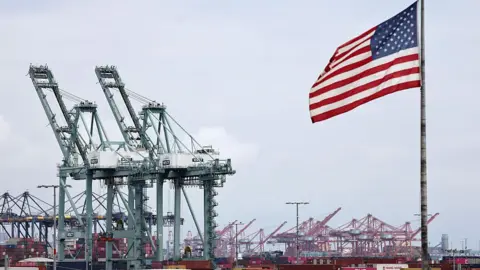
Court Ruling Declares IEEPA Tariffs Unlawful The 6‑3 Supreme Court decision on Feb 20 2026 held that the 1977 International Emergency Economic Powers Act does not authorize presidential tariff authority, instantly nullifying the global tariffs imposed by Donald Trump [1][2]. The ruling removes the legal basis for the duties that had raised import costs for U.S. businesses over the past year. Industry leaders hailed the judgment as a “major victory” while noting that the decision does not affect sector‑specific duties already in place [2].
Trump Announces Uniform 10% Tariff Using Alternate Statute Within hours of the court’s opinion, President Trump declared he would impose a 10 % tariff on all U.S. imports, citing a different statutory power that permits up to 15 % for 150 days [2][1]. He framed the move as a stronger tool to protect American interests after the court “left him more powerful.” The new tariff will coexist with existing steel, aluminum, and other targeted duties, which remain untouched [2].
Business Community Seeks Refunds and Cautious Optimism Small‑business owners such as Canadian toy importer Jenelle Peterson view the ruling as an opportunity to resume product development, though they warn that refund mechanisms for previously paid tariffs could be complex [1]. Major groups—including the National Retail Federation, Small Business Majority, and the U.S. Chamber of Commerce—called for swift reimbursement and warned that non‑IEEPA tariffs might still harm trade [1][2]. Executives emphasized the need for clear guidance from lower courts to avoid further disruption.
Economic Impact Remains Significant Despite Rate Drop Analysts estimate the effective average tariff rate will fall to 9.1 % from 16.9 %, still the highest level since 1946, leaving consumers and firms facing elevated costs [1][2]. EY‑Parthenon projects a $140 billion loss in tariff revenue for the Treasury [2]. The S&P 500 rose 0.7 % and the Nasdaq 0.9 % on the news, but experts caution that market gains may be short‑lived pending the implementation of refunds and any new tariff measures [1].
Sources
-
1.
BBC: Supreme Court Strikes Down Trump’s Global Tariffs, Business Leaders React Cautiously – Details the court’s nullification of IEEPA tariffs, small‑business concerns, industry group reactions, and modest stock market response .
-
2.
The Hindu: Trump Promises 10% Global Tariff After Supreme Court Blocks His Emergency‑Power Tariffs – Highlights the 6‑3 ruling, Trump’s announcement of a uniform 10 % tariff, unchanged sector‑specific duties, projected revenue loss, and international reactions .
Related Tickers
Timeline
2025 – President Trump imposes sweeping global tariffs under the International Emergency Economic Powers Act, burdening importers and causing a 25 % profit hit for small‑business owners such as Canadian‑based toy importer Jenelle Peterson, who pauses new designs ([1]).
2025 – The average effective U.S. tariff rate climbs to about 16.9 %, the highest level since 1946, intensifying cost pressures on consumers and firms ([2]).
Feb 20, 2026 – The Supreme Court issues a 6‑3 decision that IEEPA does not authorize presidential tariff authority, nullifying Trump’s global tariff scheme and removing the primary legal basis for the levies ([1][2]).
Feb 20, 2026 – President Trump announces he will impose a uniform 10 % tariff on all U.S. imports, citing the Court’s ruling as making him “more powerful” to protect the country, and signals a possible executive order that could raise the rate to 15 % for up to 150 days under a different statute ([2]).
Feb 20, 2026 – Industry leaders from the National Retail Federation, US Chamber of Commerce, Learning Resources and Small Business Majority call the Court’s ruling a “major victory,” urge swift refunds for importers, and warn that non‑IEEPA tariffs could still harm businesses ([1][2]).
Feb 20, 2026 – Small‑business owner Jenelle Peterson says the decision could let her increase imports and resume product development after the prior 25 % profit loss, though she remains wary of lingering uncertainties ([1]).
Feb 20, 2026 – The S&P 500 rises 0.7 % and the Nasdaq gains about 0.9 % on Friday, reflecting modest market optimism that may be short‑lived pending refund implementation and any new tariff actions ([1]).
Feb 20, 2026 – EY‑Parthenon estimates the U.S. could lose roughly $140 billion in tariff revenue, while Yale’s Budget Lab projects the average effective tariff rate falling to 9.1 % from 16.9 %, still the highest since 1946 ([2]).
Feb 20, 2026 – The European Union, Britain and Canada announce they will study the ruling’s impact on trade talks, and California Governor Gavin Newsom demands immediate refunds with interest for “unlawfully taken” dollars ([2]).
Summer 2026 – Negotiations to update the United States‑Mexico‑Canada Agreement (USMCA) loom, with the high effective tariff rate and pending refund processes shaping the talks ([1]).
Future (post‑Feb 2026) – Trump plans to sign an executive order implementing the 10 % global tariff under the alternative statutory authority, potentially extending to 15 % for 150 days, while companies brace for a complex claims system to recover tariffs already paid ([1]).