Bank of England Keeps Rate at 3.75% After Narrow Vote
Updated (4 articles)

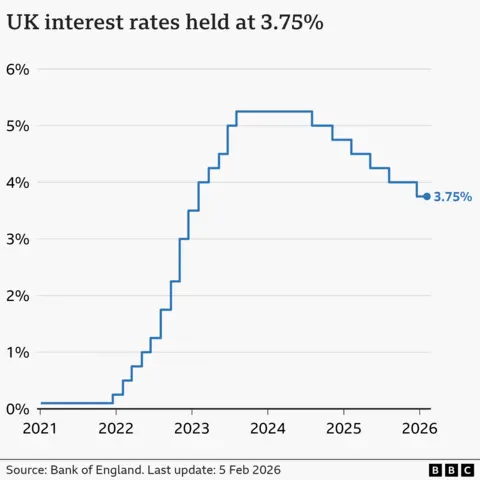

Five‑to‑Four Vote Leaves Rate Unchanged The Monetary Policy Committee voted 5‑4 to keep the Bank Rate at 3.75% on 5 February 2026, rejecting market expectations of a cut [1]. The decision reflects a split among members over the balance between inflation risks and slowing growth [1]. The announcement came after a brief period of heightened speculation about a possible rate reduction in March or April [1].
Governor Bailey Signals Possible Rate Reductions Governor Andrew Bailey told reporters that “some further reduction” is likely later in the year, citing expectations that CPI will fall to the 2% target by “some point in the Spring” [1]. He emphasized that rates will not return to the pandemic‑low levels that prevailed in 2020‑21 [1]. Bailey’s comments aim to reassure markets while maintaining policy flexibility [1].
Bank Revises Growth and Unemployment Projections The BoE lowered its 2026 GDP growth forecast from 1.2% to 0.9%, indicating weaker economic momentum [1]. Unemployment expectations were raised from 5.0% to 5.3%, reflecting a modest rise in joblessness [1]. These revisions underscore the central bank’s concern about a decelerating recovery [1].
Analysts Adjust Expectations for First Cut Capital Economics’ Paul Dales now expects the first rate cut to occur at the late‑April meeting, though a March cut remains a possibility [1]. Quilter’s Lindsay James noted that market pricing for the initial cut shifted from June to April after the decision [1]. Analysts stress that the timing will depend on inflation data and labour market trends [1].
Borrowers and Savers React to Holding Rate HGV driver Bart Ambrozik said the timing feels “perfect” for buying a home despite high mortgage rates, indicating some demand persists [1]. Meanwhile, more than two‑thirds of savings providers have reduced rates since the start of the year, hurting savers’ returns [1]. The mixed reactions highlight divergent impacts across the credit market [1].
Bailey Responds to Mandelson‑Epstein Allegations At the press conference, Bailey expressed shock over claims that former Business Secretary Lord Mandelson passed market‑sensitive information to Jeffrey Epstein while in cabinet [1]. He referenced a legal case in which he testified, underscoring the seriousness of the allegations [1]. The comment added an unexpected political dimension to the monetary policy briefing [1].
Timeline
Dec 17, 2025 – The Bank of England lowers its policy rate from 4 % to 3.75 % in a knife‑edge 5‑4 vote, the lowest level in almost three years, as rising unemployment and weak growth prompt the move; inflation eases to 3.2 % in the year to November and the Budget delivers a £150 energy‑bill cut plus freezes on fuel duty, prescriptions and rail fares[4].
Dec 18, 2025 – Governor Andrew Bailey acts as the swing voter in a narrow rate‑cut decision, declaring that the UK has passed the peak of inflation and that the 2 % target could be reached by April, while citing Budget measures, high household savings and a drag on spending; Deputy Governor Clare Lombardelli adds that energy‑price cuts and rail‑fare freezes will further tame inflation, and Opposition Leader Kemi Badenoch condemns the cuts as “CPR” for a faltering economy[3].
Jan 2026 – Private‑sector wage growth slows to 4.5 % in the Sep‑Nov quarter, the weakest in five years, while public‑sector pay climbs 7.9 %; payrolls drop by 135,000 jobs, unemployment sits at 5.1 %, and inflation remains at 3.2 % in November; the Bank of England has already cut rates several times since 2024, National Insurance contributions rise to 15 %, the minimum wage is set to increase again in April, and the WorkWell scheme expands to a three‑year program supporting disabled workers[2].
Feb 5, 2026 – The Monetary Policy Committee votes 5‑4 to keep the Bank of England’s rate at 3.75 % amid a split view, while Governor Bailey signals that “some further reduction” is likely later in the year as CPI is expected to hit the 2 % target by spring; the Bank trims its 2026 GDP growth forecast to 0.9 % and nudges unemployment up to 5.3 %, and analysts now price the next cut for late April (or possibly March); borrowers express mixed reactions and Bailey expresses shock at allegations linking Lord Mandelson to Jeffrey Epstein[1].