FedEx Sues for Full Refund After Supreme Court Nullifies Trump Emergency Tariffs
Updated (19 articles)
-
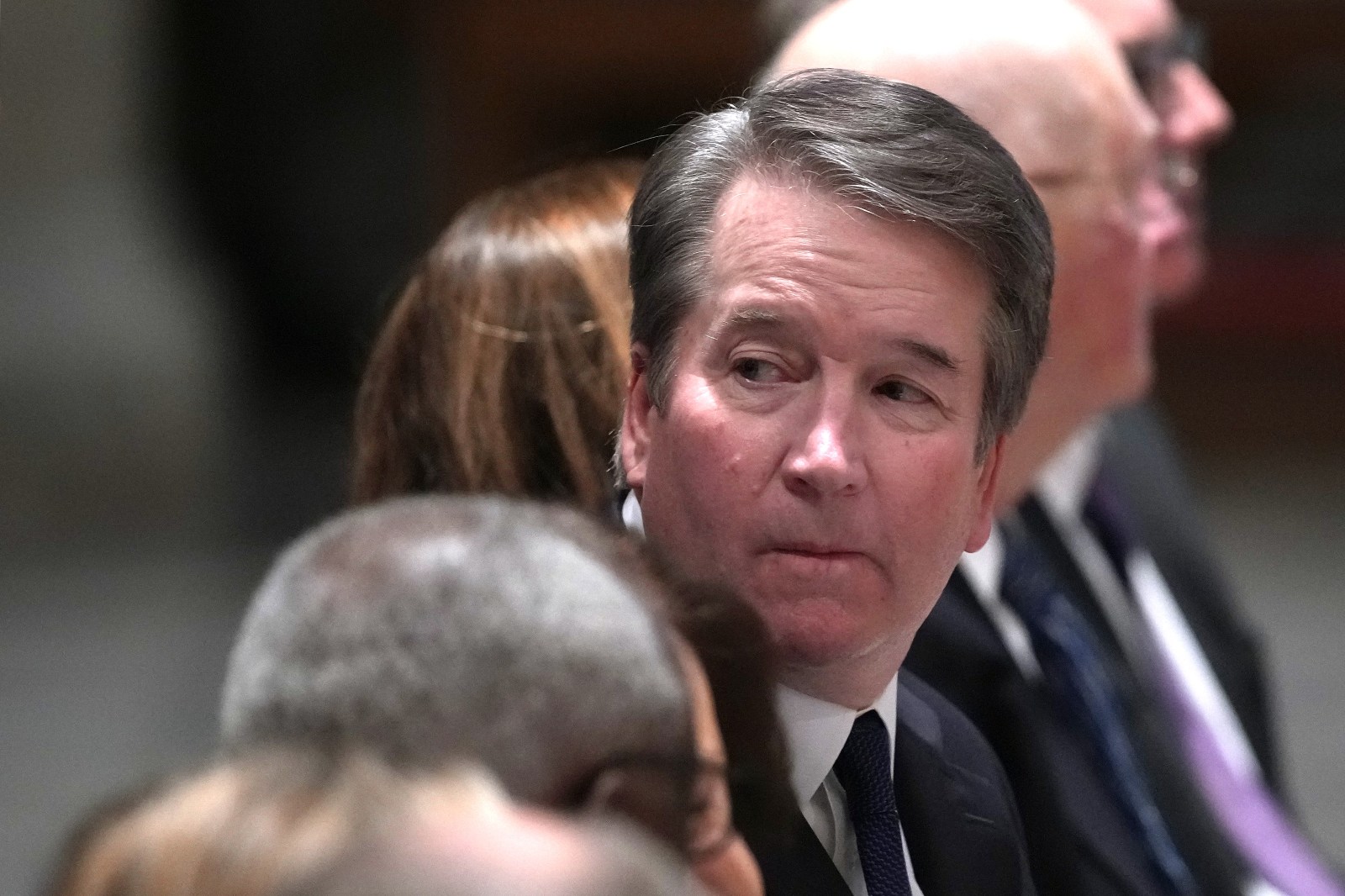 Image: NewsweekWASHINGTON, DC – NOVEMBER 20: U.S. Supreme Court Justice Brett Kavanaugh attends the funeral service of former Vice President Dick Cheney at the National Cathedral on November 20, 2025 in Washington, DC. Cheney, who served as the 46th Vice President under President George W. Bush and as the 17th Secretary of Defense, passed away at the age of 84 due to complications from pneumonia and vascular disease. (Photo by Andrew Harnik/Getty Images) Source Full size
 -
Image: NewsweekWASHINGTON, DC – NOVEMBER 20: U.S. Supreme Court Justice Brett Kavanaugh attends the funeral service of former Vice President Dick Cheney at the National Cathedral on November 20, 2025 in Washington, DC. Cheney, who served as the 46th Vice President under President George W. Bush and as the 17th Secretary of Defense, passed away at the age of 84 due to complications from pneumonia and vascular disease. (Photo by Andrew Harnik/Getty Images) Source Full size

Supreme Court Declares IEEPA Tariffs Unconstitutional The high court issued a 6‑3 decision on Feb. 21, 2026, holding that the 1977 International Emergency Economic Powers Act does not grant the president authority to levy import taxes, thereby striking down the sweeping emergency tariffs imposed by former President Trump [5][6][8][9]. The ruling invalidated duties that had generated roughly $133 billion in additional federal revenue, with analysts estimating the total at about $130 billion [1][9]. The Court’s opinion, authored by Chief Justice John Roberts, also ordered that the tariffs cease after midnight EST on Tuesday, Feb. 24 [2][3].
Trump Announces New Global Tariff and Criticizes Justices President Trump responded by labeling the six dissenting justices “absolutely ashamed,” “disloyal to our Constitution,” and “lapdogs,” while pledging to impose a worldwide tariff of 15 %—up from the 10 % he mentioned immediately after the ruling [2][3][5][7]. Within hours he signed a proclamation invoking a different trade statute to apply a 10 % tariff for 150 days and hinted at further restrictions on “unfair” trading partners [5][7]. His statements framed the court loss as a temporary setback and signaled an intent to continue aggressive trade measures despite the decision [2][5].
Senate Democrats Introduce $175 Billion Refund Bill On Feb. 23, Senators Ron Wyden, Ed Markey and Jeanne Shaheen unveiled legislation requiring U.S. Customs and Border Protection to return roughly $175 billion in tariff collections, plus interest, within 180 days and to prioritize refunds for small‑business importers [2][3][4]. The bill also directs larger importers to pass recovered funds on to customers and mandates interest payments to mitigate financial harm [4]. Although Democrats present the proposal as a “crucial first step” before the November midterms, analysts note the measure faces slim odds of passage in the closely divided Senate [4].
FedEx Files Lawsuit Seeking Complete Refund FedEx lodged a complaint in the U.S. Court of International Trade on Feb. 24, naming U.S. Customs and Border Protection and its commissioner Rodney S. Scott as defendants and demanding a full refund of all duties paid under the invalidated IEEPA tariffs [1][2][3]. The company did not disclose the monetary amount sought but said the action protects its rights as importer of record [1]. FedEx’s filing joins earlier suits by Revlon, Alcoa, Bumble Bee and Costco, all aiming to secure priority in any future reimbursement process [1].
Justice Kavanaugh Warns Refund Process Could Spark Chaos In a dissent joined by Justices Thomas and Alito, Justice Brett Kavanaugh warned that returning the billions collected would create a “mess” for the Treasury and could destabilize existing trade agreements [8][9]. Treasury Secretary Scott Bessent later said the government has the funds but doubts that refunds will reach consumers, describing the effort as a “corporate boondoggle” [8][4]. Trade lawyers anticipate a protracted, 12‑ to 18‑month refund timeline involving multiple agencies, with individual importers required to sue separately in the Court of International Trade [6][8].
Sources
-
1.
BBC: FedEx suits U.S. government for full refund of Trump‑imposed tariffs – Details FedEx’s lawsuit, the Supreme Court’s IEEPA ruling, and other firms’ legal actions, noting $130 billion in tariff revenue .
-
2.
WBNS (Columbus, OH): FedEx sues for refund after Supreme Court nullifies Trump tariffs – Highlights FedEx’s filing, CBP as defendant, Senate Democrats’ $175 billion refund bill, and Trump’s threat of a 15 % global tariff .
-
3.
King5 (Seattle, WA): FedEx sues for refund after Supreme Court voids Trump’s emergency tariffs – Mirrors WBNS coverage, emphasizing the 6‑3 decision, Trump’s condemnation, and the undisclosed refund amount .
-
4.
AP (Feb 23): Senate Democrats Push Bill to Refund $175 Billion in Trump Tariff Revenues – Focuses on the Democratic refund legislation, its small‑business priority, and political context .
-
5.
AP (Feb 21): Supreme Court Nullifies Trump Tariffs, Businesses Brace for Ongoing Uncertainty – Reports the Court’s ruling, Trump’s 10 % tariff plan, industry reactions, and unchanged duties on steel and furniture .
-
6.
AP (Feb 21): Supreme Court Overturns Trump’s $133 Billion IEEPA Tariffs, Refunds Loom – Provides the $133 billion collection figure, expected 12‑18‑month refund timeline, and state officials’ demands for resident compensation .
-
7.
CNN: Small importer’s lawsuit topples Trump’s emergency tariffs – Chronicles Victor Schwartz’s lead plaintiff role, the $134 billion refund potential, and Trump’s push for a new 10 % global tariff .
-
8.
CNN: Supreme Court Ruling Triggers $134 Billion Tariff Refund Quest – Describes the massive refund demand, Treasury’s vague process, Kavanaugh’s warning, and the likely multi‑year litigation .
-
9.
Newsweek: Kavanaugh warns Supreme Court tariff ruling could spark economic chaos – Highlights the dissent’s concern over Treasury strain, $133 billion collected, and the administration’s plan to use alternative legal bases for future tariffs .
Timeline
2025 (earlier) – Two federal appellate courts rule that President Trump lacks authority to impose sweeping import duties under the International Emergency Economic Powers Act, setting the legal foundation for challenges to the tariffs [2].
Apr 14, 2025 – Victor Schwartz of VOS Selections becomes lead plaintiff in VOS Selections, Inc. v. Trump, a lawsuit that later consolidates with suits from 12 states and Learning Resources, targeting the emergency tariffs [4].
Nov 5, 2025 – The Supreme Court hears oral arguments on whether the president may use IEEPA to levy global tariffs, with several justices questioning the breadth of the emergency‑power claim [7].
Dec 1, 2025 – Costco files a complaint in the U.S. Court of International Trade seeking a full refund of duties paid under Trump’s tariffs, arguing the levies are unlawful and that the company must secure a judgment before any Supreme Court decision [10].
Dec 2, 2025 – Costco files a separate refund claim in Manhattan, warning that Customs’ liquidation deadline of Dec 15 could close the window for protest if the Supreme Court delays its ruling [7].
Jan 12, 2026 – Donald Trump posts on Truth Social that a Supreme Court loss would create a “complete mess,” saying refunds of the billions collected would be “almost impossible” to pay [2][9].
Feb 20, 2026 – In a 6‑3 decision, the Supreme Court holds that IEEPA does not authorize presidential tariff power, striking down the emergency duties; Justice Brett Kavanaugh dissents, warning that the refund process could create “significant consequences” and destabilize trade agreements [8][5].
Feb 21, 2026 – The Court’s ruling triggers expectations of $134 billion in refunds for importers; President Trump immediately announces a new 10 % global tariff for 150 days and hints at further measures, while industry groups urge a narrower, security‑focused tariff regime [12][13][4].
Feb 23, 2026 – Senators Ron Wyden, Ed Markey and Jeanne Shaheen introduce legislation requiring Customs to return roughly $175 billion in tariff revenues with interest within 180 days, prioritizing small‑business claimants [11].
Feb 24, 2026 – FedEx files a lawsuit in the U.S. Court of International Trade demanding a full refund of all IEEPA duties, stating it has “taken necessary action to protect the company’s rights as an importer of record to seek duty refunds” [15][1].
Feb 24, 2026 – President Trump condemns the justices who voted against him as “absolutely ashamed” and “lapdogs,” and calls for a worldwide tariff of 15 % after the Court’s decision [15].
Feb 24, 2026 – U.S. Customs and Border Protection issues a bulletin confirming that the emergency tariffs cease after midnight EST Tuesday, ending IEEPA enforcement [15].
Future (2026‑2027) – Legal analysts project that refund processing will take 12‑18 months through Customs, the Court of International Trade and lower courts, while Treasury Secretary Scott Bessent says the Treasury can cover any refunds but doubts consumers will see the money [13][5].
Dive deeper (12 sub-stories)
-
FedEx Sues for Full Refund After Supreme Court Nullifies Trump Emergency Tariffs
(3 articles)
-
AP: Senate Democrats Push Bill to Refund $175 Billion in Trump Tariff Revenues
-
AP: Supreme Court Nullifies Trump Tariffs, Businesses Brace for Ongoing Uncertainty
-
AP: Supreme Court Overturns Trump’s $133 Billion IEEPA Tariffs, Refunds Loom
-
CNN: Small importer’s lawsuit topples Trump’s emergency tariffs
-
CNN: Supreme Court Ruling Triggers $134 Billion Tariff Refund Quest
-
Newsweek: Kavanaugh warns Supreme Court tariff ruling could spark economic chaos
-
BBC: Trump warns of 'complete mess' if Supreme Court rules against tariffs
-
Newsweek: Trump warns of chaos if Supreme Court strikes down tariff authority as refunds loom
-
Costco Files Federal Lawsuit Seeking Tariff Refunds as Supreme Court Review Looms
(2 articles)
-
Costco Files Trade Court Claim as Supreme Court Weighs Trump Tariff Authority
(5 articles)
-
WBNS (Columbus, OH): Costco Sues Trump Administration Over Tariffs, Seeks Refund
All related articles (19 articles)
-
BBC: FedEx suits U.S. government for full refund of Trump‑imposed tariffs
-
WBNS (Columbus, OH): FedEx sues for refund after Supreme Court nullifies Trump tariffs
-
King5 (Seattle, WA): FedEx sues for refund after Supreme Court voids Trump’s emergency tariffs
-
AP: Senate Democrats Push Bill to Refund $175 Billion in Trump Tariff Revenues
-
AP: Supreme Court Nullifies Trump Tariffs, Businesses Brace for Ongoing Uncertainty
-
AP: Supreme Court Overturns Trump’s $133 Billion IEEPA Tariffs, Refunds Loom
-
CNN: Small importer’s lawsuit topples Trump’s emergency tariffs
-
CNN: Supreme Court Ruling Triggers $134 Billion Tariff Refund Quest
-
Newsweek: Kavanaugh warns Supreme Court tariff ruling could spark economic chaos
-
BBC: Trump warns of 'complete mess' if Supreme Court rules against tariffs
-
Newsweek: Trump warns of chaos if Supreme Court strikes down tariff authority as refunds loom
-
CNN: Costco Sues Trump Administration Over Tariffs
-
AP: Costco Seeks Refunds for Trump Tariffs as Supreme Court Case Continues
-
King5 (Seattle, WA): Costco Files Refund Claim as Supreme Court Considers Trump Tariffs
-
CNN: Costco Sues U.S. Government Over Tariff Refunds Ahead of Supreme Court Decision
-
BBC: Costco Sues Trump Administration for Refund of Tariffs
-
WBNS (Columbus, OH): Costco Sues Trump Administration Over Tariffs, Seeks Refund
-
King5 (Seattle, WA): Costco Sues Trump Administration Over Tariff Refunds
-
Newsweek: Costco Sues U.S. Over Trump Tariffs, Seeks Refunds if Supreme Court Rules Against Administration
External resources (7 links)
- https://www.cbp.gov/newsroom/stats/trade (cited 1 times)
- https://storage.courtlistener.com/recap/gov.uscourts.cit.17331/gov.uscourts.cit.17331.2.0.pdf?mod=livecoverage_web (cited 2 times)
- https://www.foxnews.com/politics/fox-news-poll-voters-say-white-house-doing-more-harm-than-good-economy (cited 1 times)
- https://www.reuters.com/world/bessent-says-us-treasury-can-easily-cover-any-tariff-refunds-2026-01-10/ (cited 1 times)
- https://content.govdelivery.com/bulletins/gd/USDHSCBP-40b11c9 (cited 2 times)