Artemis II Targets Feb 8 Launch Amid Cold Florida Weather and New Astronaut Spotlight
Updated (8 articles)
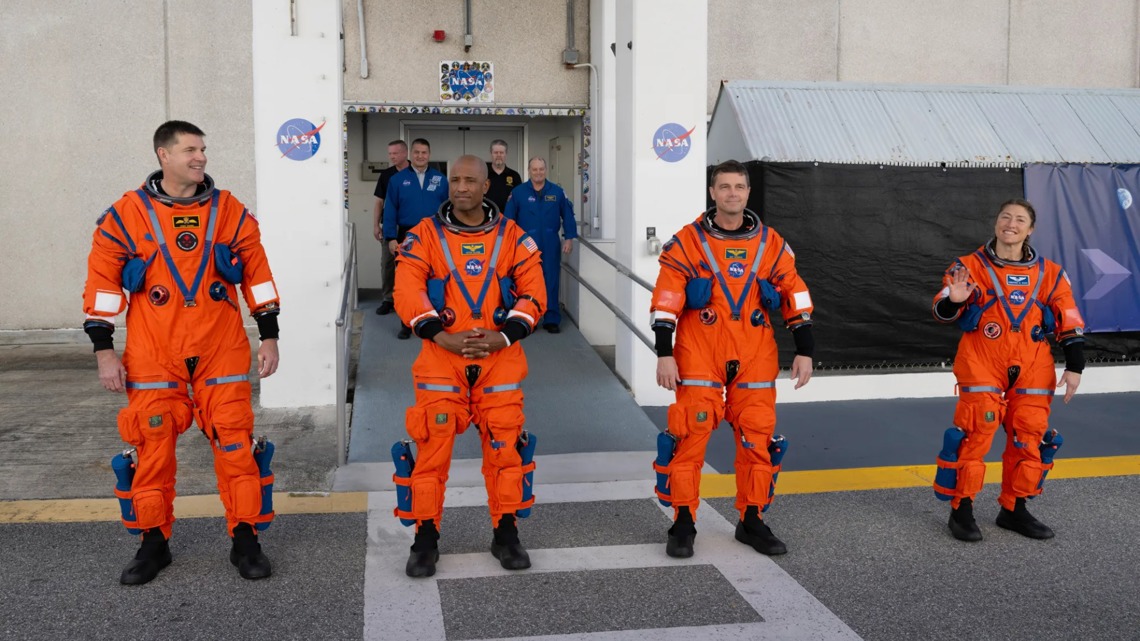
Launch Window and Crew Confirmation NASA has opened a launch window beginning Feb 8, 2026 for Artemis II, the first crewed lunar‑related launch in over five decades, with a flexible lift‑off date pending final safety checks [2][3]. The four‑person crew consists of Commander Reid Wiseman, Pilot Victor Glover, Mission Specialist Christina Koch, and Canadian astronaut Jeremy Hansen [2][3]. The mission is planned as a ten‑day deep‑space flight that will loop around the Moon without landing [2][3]. This crew composition marks the first international partnership on a U.S. lunar flyby since the Apollo era [3].
Mission Objectives and System Tests Artemis II will spend roughly two days near Earth checking Orion’s life‑support, air‑regeneration, and carbon‑dioxide removal systems before heading toward the Moon [2][3]. A targeting demonstration will be performed, and the spacecraft’s navigation and propulsion will be evaluated during the lunar flyby [2][3]. Acting associate administrator Lori Glaze describes the flight as a “key test” that validates hardware for future surface landings and paves the way toward a sustainable lunar presence and eventual crewed missions to Mars [2][3].
Potential Weather Delay and Countdown Preparations polar vortex is bringing unusually cold temperatures to Florida, raising concerns that cryogenic propellant loading (“tanking day”) and simulated countdowns could be postponed, as similar cold snaps delayed Shuttle launches in the past [1]. NASA officials will monitor the weather closely before proceeding with the final launch sequence [1]. The cold risk adds uncertainty to the already flexible launch window that began on Feb 8 [1].
New Majority‑Female Astronaut Class Highlight Dr Lauren Edgar, a Sammamish, Washington native with a Caltech PhD in planetary geology, was selected in 2025 for NASA’s first astronaut class where women form the majority [1]. She is undergoing a two‑year training program in Houston that includes flight training, ISS robotic‑arm operations, and geology drills to prepare for future Artemis missions [1]. Edgar emphasizes the complexity of the International Space Station’s interdependent systems as a key learning focus [1].
February Planetary Parade for Public Viewing Starting Feb 17, a planetary alignment will showcase Venus at sunset, followed by Jupiter, Saturn, Uranus, Neptune, and Mercury throughout the month [1]. Venus, Jupiter, and Saturn are visible to the naked eye, while Uranus and Neptune require binoculars or a telescope, with viewing improving as the planets climb higher later in February [1]. NASA solar‑system ambassador Keith Krumm encourages sky‑watchers to observe the “planetary parade” as a public outreach complement to the Artemis program [1].
Sources
-
1.
King5: February Sky Above: Planet Parade, Artemis II Launch, and a New NASA Astronaut: details the Feb 17 planetary alignment, Artemis II’s Feb 8 launch window and cold‑weather risks, and profiles Washington native Dr Lauren Edgar joining NASA’s first majority‑female astronaut class .
-
2.
WBNS: Artemis II Crewed Moon Flyby Set for Early February 2026: outlines the Feb 8 launch window, the four‑person crew, the ten‑day lunar flyby mission profile, and NASA’s framing of the flight as a stepping stone toward Mars .
-
3.
King5: Artemis II crewed lunar flyby set for early February 2026: repeats the launch window and crew details, emphasizes the ten‑day Orion and SLS test, highlights public engagement via the #Artemis hashtag, and underscores the mission’s historic return to deep‑space after a 50‑year hiatus .
Timeline
Dec 1972 – Apollo 17 lands the last humans on the Moon, ending the Apollo era and creating a half‑century gap that Artemis II seeks to close [2].
Sep 23, 2025 – NASA says Artemis II could launch as early as Feb 5, 2026, sending four astronauts on a ten‑day lunar flyby, and Open University expert Dr Simeon Barber warns “no earlier than mid‑2027 is optimistic” for a Moon landing [3].
Dec 31, 2025 – NASA confirms Artemis II remains on track for a Feb 6 launch, highlights health‑monitoring experiments, notes the heat‑shield issue from Artemis I is fixed, and frames the flight as a strategic step amid competition with China [5].
Jan 9, 2026 – NASA rolls the 98‑metre SLS and Orion from the Vehicle Assembly Building to Launch Pad 39B in a 12‑hour, 4‑mile crawl, beginning formal mission preparations and scheduling a wet‑dress rehearsal for late January [2].
Jan 17, 2026 – The rollout to Pad 39B marks the start of Artemis II’s mission phase; officials stress the flight will carry four astronauts around the Moon on a free‑return trajectory but will not attempt a landing [4].
Jan 18, 2026 – The SLS arrives at Pad 39B at 18:41; crew members watch the move, Airbus’s Sian Cleaver says “we basically can’t get to the Moon without it,” and mission‑management chair John Honeycutt stresses the team’s sole job is the safe return of the crew [1].
Jan 30, 2026 – NASA opens a launch window beginning Feb 8, 2026, pending safety checks and a “tanking day” cryogenic load; the four‑person crew (Wiseman, Glover, Koch, Hansen) will conduct a ten‑day Orion test flight with a two‑day Earth‑orbit checkout and a lunar flyby [6][8].
Feb 3, 2026 – NASA announces a planetary parade starting Feb 17, confirms Artemis II’s target launch of Feb 8, and Acting Associate Administrator Lori Glaze calls the mission a “key test flight” toward Moon landings and Mars, while Keith Krumm warns that a polar vortex could delay the launch [7][6].
2027 – 2028 – Artemis III plans a lunar south‑pole landing no earlier than 2027, with SpaceX’s Starship HLS slated for a 2028 touchdown, though NASA also evaluates alternative landers amid timeline uncertainties [2][4].
2028 and beyond – The Artemis program aims to establish a permanent lunar base as a stepping stone for crewed missions to Mars, positioning the United States against China’s growing lunar ambitions [7].
All related articles (8 articles)
-
King5 (Seattle, WA): February Sky Above: Planet Parade, Artemis II Launch, and a New NASA Astronaut
-
WBNS (Columbus, OH): Artemis II Crewed Moon Flyby Set for Early February 2026
-
King5 (Seattle, WA): Artemis II crewed lunar flyby set for early February 2026
-
BBC: Artemis II set for early February launch after SLS rollout
-
BBC: NASA’s SLS Rocket Reaches Launch Pad 39B for Artemis II
-
CNN: Artemis II will fly near the Moon with four astronauts but not land
-
CNN: Artemis II on track for first crewed lunar mission with February launch target
-
BBC: Artemis II aims for February crewed lunar flyby with four astronauts
External resources (9 links)
- https://www.nasa.gov/humans-in-space/astronauts/christina-koch/ (cited 2 times)
- https://www.nasa.gov/humans-in-space/astronauts/g-reid-wiseman/ (cited 2 times)
- https://www.nasa.gov/humans-in-space/astronauts/victor-j-glover/ (cited 2 times)
- https://www.nasa.gov/news-release/launch-your-name-around-moon-in-2026-on-nasas-artemis-ii-mission/ (cited 2 times)
- https://t.co/XWDUrrQxhd (cited 2 times)
- https://t.co/xHhp44Qzr4 (cited 2 times)
- https://twitter.com/hashtag/Artemis?src=hash&ref_src=twsrc%5Etfw (cited 2 times)
- https://bit.ly/4q4Vy1O (cited 2 times)
- https://www.asc-csa.gc.ca/eng/astronauts/canadian/active/bio-jeremy-hansen.asp (cited 2 times)