Knysna Declares Disaster as Water Levels Near Day Zero, Emergency Aid Arrives
Updated (2 articles)
State of Disaster Declared Amid Critical Shortage On 4 February 2026 the municipality announced a disaster declaration for Knysna, a Garden Route resort town of roughly 100,000 residents, warning that municipal supplies could reach “day zero” within weeks. The main Akkerkloof dam now holds only about twenty days of water, while leaking pipes waste an estimated 55 % of the drinkable supply [1].
Emergency Funding Targets Infrastructure Repairs Mayor Thando Matika secured a $1.25 million emergency grant from the national government to finance repairs to seven boreholes, a new desalination plant, a fresh borehole, water‑meter installations, and longer‑term projects such as recycling and a new dam [1]. Current restrictions limit consumption to 50 litres per person per day, aiming to stretch the dwindling reserves [1].
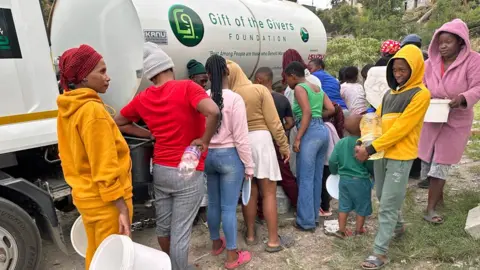
Community and NGOs Fill Immediate Gaps Gift of the Givers NGO delivers thousands of litres of tanker water daily from privately dug boreholes, coordinated by Mario Ferreira [1]. After a ten‑day municipal outage in October, retirement‑centre owner Franco de Grandis invested roughly 250,000 rand in three 10,000‑litre tanks and pressure pumps to provide a private backup supply [1].
Tourism Sector Calls for Calm While Experts Warn Broader Risks Elmay Bouwer of the Great Knysna Business Council urged residents and visitors to avoid panic‑inducing language, emphasizing the town’s reliance on tourism [1]. Water‑security campaigner Dr Ferial Adam linked Knysna’s crisis to the 2018 Cape Town “day zero” event and highlighted its relevance to national water‑security challenges [1].
Timeline
2016 – Past community‑led programs such as Jalabhagyam and Jala Jeevam install rainwater systems but “maintenance faded over time,” highlighting the need for sustained stewardship in urban water projects [2].
2018 – The Cape Town water crisis serves as a cautionary benchmark; Dr Ferial Adam later links Knysna’s risk to this historic shortage, underscoring national water‑security concerns [1].
2021 – Hyderabad’s water‑tanker trips sit at a baseline that later fuels a “238 % rise” by 2025, illustrating accelerating groundwater stress [2].
2024 – A surge in urban water demand prompts Hyderabad’s HMWS&SB to begin expanding its tanker fleet, setting the stage for a massive 2025 scale‑up [2].
April 2025 – Tanker deliveries peak at 2,90,180 trips, a 238 % increase since 2021, signaling urgent supply gaps that drive the city’s rain‑water harvesting push [2].
Oct 2025 – A municipal plant fault leaves Knysna without water for ten days; retirement‑centre owner Franco de Grandis spends roughly R250,000 on three 10,000‑litre tanks and pressure pumps to secure backup supply [1].
Late 2025 – An injection borewell at the Czech Colony complex “reduces daily reliance on water tankers,” marking a turning point for groundwater recharge in a dense urban area [2].
Late 2025 – Kavuri Hills builds a 16‑flat injection borewell with ₹20,000 resident funding, capable of harvesting about 509 m³ (5.09 lakh L) of rainwater annually, demonstrating community‑driven infrastructure [2].
Late 2025 – Hyderabad’s water board expands its tanker fleet to 1,150 units, supported by 90 filling stations and 150 filling points, to meet the “rapid uptick in bookings” while longer‑term harvesting structures scale [2].
Late 2025 – HMWS&SB launches a 100‑day action plan targeting 15,000 rain‑water‑harvesting pits across Greater Hyderabad and the Outer Ring Road, aiming to cut long‑term tanker dependence [2].
Feb 4, 2026 – Officials declare a state of disaster for Knysna as they warn that “day zero” could cut municipal water to 100,000 residents, threatening the tourism‑driven economy [1].
Feb 4, 2026 – Mayor Thando Matika secures $1.25 m in emergency aid and outlines repairs to seven boreholes, a desalination plant, a new dam, water‑meter installation and recycling projects, while imposing a 50 L per person per day restriction [1].
Feb 4, 2026 – NGO Gift of the Givers delivers daily tanker water from private boreholes; coordinator Mario Ferreira says residents are “grateful but fear the scarcity becomes accepted as normal” [1].
Feb 4, 2026 – Elmay Bouwer of the Great Knysna Business Council urges calm, warning against “panic‑inducing language,” while Dr Ferial Adam stresses that Knysna’s crisis reflects broader national water‑security challenges [1].
All related articles (2 articles)
External resources (4 links)
- http://bbcafrica.com/ (cited 1 times)
- https://twitter.com/BBCAfrica (cited 1 times)
- https://www.facebook.com/BBCnewsafrica/ (cited 1 times)
- https://www.instagram.com/bbcafrica/ (cited 1 times)