Partial U.S. Government Shutdown Enters Third Day as Senate Passes DHS Stopgap
Updated (2 articles)
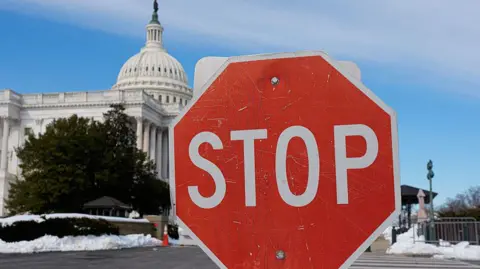
Shutdown timeline and scope The partial shutdown began when funding for federal agencies expired at midnight on Saturday, triggering furloughs and unpaid work for thousands of FAA and air‑traffic‑control staff. Senate leaders approved five spending bills covering Defense, Health, Treasury and courts through September 30, but omitted full‑year Department of Homeland Security (DHS) funding, leaving the government partially closed on Monday, the third day without a deal[1]. CNN notes the Senate passed the broader spending package hours before the Jan. 30 funding deadline, aiming to avoid a longer shutdown[2].
Senate passes two‑week DHS funding measure Senate Democrats and Republicans reached a bipartisan agreement on a two‑week stopgap for DHS, providing extra time to negotiate long‑term immigration‑enforcement provisions[1]. The stopgap includes “guardrails” that force the White House to follow congressional spending directives and satisfies Democratic demands for accountability measures after the Minneapolis federal‑agent killings[2]. Lindsey Graham objected to language in the DHS portion, delivering a floor speech criticizing the compromise[2].
House action required and political standoff The five‑bill package must survive a House rule vote before President Donald Trump can sign it, and Democrats are expected to oppose the DHS component while pushing for immigration reforms such as mandatory body‑cameras and stricter warrant requirements[1]. House Speaker Mike Johnson warned the bills could be passed by Tuesday, but a narrow Republican majority and a looming winter storm complicate attendance and voting logistics[1]. CNN emphasizes that the Senate’s move shifts shutdown pressure onto the House, which will not return to Washington until Monday[2].
Impact on workers and key programs The shutdown already forces thousands of federal employees into furlough or unpaid status and delays the Bureau of Labor Statistics’ monthly jobs report, affecting policymakers and investors[1]. The funding package maintains financing for the Pentagon, air‑traffic‑control, federal health research, NIH, Pell Grants, and a military pay raise, while trimming overall spending and cutting international aid after USAID’s closure[2]. Democrats link DHS aid to broader immigration‑policy changes, tying the funding dispute to recent fatal shootings during Operation Metro Surge in Minneapolis[1].
Sources
-
1.
BBC: Partial U.S. Government Shutdown Enters Third Day Amid DHS Funding Dispute – Details the third‑day shutdown, Senate’s five‑bill package lacking full‑year DHS funding, the two‑week DHS stopgap, Democratic immigration‑reform demands, and the House’s role before presidential signature.
-
2.
CNN: Senate Approves DHS Funding Stopgap, Shifting Shutdown Pressure to House – Describes the Senate’s approval of a two‑week DHS punt, the broader spending package through September, the Minneapolis killings’ influence, budget trims, “guardrails” for oversight, and Senator Lindsey Graham’s opposition.
Timeline
Jan 30, 2026 – Senate passes a two‑week DHS stopgap and a broader spending package that funds most agencies through September, averting an immediate shutdown; the measure adds “guardrails” that force the White House to follow congressional spending directives and preserves NIH and Pell Grant funding while cutting international aid after USAID’s closure [2].
Jan 30, 2026 – After two Minneapolis killings of U.S. citizens by federal agents earlier that month, Democrats leverage the incident to demand a DHS funding punt and immigration‑enforcement reforms, prompting President Donald Trump and Senate Republicans to quickly agree to the stopgap to avoid a shutdown [2].
Jan 30, 2026 – Sen. Lindsey Graham objects to DHS language allowing senators to sue the Justice Department over phone‑record seizures, delivering a floor speech and warning, “You jammed me, Speaker Johnson. I won’t forget this.” [2].
Feb 2, 2026 – A partial government shutdown enters its third day after midnight funding expiration; Senate’s five‑bill package funds Defense, Health, Treasury, courts and other agencies through Sept 30 but omits full‑year DHS funding, leaving many federal workers furloughed or unpaid [1].
Feb 2, 2026 – Senate’s two‑week DHS stopgap remains in place, giving lawmakers extra time to negotiate a long‑term DHS budget while the rest of the package awaits a House rule vote that Democrats are expected to oppose before it can reach President Trump for signature [1].
Feb 2, 2026 – Democrats tie immigration‑reform demands—mandatory body‑cameras, a ban on masks for agents, and stricter warrant requirements—to DHS aid, citing recent fatal shootings during Operation Metro Surge in Minneapolis as justification for the conditions [1].
Feb 2, 2026 – The shutdown delays the Bureau of Labor Statistics’ monthly jobs report and forces thousands of FAA and air‑traffic‑control staff into furlough or unpaid status, affecting policymakers, investors and the traveling public [1].
Feb 2, 2026 – President Trump posts on Truth Social urging Congress to “send a bill without delay,” while Rep. Ro Khanna calls on Democrats to reject DHS funding and House Speaker Mike Johnson predicts the bills could clear the House by Tuesday despite a winter storm and a one‑vote Republican majority [1].
Feb 2, 2026 – House leaders schedule a rule vote on the five‑bill package early in the week, with the expectation that passage will allow President Trump to sign the spending measures before the end of the month, ending the shutdown if successful [1].