Lloyd’s Register Grants In‑Principle Approval for Hybrid Nuclear‑Diesel Amphibious Vessels
Updated (3 articles)
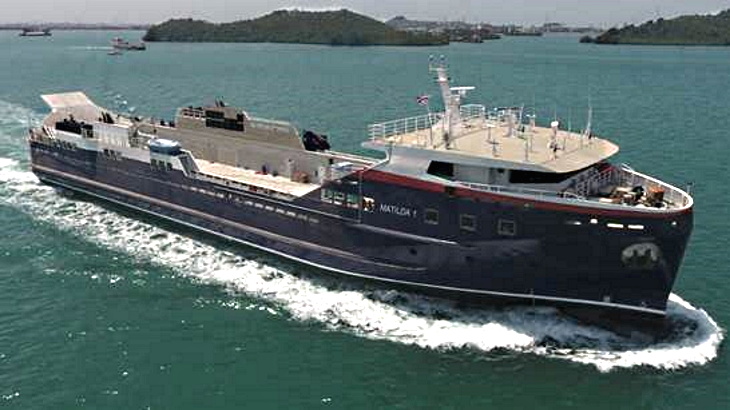
Lloyd’s Register Issues In‑Principle Approval for Hybrid Design On 26 February 2026, Lloyd’s Register granted an approval‑in‑principle (AiP) to Australian ship designer Seatransport Pty Ltd for a concept that couples licensed micro‑modular nuclear reactors (MMRs) with conventional diesel‑electric power on 73‑metre and 90‑metre amphibious stern landing vessels [1]. The AiP outlines a pathway toward full regulatory compliance but does not guarantee final certification, and Lloyd’s Register is coordinating with national authorities for eventual approval [1]. The approval marks a significant step toward integrating nuclear propulsion in non‑military maritime platforms.
Hybrid Layout Integrates 1.2‑2.6 MW Reactors with Diesel‑Electric Power The hybrid system incorporates MMRs ranging from 1.2 MW to 2.6 MW alongside proven diesel‑electric generators, aiming to reduce conventional fuel consumption and emissions while preserving vessel performance [1]. By providing effectively unlimited operational range, the design seeks to extend mission endurance and lower the carbon footprint of amphibious operations in challenging environments such as unprepared beaches [1]. The combination also offers flexibility to switch between power sources depending on mission requirements.
Sea Trials Validate Technical Assumptions on 73‑Metre Vessel A recently launched 73‑metre stern landing vessel completed sea trials that confirmed the technical assumptions underlying the MMR‑diesel hybrid concept [1]. Results demonstrated robust performance, low‑emission operation, and the ability to sustain prolonged missions without refuelling [1]. Lloyd’s Register highlighted the trials as strong assurance of practicality and robustness for future larger vessels.
Project Targets Decade‑Long Operation and Shore Power Supply Initiated in April 2025, the Seatransport‑Deployable Energy project aims to equip a 73‑metre amphibious vessel with two to five 1 MWe MMRs, enabling 8‑10 years of continuous operation without refuelling [1]. The vessel is also designed to supply power to shore grids during disaster‑relief missions, enhancing emergency response capabilities [1]. The roadmap anticipates broader adoption of the hybrid system in the early 2030s, contingent on final certification.
Related Tickers
Timeline
July 2023 – The International Maritime Organization adopts greenhouse‑gas reduction targets that require the global shipping sector, which emits about 3 % of CO₂ and burns roughly 350 million tonnes of fuel annually, to reach net‑zero emissions around 2050 [2][3].
April 2025 – Seatransport Pty Ltd and U.S. firm Deployable Energy begin a joint project to install two‑to‑five 1 MWe micro‑modular reactors (MMRs) on a 73‑metre amphibious landing vessel, aiming for 8‑10 years of continuous operation without refuelling and the ability to supply power to shore grids during disaster‑relief missions [1].
Oct 2025 – DNV publishes a white paper noting that stricter decarbonisation mandates are “reigniting interest” in nuclear ship propulsion, outlines the technical, safety and regulatory steps needed, and grants an Approval‑in‑Principle to HD KSOE for a 15,000‑TEU container ship powered by a small modular reactor with a supercritical CO₂ cycle [3].
Early 2026 – Sea trials of Seatransport’s newly launched 73‑metre stern landing vessel confirm the technical assumptions of the hybrid nuclear‑diesel layout, demonstrating that the micro‑modular reactors integrate reliably with diesel‑electric systems and validate the vessel’s unlimited‑range, low‑emission performance [1].
19 Jan 2026 – Lloyd’s Register launches a UK‑led Maritime Nuclear Consortium with Rolls‑Royce, Babcock International, Global Nuclear Security Partners, Stephenson Harwood and NorthStandard to develop the first international safety, security and commercial standards for nuclear‑powered ships; CEO Nick Brown says “advanced modular reactors… will deliver zero‑carbon ships and high‑skill jobs,” while Rolls‑Royce director Jake Thompson stresses that “multi‑sector collaboration is essential for the UK to lead the development of an international code” [2].
26 Feb 2026 – Lloyd’s Register issues an Approval‑in‑Principle for Seatransport’s hybrid nuclear‑diesel amphibious landing vessels (73‑metre and 90‑metre), confirming that licensed 1.2‑2.6 MW MMRs can be coupled with proven diesel‑electric power to provide effectively unlimited range, dramatically reduced fuel use and low‑emission operation in demanding environments; the AiP outlines a roadmap toward full certification but does not guarantee final approval [1].
Early 2030s (planned) – Lloyd’s Register and national authorities anticipate broader commercial adoption of hybrid nuclear‑diesel amphibious vessels, expecting the certification framework and regulatory pathways established by the UK consortium and other stakeholders to enable operational deployment of such ships worldwide [1][2].