Supreme Court Overturns Trump Tariffs as US Growth Slows and Trade Deficit Hits Record
Updated (6 articles)

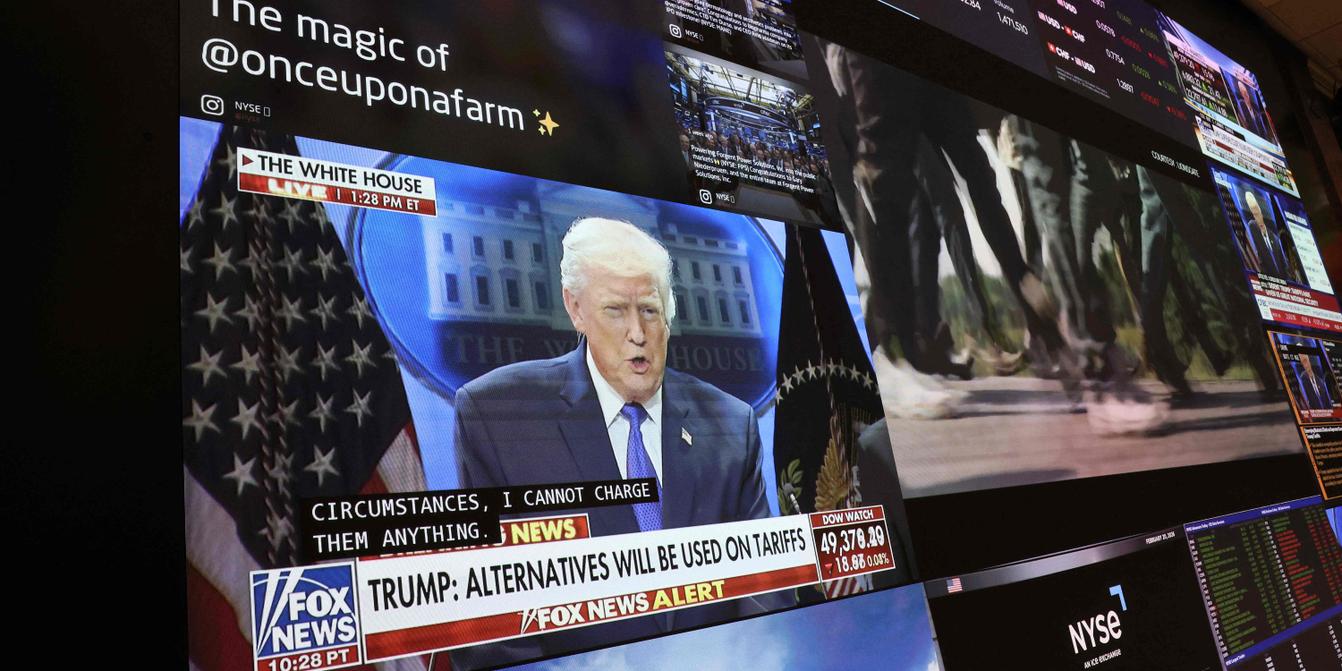


Supreme Court Nullifies Major Portion of Trump Tariffs The Supreme Court issued its decision on February 20‑21, 2026, invalidating a large portion of the tariff regime enacted under President Trump’s emergency‑law authority, hours after Commerce Department data hinted at negative growth effects. The ruling came just before the release of BEA’s Q4 2025 GDP figures and forced the administration to announce plans for a new set of tariffs under a different legal basis. Both Le Monde and CNN note the Court’s action as the most immediate policy shock to the trade agenda [1][2][3].
US Economic Growth Slows to Record Lows Real GDP grew at an annualized 1.4 % in the fourth quarter of 2025, far below the 5.4‑5.6 % Trump repeatedly claimed in speeches. Full‑year 2025 growth was 2.2 %, a decline from 2.8 % in 2024 and lower than every year of the Biden administration. The slowdown aligns with Commerce Department estimates that the October‑November 2025 shutdown trimmed growth by about one percentage point [1][2].
2025 Merchandise Trade Deficit Reaches Historic High The United States posted a merchandise trade deficit of $1.241 trillion in 2025, a 2.1 % increase over 2024 and the largest on record. Despite the tariff push, the overall deficit expanded, while the gap with China fell 32 % to $202 billion, making the European Union the biggest adverse balance at $219 billion. CNN’s data show the deficit fell only 0.2 % overall, contradicting Trump’s claim of a 78 % reduction [3][2].
Tariffs Reshape Import Sources and Consumer Costs Tariffs forced importers to shift sourcing from China to Taiwan, Vietnam and Mexico, especially for electronics and pharmaceuticals, reshaping global supply chains. Studies cited by CNN confirm that tariff costs are absorbed by U.S. importers and passed to consumers, not foreign exporters. Le Monde emphasizes that the policy failed to curb the deficit while altering trade geography [3][2].
Trump’s Political Narrative Contrasts Official Data Trump accuses Democrats of causing a two‑point GDP loss and points to a short‑term October 2025 dip to claim a 78 % trade‑deficit cut, a figure analysts label misleading. The Commerce Department attributes only a one‑point slowdown to the shutdown, and BEA data refute the high growth numbers Trump promoted. Both outlets report his pledge to introduce new tariffs despite the Court’s ruling [1][2].
Sources
-
1.
Le Monde: Trump’s Tariffs Linked to Slower US Growth – Analyzes Q4 2025 GDP 1.4 %, full‑year 2.2 % growth, Supreme Court decision, and Trump’s blame on Democrats for a one‑point slowdown.
-
2.
CNN: New Economic Data Undercut Trump’s Tariff and Growth Claims – Highlights BEA data showing 1.4 % Q4 growth, refutes Trump’s 78 % trade‑deficit claim, notes Court’s strike and Trump’s pledge for new tariffs.
-
3.
Le Monde: US Record Trade Deficit Persists in 2025 Despite Trump Tariffs – Reports $1.241 trillion merchandise deficit, 2.1 % rise, shift of imports to Taiwan, Vietnam, Mexico, and pending Court ruling.
Timeline
June 2022 – The U.S. Consumer Price Index spikes to a 9.1% year‑over‑year increase, marking the highest inflation rate since the early 1980s and setting the backdrop for later policy debates [3].
January 2025 – Inflation eases to 3% year‑over‑year, contradicting later claims that the Trump administration inherited “the worst inflation in history” [3].
October 2025 – A short‑term dip in the trade deficit creates a misleading 78% reduction figure that President Trump later posts on Truth Social, a number analysts warn is unsustainable [1].
Q1 2025 (Jan‑Mar) – Real GDP contracts, signaling the first quarterly slowdown of the year and foreshadowing a modest overall growth pace [4].
Q2 2025 (Apr‑Jun) – Real GDP rebounds with a 3.8% annualized gain, providing a brief surge amid mixed economic signals [4].
Q3 2025 (Jul‑Sep) – Real GDP expands further to a 4.4% annualized rate, the strongest quarterly performance since 2022 [4].
Full‑year 2025 – The economy grows by 2.2% annually, below the 2.8% growth recorded in 2024 and trailing every year of the Biden administration [1][6].
2025 (full year) – The United States posts a historic merchandise trade deficit of $1.241 trillion, a 2.1% rise from 2024, despite tariff hikes aimed at shrinking the gap [5].
Jan‑Nov 2025 – The trade deficit reaches $840 billion YTD, up 4% from the same period in 2024, reflecting persistent import pressures [4].
2025 – Tariff revenue jumps by roughly 200%, with the Treasury collecting $187 billion more than in 2024, underscoring the fiscal impact of the tariff regime [2].
2025 – A Harvard study finds tariffs add about 0.75 percentage point to inflation and that U.S. consumers bear roughly 43% of the tariff‑induced cost, challenging the administration’s narrative that foreign producers shoulder the burden [4].
2025 – Goldman Sachs estimates tariffs lifted inflation by 0.5 percentage point, with an additional 0.3 point projected for the first half of 2026 [2].
2025 – The S&P 500 climbs 17% for the year, yet foreign markets outpace the U.S., with South Korea up 71% and Japan up 26%, highlighting relative underperformance [4].
2025 – The U.S. trade gap with China narrows 32% to $202 billion, while the deficit with the European Union widens to $219 billion, shifting the primary source of the shortfall to Europe [5].
2025 – Import volumes from Taiwan, Vietnam, and Mexico surge as firms re‑route supply chains away from China, reshaping global trade geography [5].
December 2025 – At a cabinet meeting, President Trump blames President Biden for an “affordability crisis,” claiming he inherited the worst inflation ever even though CPI had already fallen to 3% [3].
Early January 2026 – A pending Supreme Court case threatens to invalidate many of Trump’s emergency‑law tariffs, with a decision expected in the coming weeks that could trigger refunds for businesses [2].
Early January 2026 – Tariff consultants warn that pass‑through to consumers may rise in 2026, with businesses’ share of the tariff bill potentially dropping from about 80% to roughly 20% as costs shift downstream [2].
Early January 2026 – The White House pauses or rolls back tariffs on produce, furniture, cabinets, and pasta in response to growing affordability concerns for households [2].
February 20, 2026 – The Supreme Court strikes down a large portion of the Trump administration’s tariff regime, declaring many emergency‑law levies illegal [1][6].
February 20, 2026 – President Trump announces he will replace the voided measures with new tariffs under a different legal authority, signaling a continued protectionist push [1].
February 21, 2026 – Trump accuses Democrats of costing the economy two percentage points of growth, citing the October‑November 2025 budget shutdown as a major drag [6].
February 21, 2026 – The Commerce Department estimates the shutdown cut Q4 2025 growth by roughly one percentage point, tempering Trump’s two‑point claim [6].
February 21, 2026 – Trump touts his tariffs as an “economic miracle,” citing a cherry‑picked 1.4% core‑inflation figure while data show core inflation at 2.6% for the latter half of 2025 and overall inflation near 3% [4].
First half 2026 (forecast) – Goldman Sachs projects tariffs will add another 0.3 percentage point to inflation, extending the price‑pressure effect into mid‑year [2].
2026 (ongoing) – Analysts expect the share of tariff costs borne by businesses to fall to about 20%, with consumers shouldering the majority of the burden as firms increase price pass‑through [2].
All related articles (6 articles)
-
Le Monde: Trump’s Tariffs Linked to Slower US Growth
-
CNN: New Economic Data Undercut Trump’s Tariff and Growth Claims
-
Le Monde: US Record Trade Deficit Persists in 2025 Despite Trump Tariffs
-
AP: Trump’s Tariff Claims Clash With Economic Data
-
CNN: Tariffs could sting in 2026 as prices rise and court ruling looms
-
CNN: Trump Blames Biden for Affordability Crisis, Inflation Now Slowing
External resources (17 links)
- https://www.bea.gov/news/2026/gdp-advance-estimate-4th-quarter-and-year-2025 (cited 1 times)
- https://www.bea.gov/sites/default/files/2026-02/trad1225.pdf (cited 1 times)
- https://www.whitehouse.gov/investments/ (cited 1 times)
- https://fred.stlouisfed.org/series/GDPC1 (cited 1 times)
- https://www.bu.edu/articles/2025/trade-deficit-is-a-sign-of-americas-strength/ (cited 1 times)
- https://www.cnbc.com/2026/01/29/trade-balance-soared-94percent-in-november-and-was-higher-than-a-year-ago-despite-tariff-efforts.html (cited 1 times)
- https://truthsocial.com/@realDonaldTrump/posts/116094375393499963 (cited 1 times)
- https://x.com/bencasselman/status/2016925206074327306 (cited 1 times)
- https://www.atlantafed.org/research-and-data/data/gdpnow/current-and-past-gdpnow-commentaries (cited 2 times)
- https://www.pricinglab.org/files/TrackingTariffs_Cavallo_Llamas_Vazquez.pdf (cited 2 times)
- https://rollcall.com/factbase/trump/transcript/donald-trump-interview-msnbc-chris-matthews-hardball-november-18-1999/#161 (cited 1 times)
- https://rollcall.com/factbase/trump/transcript/donald-trump-remarks-cabinet-meeting-january-29-2026/#14 (cited 1 times)
- https://rollcall.com/factbase/trump/transcript/donald-trump-remarks-unscheduled-economy-july-27-2018/#4 (cited 1 times)
- https://rollcall.com/factbase/trump/transcript/donald-trump-speech-economic-development-rome-georgia-february-19-2026/#33 (cited 1 times)
- https://rollcall.com/factbase/trump/transcript/donald-trump-speech-world-economic-forum-davos-january-21-2026/#149 (cited 1 times)
- https://www.cfr.org/articles/who-pays-trumps-tariffs (cited 1 times)
- https://www.kielinstitut.de/publications/news/americas-own-goal-americans-pay-almost-entirely-for-trumps-tariffs/ (cited 1 times)