March 3 2026 Total Lunar Eclipse Will Cast Blood‑Red Moon Over Pacific and North America
Updated (9 articles)
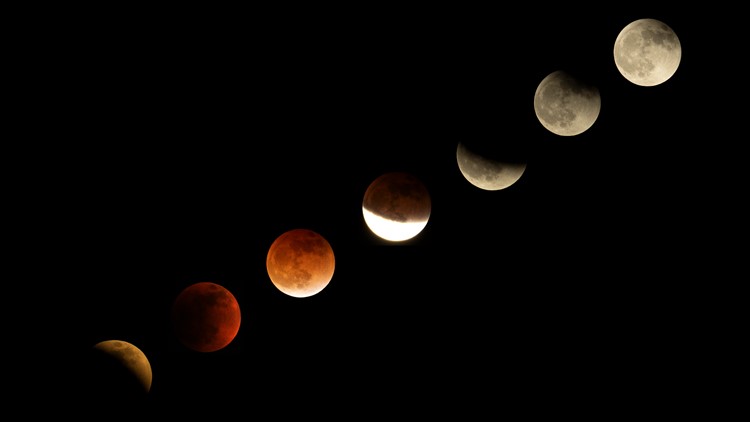
Exact Timing of the March 3 Lunar Eclipse The eclipse begins at 12:44 a.m. PST (3:44 a.m. EST, 8:44 UTC), reaches totality around 3:04 a.m. PST (6:04 a.m. EST, 11:04 UTC), and ends near 6:23 a.m. PST (9:23 a.m. EST, 14:23 UTC) with totality lasting about 59 minutes [1][2][3]. Newsweek provides the same phases in Eastern Time, noting penumbral dimming at 3:43 a.m. EST, partial at 4:49 a.m., totality from 6:03 a.m. to 7:02 a.m., and final penumbral exit at 9:23 a.m. EST [3]. All three outlets agree the event is safe to view without any special equipment.
Geographic Reach Includes Pacific, Asia, and Early‑Morning U.S. NASA data cited by WBNS and King5 state total visibility across eastern Asia, Australia, the Pacific Ocean, and early‑morning North and Central America [1][2]. Newsweek adds that western U.S. observers will see more of totality than eastern viewers, whose sunrise may truncate later phases [3]. Partial phases will be observable across much of Asia and South America, while Africa and Europe will miss the eclipse entirely [1][2][3].
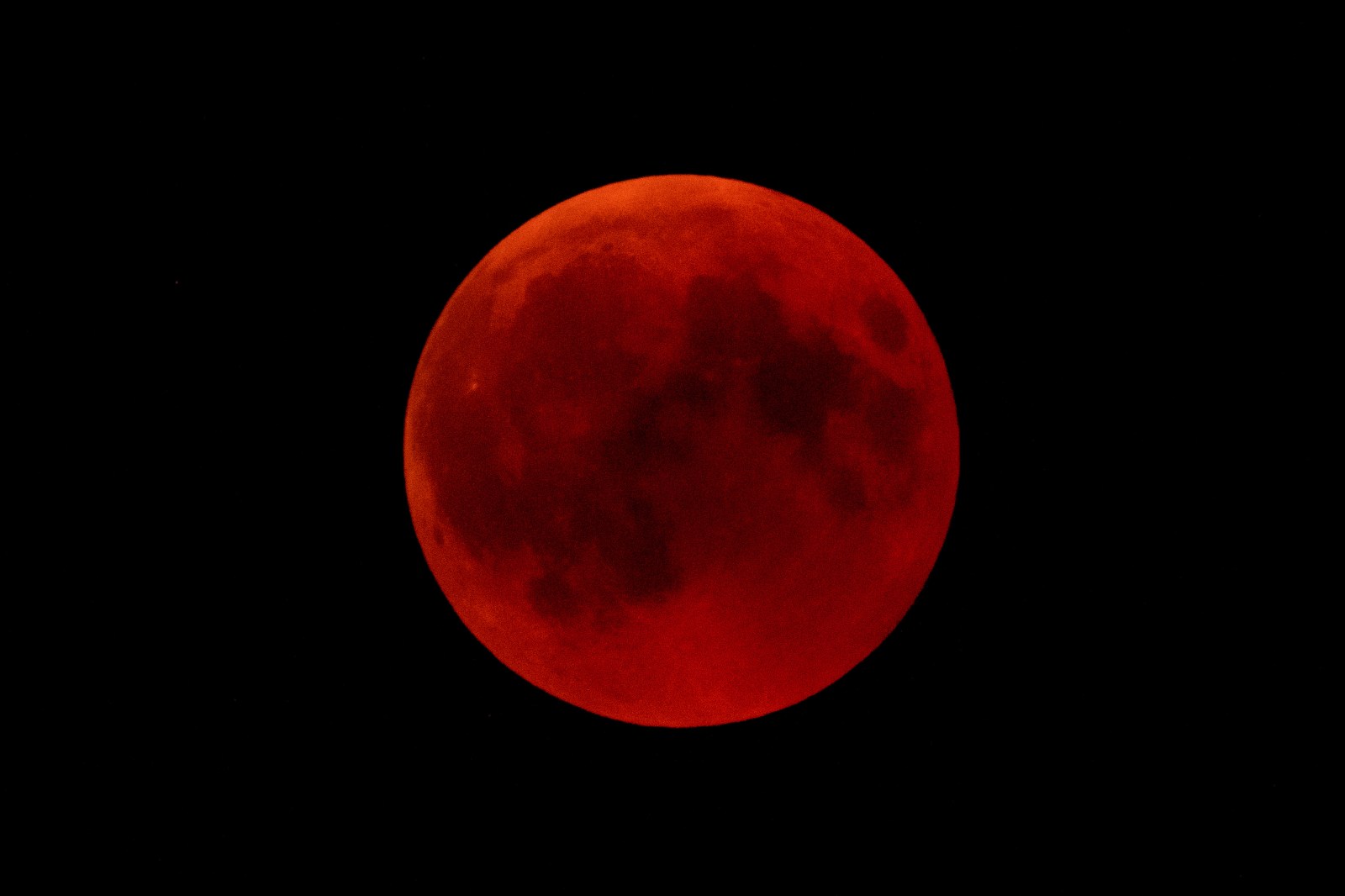
Atmospheric Scattering Produces the Characteristic Red Hue All sources explain that Earth’s atmosphere filters out short‑wavelength blue light, allowing longer red wavelengths to illuminate the Moon, creating the “blood‑moon” appearance [1][2][3]. King5 notes that dust or cloud cover can intensify the crimson color [2]. This Rayleigh scattering effect is described as projecting the world’s sunrises and sunsets onto the lunar surface [1][2].
Next Lunar Eclipses Not Until August 2026 and June 2029 NASA’s schedule, referenced by WBNS and King5, lists a partial lunar eclipse on August 27‑28 2026 and the next total lunar eclipse in June 2029 [1][2]. Newsweek echoes that the March 3 event may be the last strongly visible total lunar eclipse in the United States until 2029 [3].
Sources
-
1.
WBNS: March 3 Total Lunar Eclipse Turns Full Moon Red: reports precise start, totality, and end times, emphasizes safe naked‑eye viewing and notes next eclipses in August 2026 and June 2029.
-
2.
King5: March 3 2026 Total Lunar Eclipse Turns Full Moon Red: mirrors WBNS timing, adds that dust or clouds can deepen the red color, and repeats visibility zones and future eclipse schedule.
-
3.
Newsweek: March 3 2026 Total Lunar Eclipse Visible Across Much of U.S.: focuses on U.S. schedule in Eastern Standard Time, highlights western U.S. advantage, and calls it potentially last strongly visible U.S. total lunar eclipse until 2029.
Videos (1)
Timeline
Jan 2‑3, 2026 – The Quadrantids meteor shower peaks, delivering up to 120 meteors per hour under a full Moon, making it one of the year’s most intense brief showers [5][8].
Feb 17, 2026 – An annular “ring‑of‑fire” solar eclipse occurs, with the Moon near apogee so it leaves a bright 96 % solar rim; visibility is limited to western Antarctica, southern tips of South America, and parts of southern Africa [4][5].
Feb 17, 2026 – Lowell Observatory astronomer Joe Llama quips that “even the penguins will get the best view” as researchers in Antarctica witness the full annular phase [2].
Mar 3, 2026 – A total lunar eclipse turns the full Moon a deep red, with totality lasting 59 minutes from 6:04 a.m. EST; NASA describes the color as “all the world’s sunrises and sunsets projected onto the Moon” [1][3].
Apr 21‑22, 2026 – The Lyrid meteor shower peaks, producing fast fireballs and up to 15 meteors per hour; it is the oldest known shower, observed for more than 2,700 years [5].
May 5‑6, 2026 – The Eta Aquariids, debris from Halley’s Comet, reach their maximum, offering modest rates while the Moon is about 84 % full, which can brighten the sky [8].
Aug 12‑13, 2026 – The Perseids deliver 50‑100 meteors per hour under a new Moon, providing dark skies for one of the brightest annual showers [5][8].
Aug 12, 2026 – A total solar eclipse sweeps across Greenland, Iceland, Spain, Russia and a small part of Portugal, giving observers up to two minutes of totality; partial phases are visible across much of Europe, Africa and North America [5][4].
Oct 21‑22, 2026 – The Orionids, also from Halley’s Comet, peak with about 10‑20 meteors per hour while the Moon is ~80 % full, adding a faint glow to the night sky [8].
Nov 16‑17, 2026 – The Leonids produce roughly 15 meteors per hour; a “Beaver Moon” supermoon follows on Nov 24, appearing larger and brighter than usual [8].
Mid‑Dec 2026 – The Geminids reach up to 120 meteors per hour, with many observers seeing a greenish hue; NASA notes a meteor roughly every minute during the peak [5][8].
Dec 24, 2026 – The “Cold Moon” rises on Christmas Eve, described as a large and bright full Moon that caps the year’s celestial events [8].
Aug 2, 2027 – A total solar eclipse traverses North Africa, Europe and the Middle East, delivering a maximum totality of 6 min 23 s—the second‑longest of the 21st century—and drawing tourists to Luxor, Egypt for nearly 6.5 minutes of darkness [6][9].
Aug 2, 2027 (future) – The 2027 eclipse path will intersect the March 20, 2034 total solar eclipse track, an unusually short 7‑year interval compared with the typical 375‑year cycle [6][9].
All related articles (9 articles)
-
WBNS (Columbus, OH): March 3 Total Lunar Eclipse Turns Full Moon Red
-
King5 (Seattle, WA): March 3 2026 Total Lunar Eclipse Turns Full Moon Red
-
Newsweek: March 3, 2026 Total Lunar Eclipse Visible Across Much of U.S.
-
Newsweek: Ring of Fire Solar Eclipse Visible Only from Antarctica Today
-
WBNS (Columbus, OH): Annular Solar Eclipse on Feb 17 2026 Visible Only from Antarctica
-
WBNS (Columbus, OH): Quadrantids, eclipses and major meteor showers define 2026 skywatch calendar
-
King5 (Seattle, WA): Quadrantids launch 2026 skywatching year with eclipses to follow
-
WBNS (Columbus, OH): Aug 2, 2027 eclipse could be second-longest of the 21st century
-
King5 (Seattle, WA): Upcoming eclipse will be the longest for the next 100 years
External resources (24 links)
- https://www.youtube.com/watch?v=2XiuNsB-nBQ (cited 1 times)
- https://blogs.nasa.gov/Watch_the_Skies/2023/12/ (cited 4 times)
- https://science.nasa.gov/moon/eclipses/#h-upcoming-lunar-eclipses (cited 4 times)
- https://science.nasa.gov/solar-system/meteors-meteorites/eta-aquarids/ (cited 4 times)
- https://science.nasa.gov/solar-system/meteors-meteorites/leonids/ (cited 4 times)
- https://science.nasa.gov/solar-system/moon/what-you-need-to-know-about-the-march-2025-total-lunar-eclipse/#h-what-is-a-lunar-eclipse (cited 4 times)
- https://eclipse.gsfc.nasa.gov/SEgoogle/SEgoogle2021.html (cited 2 times)
- https://eclipse.gsfc.nasa.gov/SEplot/SEplot2001/SE2026Feb17A.GIF (cited 2 times)
- https://science.nasa.gov/eclipses/future-eclipses/ (cited 2 times)
- https://science.nasa.gov/solar-system/meteors-meteorites/geminids/ (cited 2 times)
- https://science.nasa.gov/solar-system/meteors-meteorites/quadrantids/ (cited 2 times)
- https://science.nasa.gov/solar-system/moon/march-2026-total-lunar-eclipse-your-questions-answered/ (cited 2 times)
- https://www.nasa.gov/goddard/ (cited 1 times)
- https://www.nesdis.noaa.gov/our-environment/optical-phenomena/solar-eclipse/total-solar-eclipse (cited 1 times)
- https://www.nesdis.noaa.gov/our-satellites/future-programs/space-weather-follow-program (cited 1 times)
- https://www.swpc.noaa.gov/products/coronagraph (cited 1 times)
- https://en.wikipedia.org/wiki/Solar_eclipse_of_February_17,_2026 (cited 2 times)
- https://en.wikipedia.org/wiki/Ring_of_Fire_(song) (cited 1 times)
- https://earthsky.org/astronomy-essentials/everything-you-need-to-know-lyrid-meteor-shower/ (cited 4 times)
- https://earthsky.org/astronomy-essentials/everything-you-need-to-know-perseid-meteor-shower/ (cited 2 times)
- https://www.amsmeteors.org/meteor-showers/meteor-shower-calendar/#Orionids (cited 2 times)
- https://www.timeanddate.com/eclipse/annular-solar-eclipse.html#:~:text=The%20name%20%E2%80%9Cannular%E2%80%9D%20comes%20from,called%20an%20annular%20solar%20eclipse. (cited 2 times)
- http://space.com/ (cited 1 times)
- https://phys.org/news/2026-02-solar-eclipse-dazzle-people-penguins.html (cited 1 times)