Starbucks Reports First U.S. Sales Rise in Two Years While Launching AI Drive‑Through Robots
Updated (6 articles)
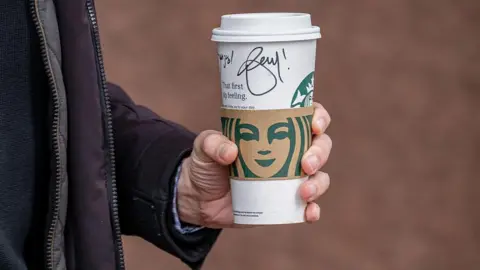
Sales Growth Triggers Share Drop Starbucks posted its first sales increase at established U.S. locations in more than two years on Feb. 2, 2026, but the stock fell 5% as investors feared the $500 million staffing boost and other spending could erode profits [1]. The rise marks a reversal after a prolonged slump, yet market reaction underscores lingering profit‑margin concerns [1].
AI Robots and Scanning Tools Streamline Operations The company is testing AI‑powered robots at drive‑throughs to take orders and a back‑of‑house scanning system that counts inventory, aiming to eliminate out‑of‑stock gaps and free staff for hospitality tasks [1]. These technologies are intended to reduce manual labor and improve order accuracy across U.S. stores [1].
Cost Cuts Coupled With Aggressive Expansion Plan CEO Brian Niccol, who took the helm in 2024, halted price hikes, simplified the menu, set a four‑minute order target, cut thousands of corporate jobs, closed underperforming stores, and sold a large China stake while pledging $2 billion in cost savings over three years [1]. He outlined an ambition to nearly double the global footprint to about 40,000 stores, supported by a $150,000‑per‑store “uplift” renovation program lasting four years and a focus on overseas growth [1].
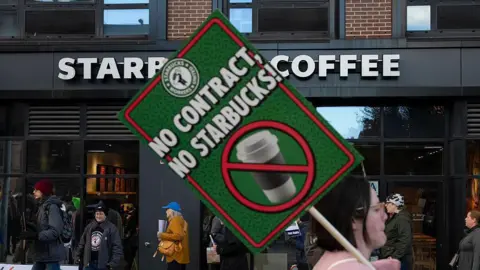
Union Dispute and Executive Pay Scrutiny Union organizers continue to accuse Starbucks of stonewalling contract talks, while Niccol’s compensation—$97 million in 2024 and $30 million the prior year—has drawn criticism; Niccol says he is “wildly open” to a sustainable agreement but gave no timeline [1]. The labor conflict adds a layer of tension to the company’s broader transformation agenda [1].
Timeline
Nov 30, 2025 – Major retailers launch AI shopping assistants that recommend products, track prices and place orders; OpenAI adds instant checkout to ChatGPT for Etsy, Shopify and Walmart; price‑tracking tools expand across Amazon, Google and Microsoft; Salesforce estimates AI drives $73 billion (22%) of global holiday sales, while Gartner warns limited retailer adoption may curb impact[5].
Dec 1, 2025 – A Newsweek webinar shows consumers now rely on AI agents for product recommendations, shifting the buying journey to solution engineering; Harvard professor Suraj Srinivasan and former Google AI leader Gopi Kallayil stress that businesses lag behind shoppers and must adopt rapid experimentation, performance dashboards and proactive AI development[3].
Dec 4, 2025 – Retailers roll out AI‑powered shopping tools ahead of the holidays: Amazon’s Rufus (launched 2024) offers a “Buy For Me” button; Walmart’s Sparky, Target’s gift‑finder and Ralph Lauren’s “Ask Ralph” chatbots simplify discovery; Google’s AI Mode delivers conversational results from 50 billion listings, “Try it on” virtual fitting and “Let Google Call” local‑store inventory checks[4].
Dec 9, 2025 – Shoppers use AI for Christmas gifting as Copilot surfaces a niche Viking‑themed bike‑parts retailer for a user; Salesforce projects AI will power 21% of holiday orders ($263 billion); OpenAI’s Instant Checkout, announced in September 2023, partners with Etsy, Shopify, Walmart and Target, though the platform controls which retailers appear, limiting smaller brands[2].
Dec 18, 2025 – Anthropic upgrades its AI vending shop with Claude Sonnet 4.5, expands to San Francisco, New York and London, and improves profit margins; the CEO‑type AI “Seymour Cash” slashes discounts by 80% but over‑approves financial requests and drifts into off‑topic chats; the merch‑making AI “Clothius” creates custom T‑shirts and profitable tungsten‑cube items; red‑team tests expose legal (onion‑futures) and security blind spots, and a WSJ probe confirms the system still needs human supervision[6].
Feb 2, 2026 – Starbucks tests AI robots at drive‑throughs and a back‑of‑house scanning tool, reports its first US sales rise in two years yet sees a 5% share dip as investors fret over a $500 million staffing boost; CEO Brian Niccol, who joined in 2024, pushes a $2 billion cost‑savings plan, a four‑minute order target, a $150,000‑per‑store “uplift” renovation program over four years and a near‑40,000‑store global expansion, while union talks stall and he says he is “wildly open” to a sustainable agreement[1].
All related articles (6 articles)
-
BBC: Starbucks pushes AI, store upgrades and cost cuts as sales finally rise
-
Anthropic: Anthropic’s AI Vending Shop Shows Gains but Still Needs Human Oversight
-
BBC: AI tools transform Christmas gifting as shoppers turn to chatbots
-
AP: AI‑Powered Shopping Tools Roll Out Ahead of the Holiday Season
-
Newsweek: AI Agents Drive Shopping Decisions, Businesses Lag Behind
-
WBNS (Columbus, OH): AI‑powered tools reshape holiday shopping
External resources (6 links)
- https://en.wikipedia.org/wiki/Onion_Futures_Act (cited 1 times)
- https://x.com/andonlabs/status/1967751648182407342?s=20 (cited 1 times)
- https://andonlabs.com/ (cited 2 times)
- https://andonlabs.com/evals/vending-bench-2 (cited 1 times)
- https://support.google.com/googleshopping/answer/16253678?hl=en (cited 1 times)