Pakistan Claims 145 Militants Killed After BLA’s Jan‑31 Assault, Blames India
Updated (3 articles)
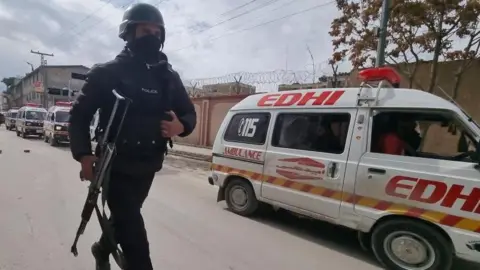
Coordinated Jan 30‑31 strikes devastate Balochistan On Jan 30‑31 insurgents attacked police stations, military outposts, a high‑security prison in Mastung and civilian sites across nine districts, killing dozens of civilians and security personnel and freeing over 30 inmates [1][2][3]. The Balochistan Liberation Army (BLA) released videos claiming the operation, named “Herof,” and asserted it killed 84 security forces and abducted 18 people [1][3]. Official Pakistani figures report 31 civilians and 17 security staff dead, while security forces killed at least 145 militants during the ensuing clashes [3][2].
Forty‑hour gun‑battle ends with heavy militant losses Security units engaged the attackers for roughly 40 hours, employing ground assaults and aerial support, and announced the elimination of at least 145 insurgents [3][2]. Provincial Chief Minister Sarfraz Bugti highlighted the intensity of the fighting, noting that 92 militants died on Saturday alone and that the total militant death toll in the past 48 hours reached 133 [2]. Analysts described the day as the deadliest for militants in decades, emphasizing the unprecedented scale of casualties [2][3].
Pakistani leadership accuses India, India denies involvement Interior Minister Mohsin Naqvi publicly blamed India for planning the attacks, a charge the Indian Ministry of External Affairs rejected as baseless and a diversion from Pakistan’s internal issues [1][2][3]. Prime Minister Shehbaz Sharif pledged to continue the war on terrorism, praising the military response while India reiterated its denial of any role [3][1].
Violence surge and economic stakes heighten provincial tension The Pakistan Institute for Peace Studies recorded 254 attacks and over 400 deaths in 2025, a 26 % rise from the previous year, underscoring a deteriorating security environment [1]. Balochistan’s mineral wealth and the $60‑billion China‑Pakistan Economic Corridor attract major projects, yet recurring insurgent attacks threaten investments such as the $500 million Strategic Metals‑Frontier Works Organisation MoU [1].
Casualty figures remain contested The BLA’s claim of 84 security deaths and 18 kidnappings contrasts with Pakistani officials’ counts of 31 civilian and 17 security fatalities, highlighting a discrepancy between insurgent propaganda and government reports [1][3]. Amnesty International continues to document over 10,000 enforced disappearances since 2011, fueling grievances that sustain the insurgency [1].
Sources
-
1.
The Hindu: BLA’s Jan 30‑31 attacks spark fresh violence and diplomatic row in Balochistan – Details coordinated strikes killing 84 security personnel, kidnapping 18, Pakistan’s counter‑offensive killing 145 militants, and interior minister’s accusation against India .
-
2.
CNN: Deadliest Day of Violence in Balochistan Claims Over 120 Lives – Reports more than 120 deaths, including 33 civilians/security personnel, 92 militants killed, BLA’s claim of responsibility, and Pakistani officials’ India accusation .
-
3.
BBC: Gun and bomb attacks in Balochistan kill dozens, spark 40‑hour clash – Highlights 31 civilian and 17 security deaths, 145 militants killed after a 40‑hour battle, BLA’s “Herof” operation claim, and Prime Minister’s pledge against terrorism .
Timeline
2011 – Over 10,000 enforced disappearances are documented in Balochistan, deepening local grievances and fueling the insurgency that later gives rise to groups such as the BLA and BLA‑FF [3].
Sep 2025 – US‑based Strategic Metals signs a $500 million MoU with the military‑aligned Frontier Works Organisation to develop mineral mines along the China‑Pakistan Economic Corridor, highlighting the province’s strategic economic importance despite security risks [3].
2025 – Violence spikes with 254 attacks and more than 400 deaths, a 26 % increase over the previous year, underscoring a deteriorating security environment in Balochistan [3].
Jan 30‑31, 2026 – The Balochistan Liberation Army launches coordinated strikes in nine districts, killing 84 security personnel, kidnapping 18 and releasing a video in which leader Bashir Zeb Baloch declares the raids “phase two of the Herof operation” [3].
Feb 1, 2026 – Interior Minister Mohsin Naqvi publicly accuses India of planning the Jan 30‑31 attacks, asserting foreign backing without presenting evidence [3].
Feb 1, 2026 – India’s Ministry of External Affairs rejects the accusation, calling Pakistan’s claim “usual tactics to deflect attention from its own internal failings” [3].
Feb 1, 2026 – Chief Minister Sarfraz Bugti reports coordinated gun and bomb assaults across Balochistan that kill 31 civilians and 17 security personnel, trigger a 40‑hour clash and result in at least 145 militants killed [1].
Feb 1, 2026 – Prime Minister Shehbaz Sharif vows to “continue the war against terrorism until its complete eradication,” emphasizing the federal government’s resolve [1].
Feb 1, 2026 – Junior Interior Minister Talal Chaudhry says attackers disguise themselves as civilians and use human shields, highlighting the indiscriminate nature of the violence [1].
Feb 1, 2026 – The deadliest day of violence in recent memory sees the death toll rise above 120, with 33 civilians and security staff killed, 92 militants eliminated and the BLA claiming responsibility through videos of female fighters [2].
Feb 1, 2026 – Analyst Abdullah Khan states that the number of terrorists killed “had never before been that large” in a single day, underscoring the unprecedented scale of the security response [2].
Feb 1, 2026 – Provincial Chief Minister Sarfraz Bugti notes that at least 700 insurgents have been killed in the past year and that 133 militants die in the last 48 hours, including 92 on Saturday, reflecting an intensified counter‑insurgency campaign [2].