Union Budget 2026‑27 Faces Slowed Deficit Reduction and Weak Tax Buoyancy
Updated (5 articles)
Fiscal Deficit Set at 4.3% With Heavy Borrowing The budget earmarks a 4.3 % deficit of GDP for FY 2026‑27, requiring ₹17.2 trillion gross borrowing and ₹11.7 trillion net borrowing [2][5]. While the government aims to keep the debt‑to‑GDP ratio near a 50 % mid‑term target, the pace of deficit reduction has stalled, improving by only 0.1 percentage point this year [1]. Opposition leaders label the plan “anti‑people,” arguing that the modest deficit cut fails to address rising welfare outlays [2].
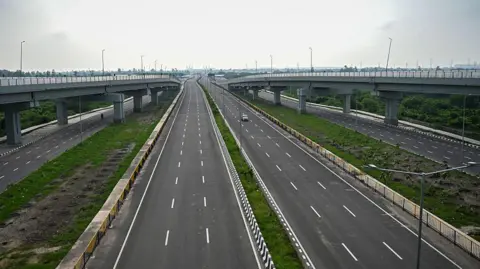
Capital Expenditure Target Raised to ₹12.2 Lakh Crore Centre‑run capex is lifted to ₹12.2 lakh crore for FY 27, up from ₹11.2 lakh crore in the previous fiscal [2][4][5]. Despite the headline increase, the projected growth rate of 11.5 % translates to just 3.1 % of GDP, barely outpacing the assumed 10 % nominal GDP growth and indicating near‑static investment levels [1]. Actual capex for 2025‑26 fell short of its ₹15.48 lakh crore plan, reaching only ₹14.04 lakh crore, raising doubts about the multiplier impact of the new target [2].
Tax‑Revenue Buoyancy Remains Low Across the Board Projected overall tax‑revenue buoyancy for 2026‑27 sits at 0.8, well below the benchmark of 1, driven by weak GST collections; direct‑tax buoyancy is 1.1 while indirect buoyancy languishes at 0.3 [1]. The revenue‑expenditure share has slipped to 77 % from 88 % in 2014‑15, shrinking fiscal space for new programmes [1]. No major personal or corporate income‑tax cuts were introduced, reinforcing the government’s focus on fiscal discipline over immediate tax relief [3][4].
Debt Sustainability Concerns Intensify Interest payments are projected to consume about 40 % of revenue at a 7.12 % effective borrowing rate, limiting private‑sector investment capacity [1]. While the budget shifts focus to lowering the debt‑to‑GDP ratio to 50 % (±1 %) by 2030‑31, the current ratio is estimated at 55.6 % and targets may be delayed, reflecting a divergence between the stated goal and the fiscal reality [5][1]. The Sixteenth Finance Commission kept states’ share of central taxes at 41 % and reduced FC grants, further tightening fiscal transfers to states [1].
Sectoral Pushes Face Execution Gaps The budget launches schemes for seven strategic manufacturing sectors, including a ₹40,000 crore Electronics Component Manufacturing Scheme and a second semiconductor mission funded with $436 million [2][5]. Rare‑earth corridors are announced in four states, and a zero‑tax concession for foreign cloud providers runs until 2047 [2][5]. However, disinvestment revenue fell dramatically short of the ₹47,000 crore target (realising only ₹8,768 crore), and previous capex under‑performance suggests execution risks may blunt the intended impact [2].
Sources
-
1.
The Hindu: Union Budget 2026‑27 Highlights Fiscal Consolidation Challenges: details revenue‑expenditure share decline, low tax buoyancy, stalled deficit reduction, and debt‑service pressures, emphasizing fiscal consolidation hurdles .
-
2.
The Hindu: Union Budget 2026‑27 pushes capital spending, manufacturing and cloud incentives: outlines the ₹12.2 lakh crore capex target, 4.3 % deficit, sectoral incentives, cloud tax holiday, and opposition criticism, noting execution gaps in disinvestment and prior capex .
-
3.
The Hindu: Union Budget 2026‑27: Key Highlights and Policy Direction: reports the budget presentation on Feb 1, focus on global integration, infrastructure for poll‑bound states, customs duty cuts, and energy‑transition measures, with no major direct‑tax cuts .
-
4.
The Hindu: Union Budget 2026 Sets Record Capital Spend and Launches Rare‑Earth Corridors: emphasizes the ₹12.2 lakh crore capex, three “kartavyas,” rare‑earth corridors, and major infrastructure projects like new waterways and freight corridors .
-
5.
BBC: India’s 2026‑27 Budget Targets Infrastructure, Manufacturing and Debt Ratio Amid Global Tensions: highlights infrastructure spending, 7.4 % growth forecast, defence outlay rise, semiconductor mission, cloud tax holiday, and a shift to a debt‑to‑GDP ratio target of 50 % by 2030‑31 .
Timeline
2025 – India signs a free‑trade agreement with the European Union, laying groundwork for later textile‑park incentives and export‑boosting measures announced in the 2026‑27 budget [1].
2025 – U.S. President Donald Trump imposes 50 % tariffs on Indian exporters, a policy the Economic Survey expects to curb India’s 7.4 % growth forecast for FY 2026‑27 [1].
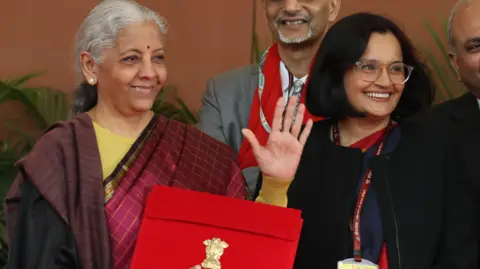
Feb 1, 2026 – Finance Minister Nirmala Sitharaman presents the Union Budget 2026‑27, her ninth consecutive budget, stating “India must remain deeply integrated, increase exports, and attract stable long‑term investment” [5].
Feb 1, 2026 – Sitharaman frames the plan around three “kartavyas”: accelerating growth and resilience, fulfilling citizens’ aspirations, and ensuring inclusive access to resources and opportunities [3].
Feb 1, 2026 – The budget raises the centre‑run capital‑expenditure target to ₹12.2 lakh crore for FY 27, up from the ₹11.2 lakh crore planned for the current fiscal [3][4].
Feb 1, 2026 – Defence outlays increase by more than 20 % as the government responds to heightened geopolitical tensions [1].
Feb 1, 2026 – A ₹73 bn scheme creates rare‑earth corridors in Odisha, Kerala, Andhra Pradesh and Tamil Nadu to secure critical mineral supplies [1][3].
Feb 1, 2026 – The government launches India Semiconductor Mission 2.0, allocating $436 m to deepen domestic chip production [1].
Feb 1, 2026 – A tax holiday for foreign cloud providers is extended until 2047 to spur data‑centre growth, benefitting firms such as Microsoft, Google and Amazon [1].
Feb 1, 2026 – Mega‑textiles parks are announced to boost exports, leveraging the recent India‑EU free‑trade agreement [1].
Feb 1, 2026 – New infrastructure projects include a national waterway in Odisha linking Talcher, Angul and Kalinga Nagar to Paradip and Dhamra ports, an East Coast Industrial Corridor, and a dedicated freight line from Dankuni (West Bengal) to Surat (Gujarat) [3].
Feb 1, 2026 – The fiscal deficit is set at 4.3 % of GDP with ₹17.2 trn gross borrowing, while the debt‑to‑GDP ratio target shifts to 50 % ± 1 % by 2030‑31 (projected at 55.6 % for 2026‑27) [1][4].
Feb 1, 2026 – The Economic Survey projects 7.4 % GDP growth for FY 2026‑27 but warns of a slowdown next year as Trump’s tariffs “begin to bite” [1].
Feb 1, 2026 – Revenue‑expenditure share falls to 77 % in 2026‑27, down from 88 % in 2014‑15, creating fiscal space for new priorities [2].
Feb 1, 2026 – Capital‑expenditure growth slows sharply, with the budget projecting an 11.5 % increase, barely above the assumed 10 % nominal GDP growth [2].
Feb 1, 2026 – Projected tax‑revenue buoyancy for 2026‑27 is 0.8 (direct‑tax buoyancy 1.1, indirect 0.3), raising concerns about funding the expanded outlays [2].
Feb 1, 2026 – The Sixteenth Finance Commission keeps states’ share of central taxes at 41 % and reduces total FC grants to 0.33 % of GDP, shrinking fiscal transfers to states [2].
Feb 1, 2026 – Opposition leaders Mallikarjun Kharge and Rahul Gandhi label the budget “anti‑people and ineffective,” saying it “fails the test of economic strategy” [4].
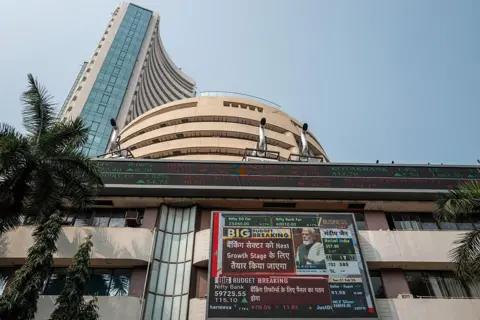
Feb 1, 2026 – Markets slip after the Securities Transaction Tax on futures and options is raised, a move highlighted by Kotak Securities CEO Shripal Shah [1].
2026‑27 onward – The government pursues the “Viksit Bharat” vision for 2047, targeting AI, biopharma, semiconductors and critical minerals as pillars of a developed‑country status [2].
2047 – The cloud‑tax holiday for foreign data‑centre providers remains in force, supporting India’s long‑term digital infrastructure strategy [1].
External resources (4 links)
- https://www.youtube.com/@bbcnewsindia/featured (cited 1 times)
- https://www.facebook.com/bbcindia/ (cited 1 times)
- https://www.instagram.com/bbcnewsindia/ (cited 1 times)
- https://x.com/BBCIndia (cited 1 times)