Treasury Secretary Bessent Warns Carney of Trade Fight Risks as USMCA Review Looms
Updated (3 articles)
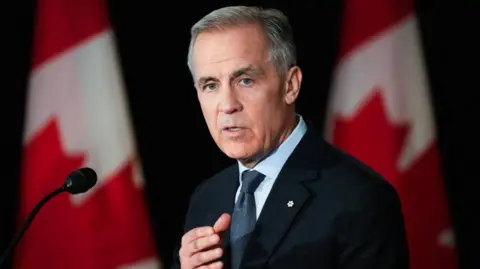
Bessent cautions Canada before USMCA review On 28 January 2026, Treasury Secretary Scott Bessent told Prime Minister Mark Carney that “picking a fight” ahead of the mandatory United States‑Mexico‑Canada Agreement review could backfire, emphasizing the pact’s role in shielding Canada from Trump‑era tariffs [1]. He dismissed Carney’s recent political pivot, noting technocrats who try to become politicians “never work out well” [1]. Trump later expressed indifference to the agreement, saying “I don’t really care about it,” while Bessent remained optimistic about a “good place” outcome [1].
Carney stands by Davos speech after Trump call Carney reiterated on 27 January 2026 that his Davos remarks condemning “economic coercion” were intentional, rejecting Bessent’s claim he was “aggressively walking back” his comments [2][3]. He described his Monday phone conversation with President Donald Trump as “very good,” covering Ukraine, Venezuela, Arctic security, USMCA review, and the Canada‑China trade talks [2]. Carney labeled Trump’s 100 % tariff threat a negotiation tactic, calling it “bluster” ahead of the USMCA review [3].
Canada‑China electric‑vehicle partnership sets limits and duties The new agreement caps Chinese EV imports at 49,000 units annually with a 6.1 % tariff, expanding to roughly 70,000 units over five years—about 3 % of Canada’s 1.8 million‑vehicle market—and includes a commitment for Chinese investment in Canadian auto production within three years [3]. Trade minister Dominic LeBlanc framed the deal as a narrow‑sector arrangement, stressing that the USMCA review is built into the existing pact and does not constitute a full renegotiation [3].
Tariff threats and diplomatic friction persist Trump warned he would impose a 100 % tariff on Canadian goods if Canada finalizes a broader China deal, a threat Carney dismissed as leverage [1][3]. Bessent publicly accused Carney of back‑tracking aggressively, while Carney maintained his original stance, creating a visible rift between U.S. Treasury and the Canadian prime minister [1][2][3]. The tariff threat coincided with Trump’s broader rhetoric about making Canada a “51st state” and pursuing Greenland, raising NATO concerns about the alliance’s cohesion [3].
Sources
-
1.
AP: Treasury Secretary Bessent cautions Canada’s Carney ahead of USMCA review – Details Bessent’s warning, Carney’s Davos speech, Trump’s tariff threat, and the uncertain future of USMCA .
-
2.
BBC: Carney Refutes Claims He Softened Davos Remarks After Call With Trump – Highlights Carney’s reaffirmation of Davos comments, his constructive call with Trump, and the framing of tariff threats as negotiation tactics .
-
3.
AP: Carney Dismisses Trump’s Tariff Threats as Negotiation Bluster Ahead of USMCA Review – Covers Carney’s dismissal of tariffs, the EV partnership caps and tariffs, LeBlanc’s limited‑sector view, and broader geopolitical tensions .
Timeline
2020 – The United States‑Mexico‑Canada Agreement (USMCA) signs, establishing a trade framework that shields Canada from the heaviest impacts of potential U.S. tariffs and mandates a periodic review, a clause that becomes central to 2026 negotiations [2].
Earlier (pre‑2026) – President Donald Trump repeatedly suggests Canada become a “51st state” and pursues Greenland, moves that heighten NATO concerns and frame his later tariff threats as part of a broader coercive posture [3].
Jan 26, 2026 – Prime Minister Mark Carney labels President Trump’s 100 % tariff threat as negotiation bluster ahead of the USMCA review, reiterates Canada’s lack of interest in a comprehensive China deal, and announces a limited Canada‑China electric‑vehicle partnership that caps annual Chinese EV imports at 49,000 units with a 6.1 % tariff, expanding to 70,000 over five years and targeting Chinese investment within three years [3].
Jan 26, 2026 – Trade Minister Dominic LeBlanc frames the Canada‑China talks as a narrow‑sector arrangement, emphasizing that the upcoming USMCA review, not a full renegotiation, will address any concerns, and notes that the review is built into the pact [3].
Jan 27, 2026 – Carney tells reporters he “means what he said in Davos,” refutes Treasury Secretary Scott Bessent’s claim that he aggressively back‑pedals his Davos remarks, and describes his phone call with President Trump as a “very good conversation” covering Ukraine, Venezuela, Arctic security, trade, the USMCA review, and the China agreement [1].
Jan 27, 2026 – Carney explains that Trump’s tariff threat functions as a bargaining tactic ahead of the USMCA review, while his Davos speech indirectly criticizes Trump’s world‑order stance by referencing a “rupture” in the post‑war order, prompting Trump to reply that “Canada lives because of the United States” [1].
Jan 28, 2026 – Treasury Secretary Scott Bessent cautions Carney against sparring before the formal USMCA review, warns that picking a fight could backfire, and dismisses Carney’s political pivot as ineffective, noting “I would not pick a fight going into USMCA to score some cheap political points” [2].
Jan 28, 2026 – Bessent reiterates Trump’s 100 % tariff threat tied to the China deal, describes Carney’s earlier walk‑back as “very aggressively walking back” his Davos remarks, and observes that Trump says he “doesn’t really care” about the USMCA, leaving the pact’s future uncertain [2].
Later in 2026 – The USMCA mandatory review commences, with expectations of a “robust review” that could reshape North American trade rules and test Canada’s ability to navigate U.S. tariff pressures while pursuing limited China cooperation [1][3].