Trump Administration Unveils American AI Exports Program at New Delhi Summit
Updated (10 articles)
Program Origin and Presidential Decree The White House issued a presidential decree in July 2025 establishing the “American AI Exports Program,” a coordinated national effort to market U.S. artificial‑intelligence technology abroad [1]. The decree mandates a unified push to sell full‑stack AI solutions, encompassing hardware, data‑center services, language models and end‑user applications [1]. It signals a strategic shift toward treating AI as a tradable export commodity rather than a purely domestic asset [1].
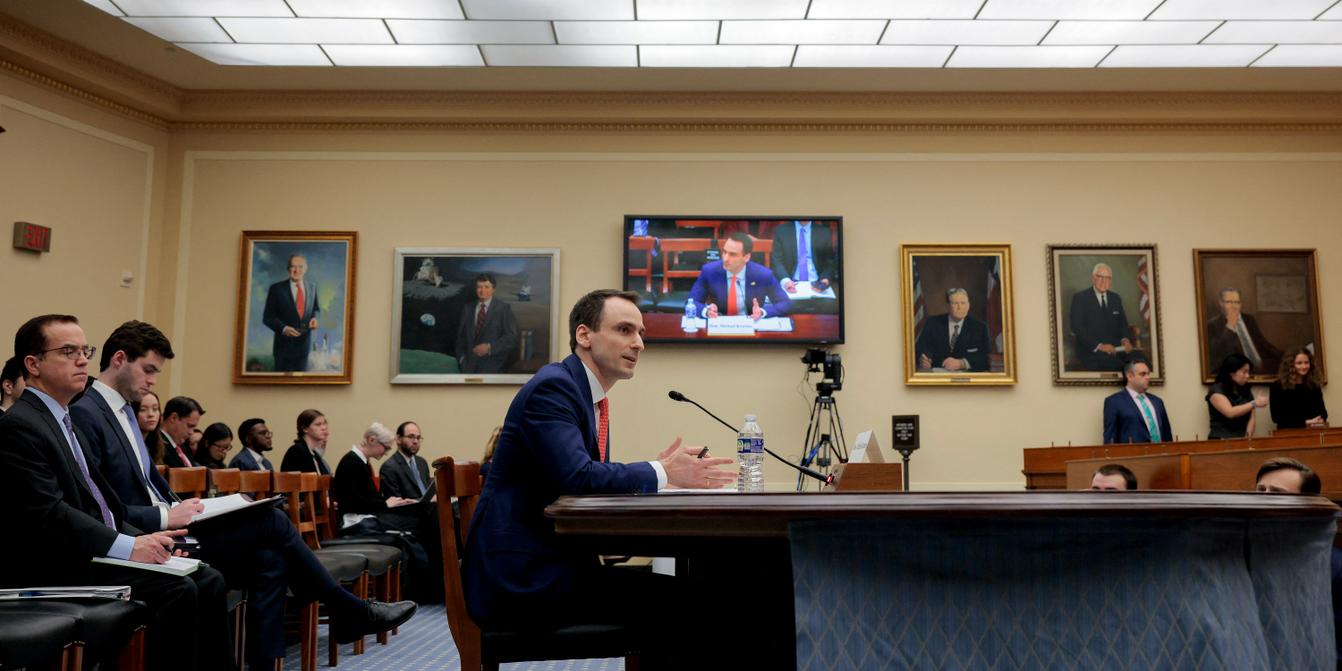
Michael Kratsios Announces Plan in New Delhi Special envoy Michael Kratsios presented the program on 20 February 2026 at the New Delhi AI summit, standing before U.S. flags on stage [1]. In his remarks, Kratsios likened the export initiative to the revolutionary spirit of the nation’s founders, urging other countries to join the “new frontier” of American AI [1]. The announcement came moments before the U.S. Supreme Court declared American tariffs illegal, adding a legal backdrop to the policy rollout [1].
Full‑Stack AI Packages Target Global Markets The decree directs the export of complete AI stacks, from semiconductor chips to cloud services and generative‑model applications, to streamline foreign procurement [1]. By bundling hardware, data‑center infrastructure, and software, the program aims to reduce integration barriers for partner nations [1]. This full‑stack approach reflects a broader U.S. intent to dominate the international AI supply chain [1].
Consortium to Include Leading U.S. AI Companies A consortium is being assembled to negotiate deals, drawing participants from chip makers such as Nvidia and Qualcomm, cloud providers Amazon, Microsoft and Google, and model developers OpenAI, Anthropic and Google [1]. Application developers including Meta will also join, creating a cross‑industry alliance to promote U.S. AI exports [1]. The consortium’s formation underscores the government’s reliance on private‑sector expertise to execute the export strategy [1].
Related Tickers
Videos (2)
Primary Data (3)
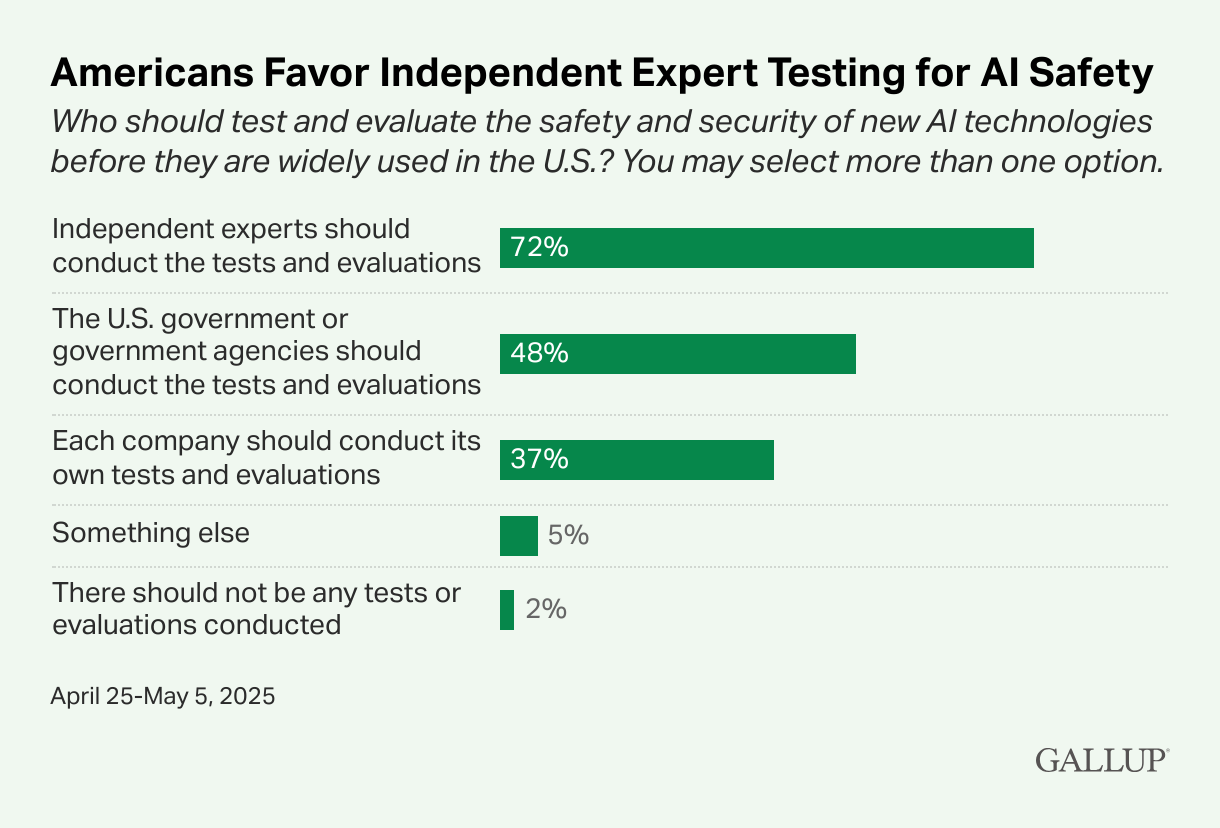
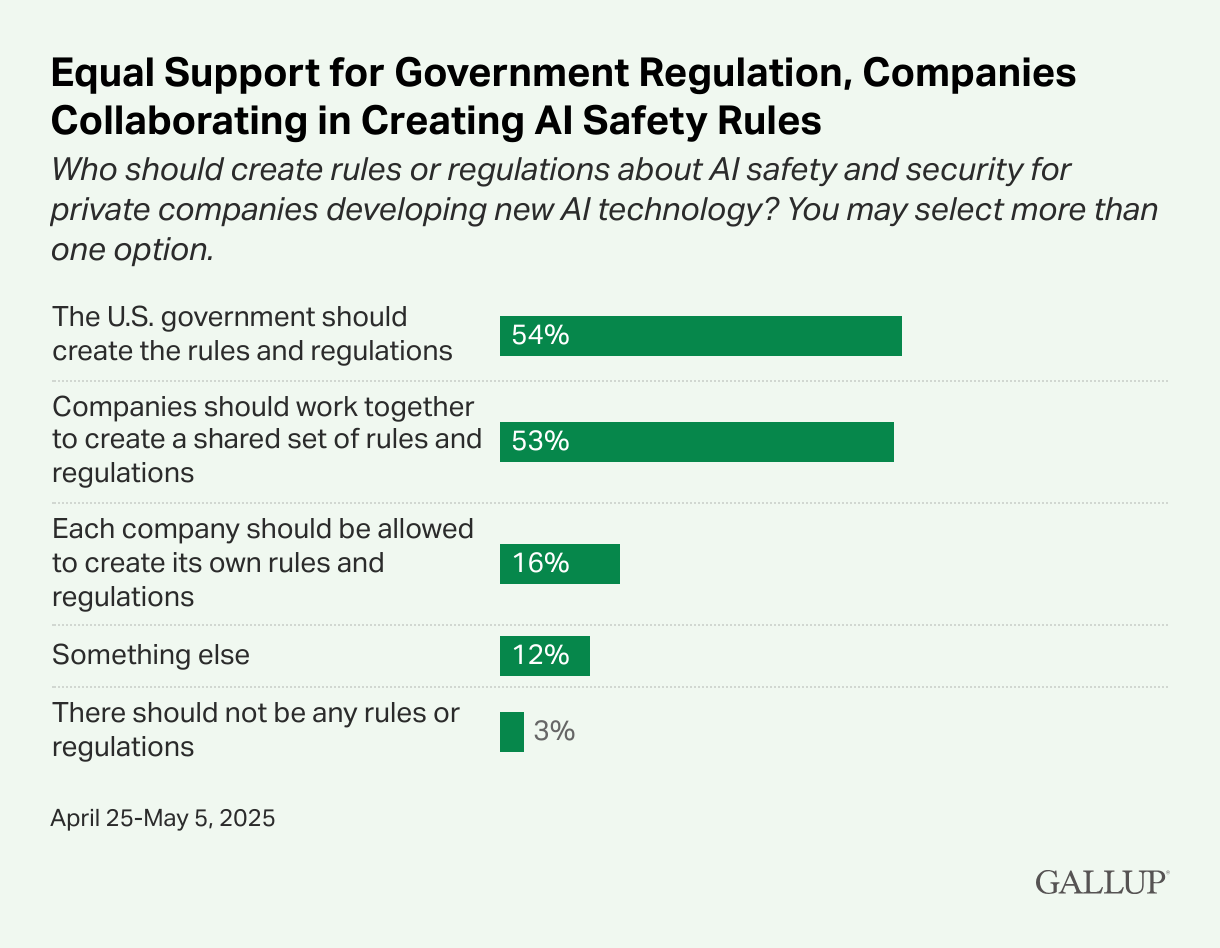
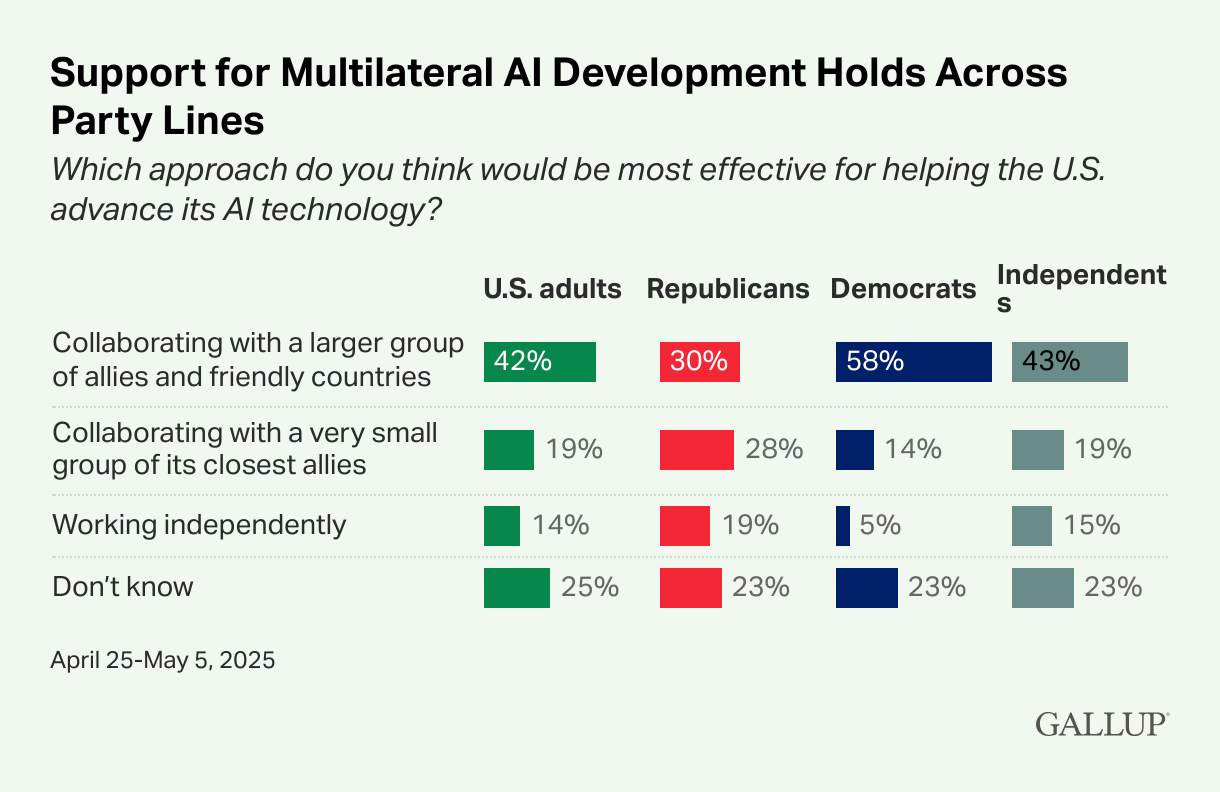
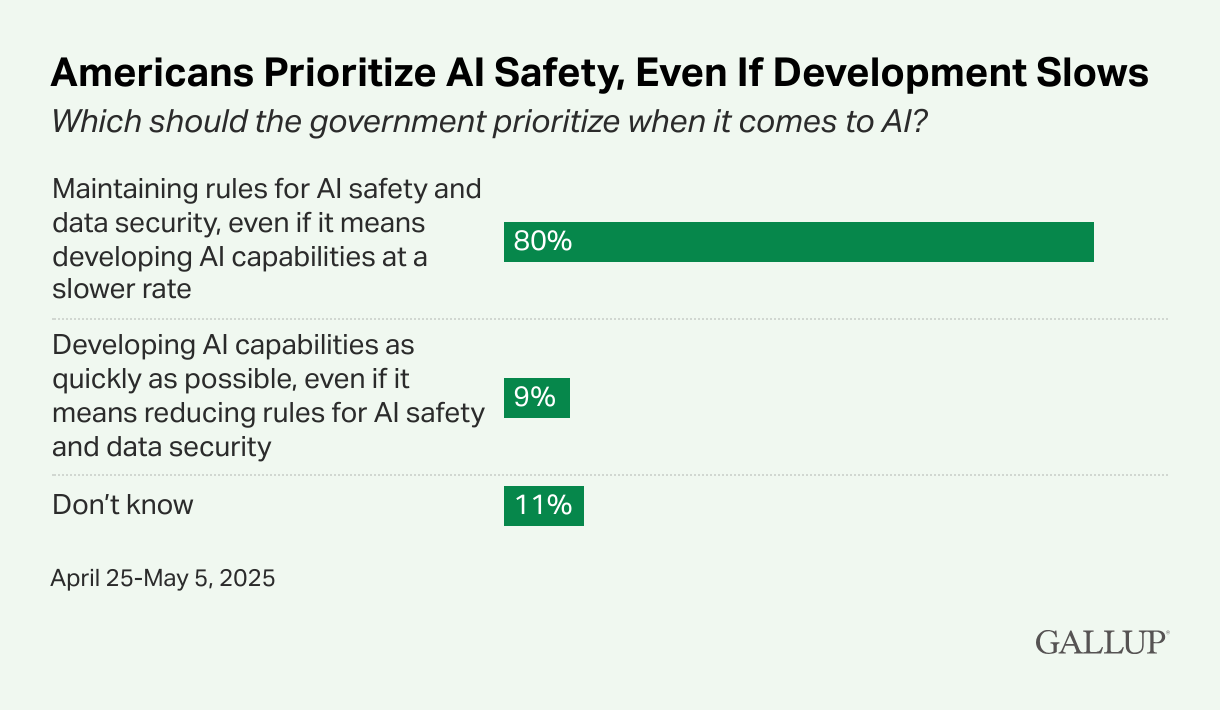
Gallup: Americans Prioritize AI Safety and Data Security
Published (5 tables/charts)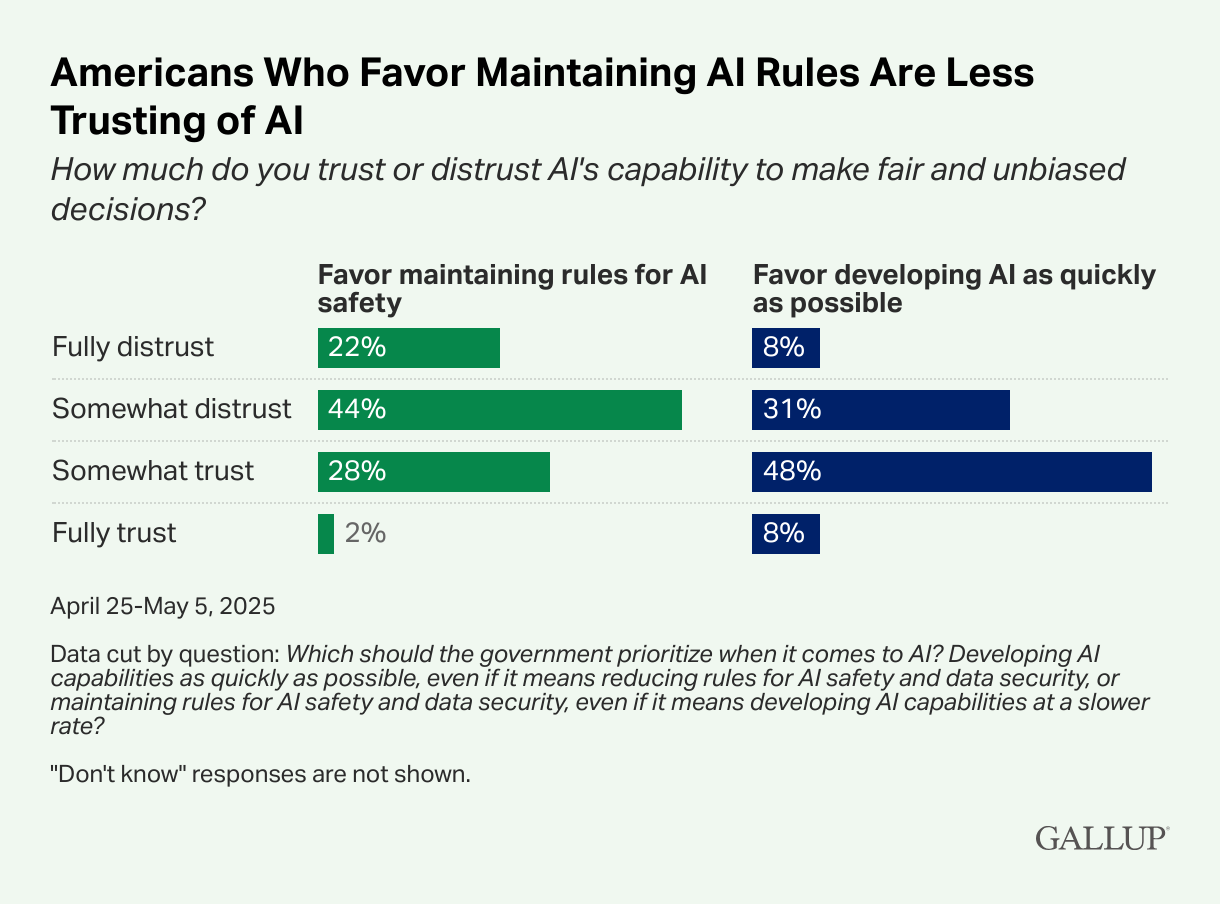


Timeline
July 2025 – The Senate removes a 10‑year moratorium on state AI regulation from a domestic policy bill and declines to add a similar moratorium to the National Defense Authorization Act, clearing the way for federal pre‑emption efforts [4][6].
2025 (throughout the year) – More than 1,000 AI‑related bills are introduced in state legislatures, and 38 states enact roughly 100 AI rules covering chatbot disclosure, risk‑mitigation, anti‑harassment, IP protection and medical‑title usage [1].
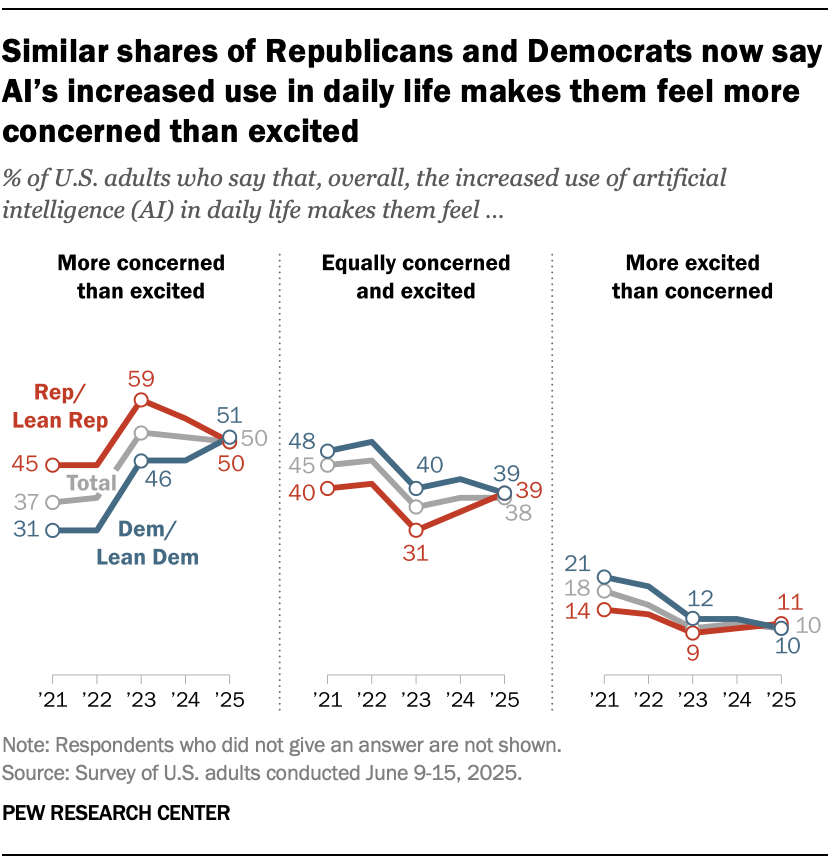
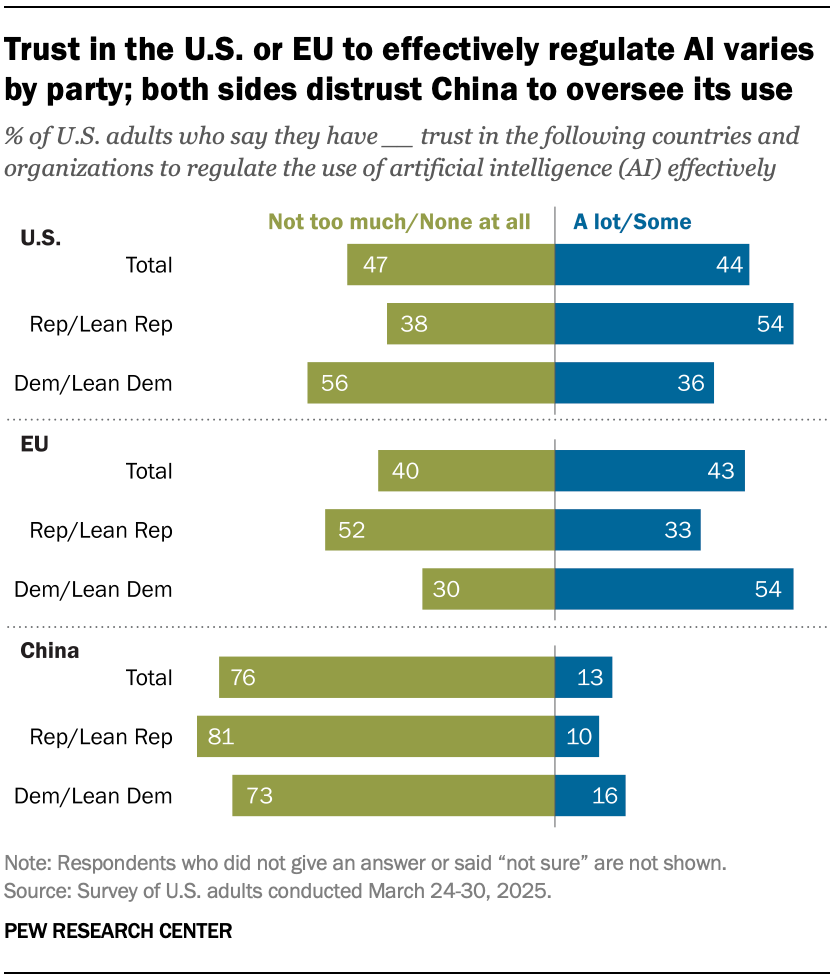
September 2025 – A Pew Research Center poll finds that 50 % of Americans feel more concerned than excited about AI’s growing role, while only 10 % feel more excited than worried, signaling rising voter anxiety ahead of congressional debates [2].
November 2025 – White House AI czar David Sacks meets longtime Trump adviser Mike Davis in Vice President JD Vance’s office; Davis accuses Sacks of trying to “run over Congress” with an unchecked AI agenda, and Sacks replies he is merely carrying out Trump’s wish to unleash an AI boom, exposing a fault line within the MAGA coalition [2].
December 8 2025 – President Trump posts on Truth Social that he will sign an executive order pre‑empting state AI regulations, calling for “one rulebook” to keep the United States ahead of China and directing the Attorney General to form an AI Litigation Task Force [6].
December 10 2025 – The bipartisan super‑PAC “Leading the Future” launches its first TV ads in Texas’s 10th and New York’s 12th congressional districts, urging voters to support candidates who back a federal AI regulatory framework and oppose the patchwork of state rules [5].
December 11 2025 – President Trump signs the executive order that bars states from enforcing their own AI regulations and mandates federal agencies to develop a unified national AI framework in partnership with Congress, while pledging not to challenge child‑safety laws [4].
December 12 2025 – The order creates an AI Litigation Task Force, empowers the Commerce Department to label “onerous” state rules, and threatens to withhold BEAD broadband grant money from states with AI laws, prompting former adviser Steve Bannon to label the order “entirely unenforceable” on GETTR [8][9][7].
December 12 2025 – Tech industry group NetChoice welcomes the pre‑emption, saying it will create clear nationwide standards for innovators, whereas critics such as Julie Scelfo (Mothers Against Media Addiction) and Governor Gavin Newsom warn it erodes state safeguards and serves big‑tech interests [1].
December 30 2025 – AI moves from back‑office tools to front‑line policy and consumer services; President Trump highlights Nvidia and AMD chips as leverage in U.S.–China trade tensions, rolls out an AI action plan that reduces regulation, and the administration’s “summer framework” fast‑tracks AI projects while the industry spends tens of billions on data‑center infrastructure [3].
February 2 2026 – Reporting reveals that the November 2025 Vance‑office clash over AI policy has sparked a public rift within MAGA, with former adviser Steve Bannon warning supporters will “fight like hell” against the president’s AI push and commentator Joe Allen decrying tech leaders as building “sand gods” [2].
February 20 2026 – At the New Delhi AI summit, special envoy Michael Kratsios unveils the “American AI Exports Program,” a July 2025‑created initiative that will coordinate a consortium of U.S. chip, data‑center and language‑model firms to sell full‑stack AI packages worldwide, likening the effort to a “Founding‑Father revolution” [10].
2026 (upcoming) – As the 2026 midterm elections approach, pro‑AI super‑PACs and industry‑backed groups pour roughly $100 million into races, targeting anti‑AI candidates and positioning AI regulation as a decisive campaign issue [2][5].
All related articles (10 articles)
-
Le Monde: Trump Administration Launches American AI Exports Program at India Summit
-
CNN: Trump’s Executive Order Sparks AI Rift Within MAGA
-
CNN: AI reshapes policy and markets in 2025 amid safety concerns and investment surge
-
Newsweek: Bannon Criticizes Trump’s AI Executive Order as Unenforceable
-
BBC: Trump signs order to block state AI regulations
-
Newsweek: Trump’s AI Order Threatens Broadband Funding for Red States
-
AP: Trump Signs Executive Order to Block State AI Regulations
-
CNN: Trump Signs Executive Order to Block State AI Regulations
-
CNN: Pro-AI super PAC launches first candidate ads
-
CNN: Trump to sign executive order preempting state AI regulations to establish a single national rulebook
External resources (21 links)
- https://www.youtube.com/watch?v=6XwUATxbipY (cited 1 times)
- https://www.youtube.com/watch?v=Rni7Fz7208c (cited 1 times)
- https://www.whitehouse.gov/presidential-actions/2025/12/eliminating-state-law-obstruction-of-national-artificial-intelligence-policy/ (cited 2 times)
- https://lofgren.house.gov/media/press-releases/leader-jeffries-announces-new-house-democratic-commission-ai-and-innovation (cited 1 times)
- https://news.gallup.com/poll/694685/americans-prioritize-safety-data-security.aspx (cited 1 times)
- https://www.pewresearch.org/science/2025/09/17/how-americans-view-ai-and-its-impact-on-people-and-society/ (cited 1 times)
- https://www.pewresearch.org/short-reads/2025/11/06/republicans-democrats-now-equally-concerned-about-ai-in-daily-life-but-views-on-regulation-differ/ (cited 1 times)
- https://www.stlouisfed.org/on-the-economy/2026/jan/tracking-ai-contribution-gdp-growth (cited 1 times)
- https://www.axios.com/2025/09/23/meta-superpac-ai-regulation (cited 1 times)
- https://truthsocial.com/@realDonaldTrump/posts/115573090200730933 (cited 1 times)
- https://truthsocial.com/@realDonaldTrump/posts/115684148454828379 (cited 1 times)
- https://x.com/RonDeSantis/status/1990850245832683816 (cited 1 times)
- https://x.com/elonmusk/status/2001361571407368589 (cited 1 times)
- https://x.com/jasonfurman/status/1971995367202775284 (cited 1 times)
- https://x.com/sama/status/1978129344598827128 (cited 1 times)
- https://am.jpmorgan.com/us/en/asset-management/adv/insights/market-insights/market-updates/on-the-minds-of-investors/is-ai-already-driving-us-growth/ (cited 1 times)
- https://bit.ly/4aBNhyj (cited 1 times)
- https://civilrights.org/resource/leadership-conference-letter-50-signatures-senate-opposing-ban-state-local-ai-laws/ (cited 1 times)
- https://demandprogress.org/wp-content/uploads/2025/11/Letter-Opposing-AI-State-Preemption-November-19.pdf (cited 1 times)
- https://statescoop.com/state-ai-law-moratorium-omitted-2026-defense-bill-trump-eo/ (cited 1 times)
- https://www.mckinsey.com/industries/public-sector/our-insights/the-data-center-balance-how-us-states-can-navigate-the-opportunities-and-challenges (cited 1 times)