South Korean Industry Minister Says Misunderstandings Resolved After Washington Talks, Bill Processing Accelerated
Updated (11 articles)
-
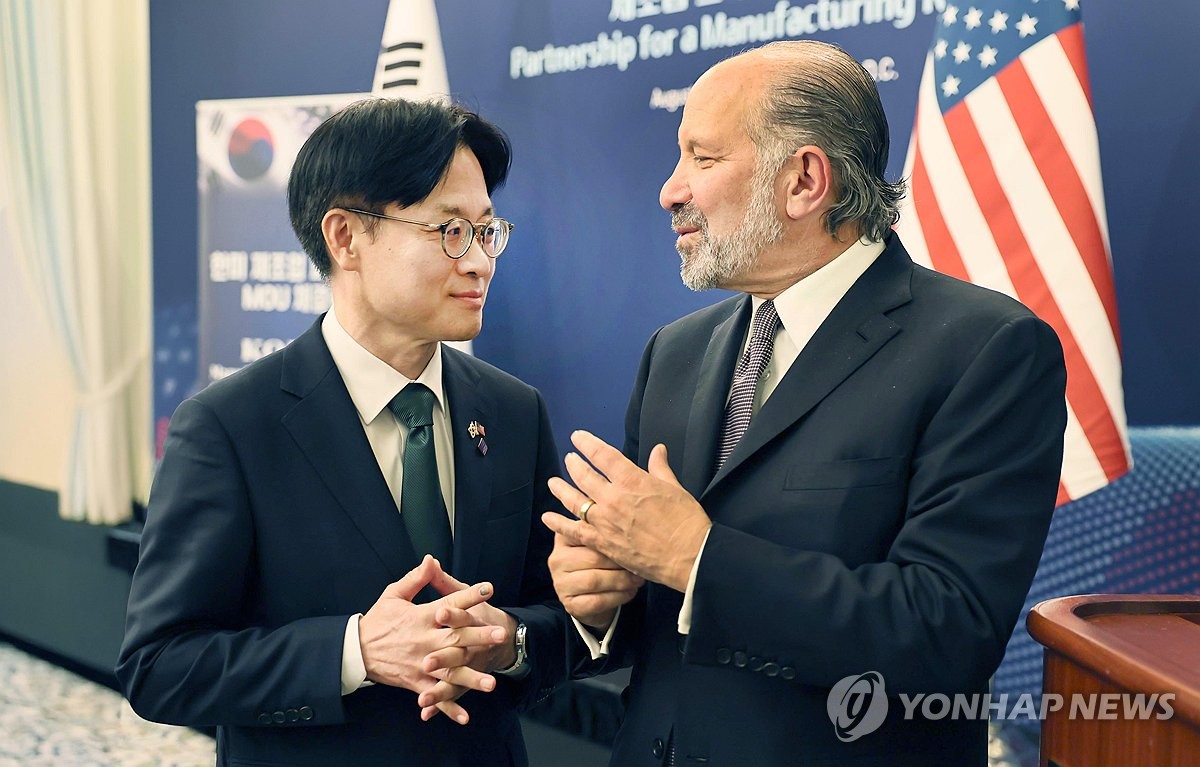 Image: YonhapIndustry Minister Kim Jung-kwan (L) and U.S. Commerce Secretary Howard Lutnick talk during the signing of a memorandum of understanding on a manufacturing partnership between South Korea and the United States at a hotel in Washington in this Aug. 25, 2025, file photo provided by the industry ministry. (PHOTO NOT FOR SALE) (Yonhap) Source Full size
-
Image: YonhapIndustry Minister Kim Jung-kwan (L) and U.S. Commerce Secretary Howard Lutnick talk during the signing of a memorandum of understanding on a manufacturing partnership between South Korea and the United States at a hotel in Washington in this Aug. 25, 2025, file photo provided by the industry ministry. (PHOTO NOT FOR SALE) (Yonhap) Source Full size


Washington Meetings Highlight Tariff Standoff Industry Minister Kim Jung‑kwan met U.S. Commerce Secretary Howard Lutnick at the Commerce Department on Jan 29‑30, 2026, holding two consecutive days of talks in Washington [2][3][4][5][6]. Both officials reported that the sessions ended without a formal agreement, though each side said it left the negotiations with a clearer picture of the other’s position [2][4]. Kim announced that follow‑up discussions will continue via video link after his return to Seoul [2][3].
Trump’s 25% Tariff Threat Pressures Seoul President Donald Trump warned on Jan 27 that the United States would raise reciprocal tariffs on South Korean autos, lumber and pharmaceuticals from the current 15 % to 25 % if Seoul does not promptly approve the pending trade framework [1][7][8][9][10][11]. The threat targets the same product categories in each statement and links the increase to delays in the Korean National Assembly’s legislative process [1][9][10]. No specific date for the tariff hike was disclosed, leaving the timing uncertain [2].
$350 Billion Investment Pledge Remains Central The bilateral agreement, announced in late July 2025, obliges South Korea to invest US$350 billion in the United States in exchange for reduced U.S. tariffs on Korean goods [1][2][3][4][5][6][7][8][9][10][11]. All sources stress that the investment commitment is the cornerstone that secured the original tariff cut from 25 % to 15 % for Korean exports [1][3][7]. Failure to meet the pledge could jeopardize the tariff concessions already granted [2][3].
South Korean Parliament Yet to Pass Bill The Democratic Party submitted a special bill in November 2025 to enact the trade and investment agreement, but the National Assembly has not approved it as of Jan 31, 2026 [1][6][7][8][10][11]. Kim told reporters the delay is procedural, not a policy reversal, and pledged to expedite the bill’s processing upon his return [1][6]. He emphasized that the government intends to honor the tariff commitments despite the legislative bottleneck [1].
Kim Declares Misunderstandings Resolved on Return After landing at Incheon International Airport on Jan 31, 2026, Kim said the Washington meetings cleared “unnecessary misunderstandings” and deepened mutual understanding with the United States [1]. He reiterated South Korea’s intention to honor the tariff agreement and to move quickly on the special bill [1]. The statement was made immediately after his arrival, underscoring the urgency of the trade dispute [1].
Sources
-
1.
Yonhap: South Korean Industry Minister Claims Trade Misunderstandings Resolved After US Talks: Kim Jung‑kwan says Washington meetings cleared misunderstandings, pledges swift bill processing, and returns to Korea on Jan 31 2026 .
-
2.
Yonhap: South Korea and U.S. Commerce Secretary End Tariff Talks Without Agreement: Talks on Jan 30 end without resolution; both sides claim better understanding and plan video‑link talks .
-
3.
Yonhap: South Korean Industry Minister Holds Second Day of Talks with U.S. Commerce Secretary Over Trump’s Tariff Threat: Second‑day meeting on Jan 30 aims to prevent a shift from 15 % to 25 % tariffs; Kim pledges aggressive negotiation .
-
4.
Yonhap: South Korean Industry Minister and U.S. Commerce Secretary Conclude First Day of Tariff Talks Without Deal: First‑day session on Jan 29 ends inconclusively; both plan to reconvene .
-
5.
Yonhap: South Korean Industry Minister Meets U.S. Commerce Secretary Amid Trump Tariff Threat: Initial meeting on Jan 29 follows Trump’s 25 % tariff warning; Kim vows to do his best .
-
6.
Yonhap: South Korean Industry Minister to Meet U.S. Commerce Secretary Amid Trump Tariff Threat: Announcement of Jan 29 meeting; highlights pending Korean investment bill and procedural U.S. steps .
-
7.
Yonhap: No Trade Deal Confirmed Until South Korean Parliament Ratifies It: Treasury Secretary Scott Bessent says deal pending Korean legislative approval; Trump threatens 25 % tariffs .
-
8.
Yonhap: South Korean Industry Minister Heads to Washington Amid U.S. Tariff Threat: Kim’s travel itinerary to Dulles; emphasizes $350 billion investment link to tariff cuts .
-
9.
Yonhap: Trump says U.S. will work “something” out with South Korea on tariffs: Trump promises negotiation after tariff threat; notes lack of progress on deal .
-
10.
AP: Trump threatens to hike South Korean tariffs to 25%: President announces 25 % tariff increase via social media; cites unratified trade framework and $350 billion pledge .
-
11.
King5 (Seattle, WA): Trump Raises South Korean Tariffs Over Unapproved Trade Framework: Details of 25 % tariff hike, pending Korean legislation, and five bills for the investment plan .
Timeline
Late July 2025 – The United States and South Korea sign a bilateral trade agreement that ties a US $350 billion Korean investment pledge to a reduction of reciprocal tariffs from 25 % to 15 % on Korean autos, lumber and pharmaceuticals, establishing the framework for future economic cooperation [1][9].
Oct 2025 – President Donald Trump visits Seoul and reaffirms the trade framework, emphasizing the investment commitment and signaling U.S. willingness to lower tariffs once the deal is ratified [1].
Nov 2025 – South Korea’s ruling Democratic Party submits a special bill to the National Assembly to enact the trade‑investment agreement, beginning the legislative process needed for the pact’s implementation [3].
Jan 19 2026 – Treasury Secretary Scott Bessent speaks at the Davos World Economic Forum, underscoring his role in shaping U.S. trade policy amid rising tensions with allies [9].
Jan 26 2026 – President Trump announces on social media that U.S. duties on South Korean autos, lumber and pharmaceuticals will rise from 15 % to 25 % under an “economic emergency” because Seoul has not yet ratified the trade framework [1][2].
Jan 27 2026 – Trump tells reporters the United States will “work something out” with South Korea on the tariff issue, hinting at a possible de‑escalation after the sharp tariff threat [11].
Jan 28 2026 – Treasury Secretary Bessent states that the United States has no trade agreement with South Korea until the Korean parliament ratifies it, reinforcing the link between legislative approval and tariff relief [9].
Jan 28 2026 – Industry Minister Kim Jung‑kwan lands at Dulles International Airport (9:25 p.m. local) after departing Ottawa, beginning his Washington visit to address the tariff dispute [10].
Jan 28 2026 – At a press briefing at Dulles, Kim says the upcoming talks will be “extensive” and that he will “do my best” to protect Korean exporters [6][7].
Jan 29 2026 – Kim meets U.S. Commerce Secretary Howard Lutnick at the Commerce Department for the first day of tariff negotiations; both sides discuss the pending investment pledge but leave without a formal agreement [7][8][6].
Jan 30 2026 – On the second day of talks, Kim and Lutnick again fail to reach a deal, though each notes a deeper mutual understanding; Kim adds that further discussions will continue via video link after he returns to Seoul [5][4].
Jan 31 2026 – Returning to Incheon Airport, Kim tells reporters that “unnecessary misunderstandings” have been cleared and “our mutual understanding has deepened significantly,” emphasizing South Korea’s intent to honor the investment commitment [3].
Future (post‑Jan 31 2026) – Trade Minister Yeo Han‑koo is slated to travel to Washington to meet U.S. Trade Representative Jamieson Greer, extending the dialogue beyond commerce [10].
Future (2026) – Five separate bills in the Korean National Assembly are expected to be merged into a single proposal to implement the US $350 billion investment plan, pending approval by the finance and judiciary committees [1].
Ongoing (2026) – A Supreme Court case on the President’s authority under the 1977 International Emergency Economic Powers Act and pending Section 232 investigations could shape the ultimate outcome of the tariff dispute [1][2].