45,000‑Year‑Old German Artifacts Reveal Symbol System Predating Writing
Updated (3 articles)
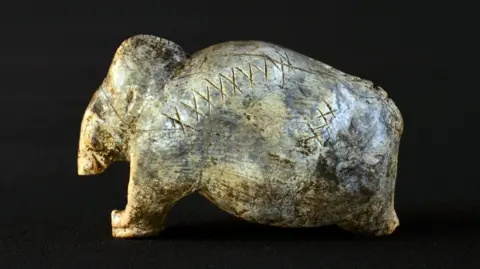
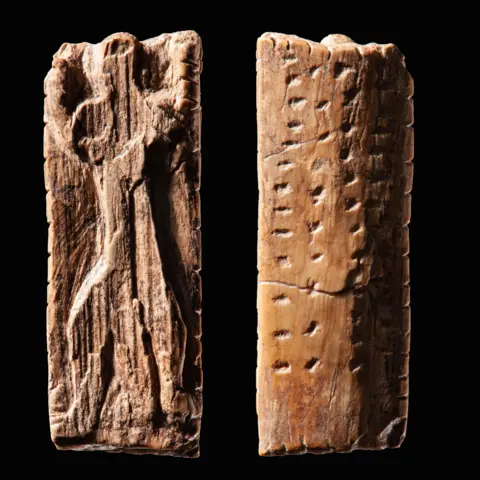
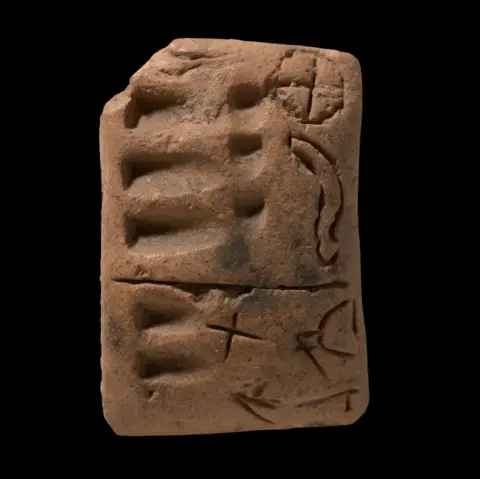
New Study Catalogues Tens of Thousands of Marks Researchers examined 260 mammoth‑tusk and ivory objects from Germany’s Lonetal and Geißenklösterle caves, dating to roughly 45,000 years ago, and recorded more than 3,000 individual lines, notches, dots and crosses [1]. The marks appear deliberately arranged in rows and clusters, suggesting intentional communication rather than random decoration [1]. The team used statistical pattern‑analysis to treat the collection as a “DNA of writing,” emphasizing systematic regularity across the artifacts [1].
Pattern Regularity Mirrors Early Proto‑Cuneiform Statistical comparison shows the information density of the Paleolithic marks rivals that of the earliest Mesopotamian proto‑cuneiform tablets created about 40,000 years later [1]. Repetition and predictability of the symbols indicate purposeful encoding of messages, not merely aesthetic motifs [1]. Researchers argue that such density reflects an early form of symbolic coding comparable to later writing systems [1].
Findings Challenge Conventional Writing Origin Timeline Conventional scholarship places the birth of writing in proto‑cuneiform around 5,000 years ago in ancient Iraq [1]. The German artifacts push evidence of systematic symbolic communication back by tens of millennia, forcing a reassessment of when humans first used writing‑like systems [1]. The study therefore questions the long‑held view that writing emerged solely in the Near East during the Bronze Age [1].
Implications for Upper Paleolithic Cognitive Abilities Many of the examined objects are small enough to be carried easily, indicating that Upper Paleolithic hunters routinely transported symbolic items across regions [1]. This mobility suggests a shared cultural repertoire and a sophisticated understanding of abstract representation among groups that roamed Europe [1]. The research concludes that these peoples possessed a complex symbol system akin to early writing, reshaping views of Paleolithic cognition [1].
Related Tickers
Timeline
~73,000 years ago – Cross‑hatched markings appear on a South African cave wall, providing some of the earliest evidence of complex symbolic marks that predate the Sulawesi finds [3].
67,800 years ago – Artists in Liang Metanduno cave on Sulawesi blow pigment over hands pressed to the rock, creating tan hand stencils with deliberately pointed fingertips, the oldest reliably dated cave art [2][3].
~66,700 years ago – A hand stencil in Spain’s Maltravieso cave receives a revised minimum age, slightly younger than the Sulawesi stencil but still among the world’s oldest known hand prints [2].
~65,000 years ago – Homo sapiens reach northern Australia (Sahul), indicating that modern humans were capable of complex symbolism on the island well before the previously assumed 50,000‑year arrival [2].
51,200 years ago – Sulawesi artists paint a narrative pig‑human figure, adding to a growing sequence of early creative expression on the island [2].
45,000 years ago – Upper‑Paleolithic hunters in Germany carve lines, notches, dots and crosses on mammoth tusks and ivory plaques; researchers catalog over 3,000 marks on 260 objects and describe the pattern density as comparable to proto‑cuneiform tablets [1].
44,000 years ago – A hunting scene is painted on Sulawesi cave walls, illustrating early representational art that predates European Ice‑Age art [2].
40,000 years ago – Additional hand stencils are created in Sulawesi caves, showing that the region’s rock‑art tradition spans tens of millennia [2].
~5,000 years ago – Proto‑cuneiform writing emerges in ancient Mesopotamia, establishing the conventional benchmark for the origin of writing that the German symbols now challenge [1].
Jan 2026 – Researchers publish the Sulawesi hand‑stencil study in Nature; paleoanthropologist Genevieve von Petzinger “lets out a squeal of joy,” confirming the find aligns with expectations about early art [3].
Feb 2026 – A team releases a detailed analysis of the 45,000‑year‑old German artifacts, calling the collection the “DNA of writing” and highlighting its statistical regularity and information density [1].
All related articles (3 articles)
External resources (2 links)
- https://www.nature.com/articles/s41586-018-0514-3 (cited 1 times)
- https://www.nature.com/articles/s41586-025-09968-y (cited 1 times)