DOE Partners with Oak Ridge on $27 Million Kairos Reactor; France Begins Sodium Test Loop
Updated (2 articles)
_52351.jpg)
DOE‑Oak Ridge partnership accelerates fluoride‑salt reactor design The U.S. Department of Energy and Oak Ridge National Laboratory signed a five‑year, $27 million agreement with Kairos Power on 23 February 2026 to fast‑track the company’s fluoride‑salt‑cooled high‑temperature reactor. The contract grants ORNL access to its facilities and expertise for fuel and material testing, while the DOE also earmarks up to $303 million under the Advanced Reactor Demonstration Program for risk‑reduction work. Kairos is concurrently constructing the Hermes 1 low‑power demonstration reactor at Oak Ridge, the first non‑light‑water reactor approved by the NRC, with ground broken in July 2024 and safety‑related construction beginning in May 2025[1].
ORNL focuses on TRISO fuel and salt‑compatible materials During the partnership, ORNL will evaluate manufacturing methods for TRISO fuel particles, assess the quality of fuel pebbles, and test ceramics, carbon composites, and metals that contact molten fluoride salt at extreme temperatures. The laboratory will also develop remote‑maintenance systems suited for high‑heat, radiation‑rich environments, aiming to prove long‑term material durability. Kairos CTO Ed Blandford highlighted that ORNL’s decades‑long expertise is essential for accelerating technology maturity[1].
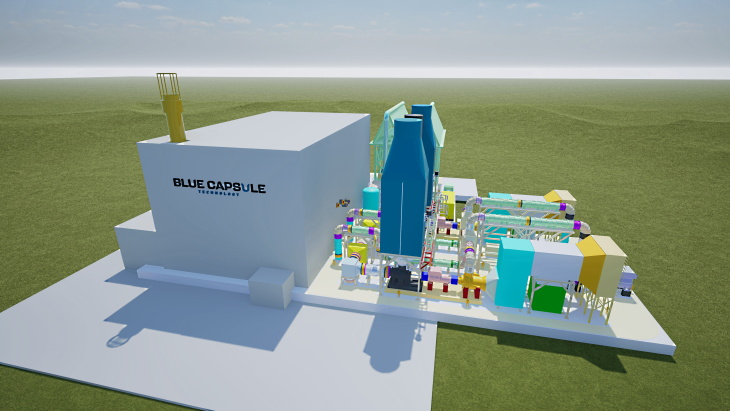
Blue Capsule launches ELISE sodium test loop in France On 19 February 2026, Blue Capsule Technology began building the nine‑metre‑high ELISE full‑size sodium test rig at Peyrolles‑en‑Provence, in collaboration with CSTI Groupe. The loop will replicate reactor conditions up to 750 °C to gather thermo‑hydraulic data on liquid sodium natural circulation. The associated sodium‑cooled high‑temperature SMR targets 150 MW of heat at 700 °C and 50 MW of electricity, using low‑enriched (<5 %) TRISO fuel for safety and economic benefits[2].
Parallel timelines push advanced reactors toward deployment Hermes 1 construction proceeds toward commissioning, while the larger Hermes 2 50 MWe plant is slated for later development under the same DOE‑ORNL framework. Blue Capsule plans a proof‑of‑concept sodium loop and a non‑nuclear prototype by 2030, with first reactor construction scheduled for 2029‑30 and commercial deployment in the early 2030s. Both programs emphasize early‑stage testing to de‑risk full‑scale reactors before grid integration[1][2].
Funding and multi‑partner support underline strategic priority The DOE’s $303 million ARDP commitment reflects a broader U.S. strategy to meet rising energy demand through advanced nuclear technologies, a point stressed by ORNL director Stephen Streiffer. In France, the ELISE project cleared a Phase 2 review in May 2025 and is backed by CEA, Framatome, Egis, and other industry partners, with a target industrial heat cost of USD 60 per MWh. Both initiatives illustrate coordinated government‑industry investment to accelerate next‑generation reactor readiness[1][2].
Sources
-
1.
World Nuclear News: DOE and Oak Ridge Partner with Kairos Power on $27 Million Advanced Reactor Project – Details the $27 million DOE‑ORNL‑Kairos agreement, Hermes 1 construction, and the broader $303 million ARDP funding for fluoride‑salt reactor development.
-
2.
World Nuclear News: Blue Capsule Starts Building Sodium Test Loop ELISE – Describes the commencement of the ELISE sodium test rig in France, its technical specifications, TRISO fuel choice, and the project’s phased timeline toward a 150 MW heat SMR.
Timeline
2020 – The Department of Energy and Oak Ridge National Laboratory begin their first partnership with Kairos Power, marking the start of a series of collaborations that will total four agreements by 2026 to advance advanced reactor technology [1].
Jul 2024 – Kairos breaks ground on the Hermes 1 low‑power demonstration reactor at Oak Ridge, the first non‑light‑water reactor to receive NRC approval, laying the physical foundation for future commercial plants [1].
May 2025 – Safety‑related construction commences on Hermes 1, advancing the project toward criticality testing and performance validation [1].
May 2025 – France’s Nuclear Safety and Radiation Protection Authority moves the ELISE sodium‑test‑loop project to Phase 2 (Preparatory Review), clearing the way for full‑scale construction [2].
Nov 2025 – Blue Capsule Technology signs a cooperation agreement with Framatome to develop low‑enriched (<5 %) TRISO fuel for its high‑temperature sodium‑cooled SMR, reinforcing safety and material efficiency goals [2].
Feb 18, 2026 – Blue Capsule begins building the nine‑metre‑high ELISE full‑size sodium test rig in Peyrolles‑en‑Provence, France, targeting temperatures up to 750 °C to gather thermo‑hydraulic data for its 150 MW‑heat/50 MW‑electricity SMR design [2].
Feb 23, 2026 – The DOE, Oak Ridge National Laboratory and Kairos Power sign a five‑year, $27 million strategic agreement to accelerate development of Kairos’s fluoride‑salt‑cooled high‑temperature reactor, granting Kairos access to ORNL’s expertise, facilities and component‑manufacturing capabilities [1].
Feb 23, 2026 – The DOE earmarks up to $303 million through the Advanced Reactor Demonstration Program to fund risk‑reduction activities for Kairos’s molten‑salt reactor, expanding federal support for next‑generation nuclear power [1].
Feb 23, 2026 – Kairos CTO Ed Blandford states, “DOE support and collaboration with ORNL give us access to decades of expertise and unique capabilities essential for deploying safe, reliable advanced reactors,” underscoring the partnership’s impact on technology maturity [1].
Feb 23, 2026 – ORNL Director Stephen Streiffer remarks, “Providing scientific foundations for new technologies and partnering with industry are key to delivering reliable, affordable energy as demand rises toward 2050,” highlighting the strategic role of advanced reactors in future energy security [1].
2027‑2030 – Blue Capsule plans to complete a proof‑of‑concept sodium loop and a non‑nuclear prototype of its SMR by 2030, paving the way for full reactor construction in 2029‑30 and commercial deployment in the early 2030s [2].
Post‑2025 (future) – Following Hermes 1’s demonstration, Kairos targets construction of the 50 MWe Hermes 2 plant, which will generate electricity and scale up the fluoride‑salt‑cooled technology toward commercial operation [1].