President Lee Secures 270 Trillion Won Corporate Pledge for Regional Growth
Updated (154 articles)
-
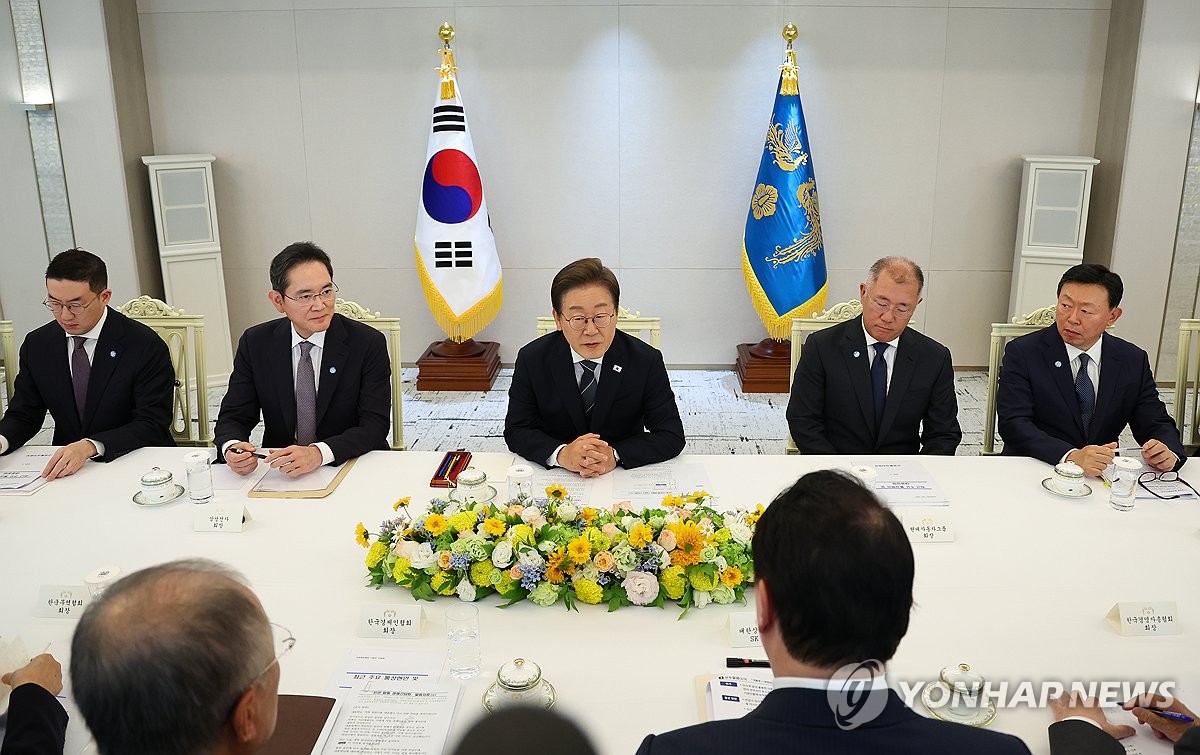 Image: YonhapIn this file photo, President Lee Jae Myung (C) attends a meeting with a group of business leaders at the presidential office in Seoul on June 13, 2025. Also at the meeting were LG Group Chairman Koo Kwang-mo (L), Samsung Electronics Co. Chairman Lee Jae-yong (2nd from L), Hyundai Motor Group Executive Chair Euisun Chung (2nd from R) and Lotte Group Chairman Shin Dong-bin. (Pool photo) (Yonhap) Source Full size
-
Image: YonhapIn this file photo, President Lee Jae Myung (C) attends a meeting with a group of business leaders at the presidential office in Seoul on June 13, 2025. Also at the meeting were LG Group Chairman Koo Kwang-mo (L), Samsung Electronics Co. Chairman Lee Jae-yong (2nd from L), Hyundai Motor Group Executive Chair Euisun Chung (2nd from R) and Lotte Group Chairman Shin Dong-bin. (Pool photo) (Yonhap) Source Full size


Corporate Pledge Secured at Cheong Wa Dae Meeting President Lee Jae Myung convened the heads of the nation’s ten largest chaebols on February 4, obtaining commitments totaling 270 trillion won (US$186 billion) for investment in regional areas over the next five years [1]. The pledge was presented as a binding financial plan to be allocated across five designated regional hubs and three self‑governing provinces [1]. CEOs pledged to align future capital spending with the government’s regional development blueprint, marking the first large‑scale corporate commitment to the policy [1].
Top CEOs Discuss Youth Employment Strategies The summit gathered Samsung Electronics Chairman Lee Jae‑yong, Hyundai Motor Group Executive Chair Euisun Chung, LG Group Chairman Koo Kwang‑mo and other leaders to explore mechanisms for creating jobs for young South Koreans [1][2]. Both articles note that the president will press firms to expand hiring of recent graduates and to locate new factories outside Seoul, where land and utility constraints have limited expansion [1][2]. The dialogue builds on a prior meeting with foreign business chambers, indicating a sustained governmental push on youth labor market issues [2].
Government Outlines Regional Hub and Province Plan Lee announced a strategy to develop five major regional hubs complemented by three special self‑governing provinces, aiming to decentralize economic activity from the capital [1]. The plan includes special legislation to establish renewable‑energy industrial complexes and “energy cities,” granting greater fiscal weight to distant regions when allocating resources [1]. Federation of Korean Industries chair Ryu Jin confirmed that the top ten firms will channel the pledged funds into these designated areas within the five‑year horizon [1].
Legislative Measures Target Renewable Energy Zones The administration intends to pass laws creating renewable‑energy zones and to support “energy cities” that will host clean‑power infrastructure and related industries [1]. These measures are designed to attract corporate investment by offering incentives and streamlined permitting for projects in under‑developed regions [1]. The policy reflects Lee’s argument that improved transport and communications now make regional sites more viable for large‑scale production [1].
China Responds with Constructive Stance on Peninsula Issues On February 3, Chinese Ambassador Dai Bing said Beijing would play a “constructive role in our way” to support peace on the Korean Peninsula, praising Lee’s efforts to ease inter‑Korean tensions [3]. Dai also announced the removal of a contested fixed platform in the Yellow Sea, describing it as a civilian aquaculture structure, to reduce maritime disputes [3]. The statement links China’s diplomatic posture to the broader context of Lee’s regional and youth‑employment initiatives, suggesting external approval of Seoul’s domestic reforms [3].
Sources
-
1.
Yonhap:President Lee Secures 270 trillion‑won Pledge from Conglomerates for Regional Growth: Details the February 4 meeting, the 270 trillion‑won commitment, CEOs present, and the government’s hub and renewable‑energy legislation .
-
2.
Yonhap:President Lee to Convene Top Conglomerate Heads on Youth Jobs and Regional Investment: Announces the February 3 scheduled meeting, lists attending conglomerates, emphasizes youth‑employment focus, and references prior foreign‑business dialogue .
-
3.
Yonhap:China Says It Will Play “Constructive Role in Our Way” on Korean Peninsula: Reports China’s diplomatic comments, praise for Lee’s peace efforts, clarification of disputed maritime structures, and removal of a fixed platform .
Timeline
Dec 2 2025 – President Lee Jae Myung pledges a phased denuclearisation of the Korean Peninsula, sets a target to start formal talks within six months and aims for a full agreement by 2030, while reaffirming the U.S. security alliance [30].
Dec 2 2025 – Lee calls for restoring inter‑Korean hotlines and other diplomatic contacts, arguing that reopening channels will reduce tensions and enable dialogue [29].
Dec 3 2025 – Foreign Minister Cho Hyun stresses that diplomatic engagement with North Korea must accompany deterrence, urging de‑escalation and the resumption of talks [28].
Dec 4 2025 – Kim Jong Un declares that expanding North Korea’s nuclear capabilities is essential to counter a “geopolitical crisis,” signalling a hardening stance [17].
Dec 18 2025 – Seoul asks Beijing to help create conditions for renewed North‑Korean talks; China’s Ma Zhaoxu affirms a constructive role and both sides discuss the disputed Yellow Sea steel structures [24].
Dec 30 2025 – Lee announces his upcoming four‑day state visit to China, the first by a South Korean president since 2017, aiming to restore a “strategic cooperative partnership” and seek Beijing’s help on the Korean Peninsula [23].
Jan 2 2026 – Cheong Wa Dae confirms that Lee and Xi will hold a bilateral summit in Beijing on Monday [22].
Jan 2 2026 – Lee prepares to meet Xi, then travel to Shanghai, focusing on supply‑chain cooperation, North‑Korean security and urging China to play a constructive role in Korean‑Peninsula peace [21].
Jan 3 2026 – Korean media highlight the upcoming Xi meeting, Lee’s reaffirmation of the One‑China policy, and concerns over AI, the KOSPI and China’s unofficial ban on Korean cultural content [20].
Jan 4 2026 – Lee departs Seoul for Beijing, launching his first presidential visit to China since 2019, travelling with a 400‑person business delegation [19].
Jan 4 2026 – Lee lands in Beijing, begins a four‑day state visit centred on North‑Korea, trade and cultural exchanges, and reiterates South Korea’s One‑China stance in a CCTV interview [18][5].
Jan 4 2026 – North Korea fires ballistic missiles toward the East Sea ahead of its party congress, adding volatility to Lee’s diplomatic agenda [5].
Jan 5 2026 – Lee and Xi open talks in Beijing, stressing denuclearisation on the peninsula and expanding economic and cultural ties; the meeting follows Xi’s earlier APEC encounter with Lee [16].
Jan 5 2026 – Both leaders publicly back the resumption of dialogue with North Korea, underscoring the priority of Korean‑Peninsula diplomacy [15].
Jan 6 2026 – Lee meets Xi, describes the visit as a “crucial opportunity” to usher in a new phase of South‑Korea‑China relations, signs cooperation deals in technology, trade and the environment, and raises security cooperation on North Korea [1].
Jan 7 2026 – Lee returns to Seoul after the China trip, says he expects China to remove at least one of the three Yellow Sea steel platforms and reiterates his request for Xi to mediate on Korean‑Peninsula issues [13][12].
Jan 7 2026 – Lee tells reporters he asks China to act as a mediator on North‑Korean nuclear matters, noting that inter‑Korean channels are “completely blocked” and that “zero trust” remains [14][4].
Jan 7 2026 – Xi acknowledges the request and says China will try to mediate, urging patience as “military pressure makes North Korea extremely nervous” [14].
Jan 7 2026 – Lee highlights China’s informal ban on Korean cultural content, quoting Xi’s metaphor that the “large lump of ice will melt gradually” as talks progress [14].
Jan 7 2026 – Finance Minister Koo Yun‑cheol pledges deeper cultural cooperation with China, planning a phased revival of arts, sports, tourism and media exchanges after the summit [6].
Jan 12 2026 – Lee urges deeper Korea‑Japan cooperation ahead of the Nara summit, stressing shared values and the need to complement each other on regional challenges [11].
Jan 12 2026 – Prime Minister Sanae Takaichi hosts Lee in Nara for the first full summit, focusing on trade, security and cultural ties, and schedules a visit to the historic Hōryū‑ji temple [3].
Jan 13 2026 – Lee and Takaichi meet in Nara, pledge to boost bilateral cooperation, discuss North‑Korea and China‑Japan tensions, and note that lifting Fukushima‑related import bans is needed for South Korea’s TPP accession [2].
Jan 20 2026 – Foreign Minister Cho Hyun announces plans to seek a one‑on‑one meeting with Chinese FM Wang Yi in the first quarter to address Yellow Sea platform disputes and the unofficial Korean‑content ban [10].
Jan 21 2026 – Lee vows a diplomatic push to restart North‑Korea‑U.S. talks, restore the 2018 inter‑Korean military agreement, and warns that North Korea can produce 10‑20 nuclear weapons per year and advance ICBM technology [8][9].
Jan 21 2026 – Lee predicts the won will firm to around 1,400 per USD within one‑to‑two months and outlines measures to stabilise the foreign‑exchange market [7].
Jan 21 2026 – A Seoul court prepares to deliver a verdict on former Prime Minister Han Duck‑soo’s alleged role in the 2024 emergency martial‑law order, a case that could set a precedent for political accountability [7].
Jan 21 2026 – Prime Minister Kim Min‑seok plans a U.S. visit to meet senior officials and possibly Vice President J.D. Vance, marking his first overseas trip as prime minister [7].
Jan 21 2026 – Hanwha Defence appoints former Canadian Navy officer Glenn Copeland as CEO of its Canadian unit to lead the Ottawa submarine‑bid effort [7].
Jan 21 2026 – Cultural authorities grant conditional approval for BTS to film at historic Seoul sites, reflecting a broader cultural‑diplomacy push [7].
Dive deeper (17 sub-stories)
-
President Lee Secures 270 Trillion Won Pledge From Chaebols for Regional Growth
(2 articles)
-
China Commits Constructive Role, Removes Yellow Sea Platform, Calls for Security Guarantees
(53 articles)
-
President Lee Jae Myung Unveils $36 Billion FDI Record and Global Investment Hub Strategy
(5 articles)
-
South Korea Reviews Appointment of Special Envoy Ahead of Trump’s Planned China Visit
(37 articles)
-
Lee Jae Myung’s Pragmatic Diplomacy Targets US Alliance, China, Japan, and North Korea
(27 articles)
-
Unification Minister Unveils Nine‑Project Plan to Restart Inter‑Korean Exchanges
(2 articles)
-
North Korea Demands Sanctions Relief and Nuclear Recognition Before Resuming Talks
(6 articles)
-
Yonhap: Lee calls for 3-way cooperation with Tokyo and Beijing in summit with Takaichi
-
South Korean Leader Urges Japan to Deepen Cooperation Amid Historical Reconciliation Efforts
(2 articles)
-
Yonhap: Lee and Takaichi begin summit talks in Nara
-
Lee Pushes Expanded Korea‑China Startup, AI, Beauty, and Culture Collaboration During Shanghai Visit
(3 articles)
-
Lee and Xi Agree to Annual Summits, Expanded Defense Ties, and North Korea Dialogue
(5 articles)
-
Lee Jae Myung’s Beijing Visit Yields Nine MOUs Across Tech, Consumer Goods, and Supply Chains
(4 articles)
-
Lee‑Xi Summit Drives Security Talks, Cultural Ban, and Administrative Reform Agenda
(2 articles)
-
Yonhap: Lee calls national unity urgent task
-
Yonhap: Kim Chang-son, NK protocol chief, dies, KCNA reports
-
South Korea’s Foreign Minister Cho Hyun Commits to Dialogue and Submarine Talks
(2 articles)
All related articles (154 articles)
-
Yonhap: President Lee Secures 270 trillion‑won Pledge from Conglomerates for Regional Growth
-
Yonhap: President Lee to convene top conglomerate heads on youth jobs and regional investment
-
Yonhap: China Says It Will Play “Constructive Role in Our Way” on Korean Peninsula
-
Yonhap: President Lee pledges to position South Korea as premier global investment hub
-
Yonhap: President Lee Calls on Foreign Firms to Expand South Korean Investment
-
Yonhap: South Korean Government Reviews Special Envoy to Aid U.S.–North Korea Talks
-
Yonhap: South Korea to Boost Cultural Cooperation with China After Summit
-
Yonhap: Lee Jae Myung's pragmatism guides diplomacy with US, China and Japan
-
Yonhap: South Korea calls for pragmatic peace with North Korea and phased denuclearization with renewed U.S. engagement
-
Yonhap: Unification minister vows to resume inter-Korean exchanges, outlines nine-program plan
-
Yonhap: Lee vows diplomacy to restart NK-U.S. talks; court to rule on ex-PM Han; Hanwha taps Canadian officer for Ottawa bid; PM to visit U.S.; BTS filming approved
-
Yonhap: Lee vows diplomatic push to restart North Korea-U.S. talks and revive inter-Korean dialogue
-
Yonhap: Lee vows diplomatic push to resume NK-U.S. talks and restore 2018 inter-Korean pact
-
Yonhap: Lee vows diplomacy to restart North Korea-U.S. talks and restore military pact
-
Yonhap: Lee calls to restore 2018 pact reducing military tension with North Korea
-
Yonhap: Lee vows diplomatic push to restart North Korea-U.S. talks and inter-Korean dialogue
-
Yonhap: South Korea seeks first-quarter talks with China's Wang Yi on maritime issues and culture ban
-
Yonhap: North Korea would seek sanctions relief and nuclear acknowledgment to engage in talks, ex-envoy says
-
Yonhap: Lee stresses mutually beneficial relations with Japan
-
Yonhap: Ministries launch regular consultative channel on North Korea policy
-
Yonhap: South Korea's Lee calls for bipartisan diplomacy after Xi and Takaichi talks
-
Yonhap: Seoul and Tokyo deepen security and economic ties after second shuttle-diplomacy summit
-
Yonhap: Lee returns home from Japan trip focused on deepening bilateral ties
-
Yonhap: Lee returns from Japan trip focused on deepening bilateral ties and regional cooperation
-
Yonhap: Lee tells Takaichi cooperation between Seoul and Tokyo more important than ever
-
Yonhap: Lee says S. Korea and Japan reaffirm commitment to complete denuclearization of Korean Peninsula
-
Yonhap: Lee calls for 3-way cooperation with Tokyo and Beijing in summit with Takaichi
-
AP: South Korea and Japan pledge to deepen cooperation at Nara summit
-
Yonhap: Lee says Korea-Japan cooperation vital amid complex regional order in Nara talks
-
Yonhap: Lee urges Seoul-Tokyo cooperation amid complex global order
-
Yonhap: Lee tells Takaichi cooperation between South Korea and Japan more important than ever
-
Yonhap: Lee Jae Myung and Takaichi Begin Nara Summit Talks
-
Yonhap: Lee and Takaichi begin summit talks in Nara
-
Yonhap: Lee Jae Myung arrives in Japan for summit with Takaichi on Jan. 13
-
Yonhap: Lee arrives in Japan for shuttle diplomacy summit with Takaichi
-
Yonhap: Lee departs for Nara for summit with Takaichi
-
Yonhap: Lee says Korea-Japan ties are as important as China, urges cooperation ahead of Nara summit
-
Yonhap: Lee to meet Japan's Takaichi in Nara for two-day summit on ties and regional issues
-
AP: Japan's Takaichi to host Lee in Nara for first full summit amid regional tensions
-
Yonhap: Lee urges deeper Korea-Japan cooperation ahead of Nara summit
-
Yonhap: Lee urges deeper Korea-Japan cooperation ahead of Nara summit
-
Yonhap: Japan PM says Korea-Japan cooperation 'more important than ever' during Tokyo talks with lawmakers
-
Yonhap: Lee to visit Nara for summit with Takaichi to bolster ties
-
Yonhap: Blue House says Lee and Japan's Takaichi to bolster humanitarian cooperation to resolve historical issues
-
Yonhap: Lee to visit Nara for summit with Takaichi next Tuesday
-
Yonhap: Lee to visit Nara for summit talks with Takaichi next week
-
Yonhap: Lee to visit Nara for Jan 13-14 summit with Takaichi, Cheong Wa Dae says
-
Yonhap: Lee says China visit laid foundation for full restoration of ties with Beijing
-
Yonhap: Lee-Xi summit yields no quick end to China’s ban on Korean culture
-
Yonhap: South Korean papers lead with Lee's China diplomacy and Yellow Sea structures removal
-
Yonhap: President Lee returns from four-day China visit after talks with Xi to boost ties and press Beijing on Yellow Sea structures
-
Yonhap: President Lee returns from four-day China visit after summit with Xi on economy and North Korea
-
AP: South Korea’s Lee asks China’s Xi to mediate as ties with North Korea remain blocked
-
Yonhap: S. Korea envoy says envisioned Lee–Takaichi summit in Nara could meaningfully advance bilateral ties
-
Yonhap: Lee urges deeper South Korea–China startup partnership at Shanghai summit
-
Yonhap: President Lee asks Xi to mediate on Korean Peninsula, including North Korea nuclear issue
-
Yonhap: South Korea’s Lee asks China’s Xi to mediate Korean Peninsula, including North Korea nuclear issue
-
Yonhap: Lee says he asked Beijing to mediate on North Korea nuclear issue during Shanghai visit
-
Yonhap: Lee says he asked Beijing to play mediator role on Korean Peninsula
-
Yonhap: Lee frames China state visit as turning point while summit highlights unresolved strategic gaps
-
Yonhap: Lee urges easing South Korea-China public tensions to deepen economic ties during Shanghai visit
-
Yonhap: Lee urges easing South Korea–China public tensions to boost economic cooperation during Shanghai visit
-
Yonhap: President Lee visits Shanghai to mark provisional government site, attend startup summit
-
Yonhap: Lee arrives in Shanghai to mark provisional government site and attend Korea‑China startup summit
-
Yonhap: Lee tells China's premier on Jan. 6 he will make restoration of Seoul-Beijing ties an 'irreversible' trend
-
Yonhap: Lee urges Li to make restoration of Korea-China ties an 'irreversible trend' during Beijing meetings
-
Yonhap: Lee and Xi meet in Beijing as leaders seek to restore ties and cooperate on North Korea and Yellow Sea
-
BBC: South Korea's Lee meets Xi in Beijing seeking 'new phase' and cooperation on security, culture and trade
-
Yonhap: Korean press frames revival of S. Korea-China ties as annual summit and cultural-exchange push
-
Yonhap: Lee to meet Li Qiang on Jan. 6 after Xi talks
-
Yonhap: Lee Jae Myung and Xi Jinping push to resume North Korea talks at Beijing summit
-
Yonhap: Jan 5, 2026: Lee and Xi push to resume talks with North Korea at Beijing summit
-
Yonhap: Xi says Lee's visit is meaningful, firms up basis for 'new era' of S Korea-China relations, Seoul official
-
Yonhap: Lee and Xi urge resumption of talks with North Korea, Cheong Wa Dae says
-
Yonhap: Lee and Xi agree on joint efforts to address negative sentiment toward South Korea and China, Cheong Wa Dae says
-
Yonhap: Lee and Xi pledge annual meetings, expand defense communication, Cheong Wa Dae says
-
Yonhap: Lee Jae Myung seeks viable peace measures with China at Beijing summit amid regional tensions
-
Yonhap: Lee calls for joint efforts with China to explore viable measures for Korean Peninsula peace
-
The Hindu: South Korea's Lee meets Xi with trade, Pyongyang on agenda
-
Yonhap: Lee Jae Myung and Xi begin summit focused on denuclearization and economic ties
-
Yonhap: Lee and Xi begin summit talks at Cheong Wa Dae
-
Yonhap: Korean and Chinese firms sign nine MOUs during Lee Jae Myung's Beijing state visit
-
Yonhap: Lee calls for expanded Korea-China cooperation in AI, beauty and culture during Beijing forum
-
Yonhap: Lee calls for cooperation with China in AI, beauty and cultural products
-
Yonhap: Lee to attend forum with top execs ahead of Xi summit
-
Yonhap: Lee to meet Xi in Beijing for Monday summit on North Korea, trade and culture
-
Yonhap: Jan 5: Korea's Lee Jae Myung travels to China to reset Seoul-Beijing ties
-
Yonhap: Beijing visit tests Seoul's bid for strategic autonomy as North Korea fires missiles
-
Yonhap: Kim says need to advance North Korea's nuclear capabilities amid geopolitical crisis
-
Yonhap: Lee calls China an important partner for peace on Korean Peninsula
-
Yonhap: Lee Jae Myung arrives in Beijing for Xi summit as North Korea fires missiles
-
Yonhap: South Korean business leaders depart for China ahead of state visit
-
Yonhap: Lee Jae Myung arrives in Beijing for Xi talks on North Korea and trade
-
Yonhap: Lee Jae Myung departs for Beijing for Xi Jinping summit talks
-
The Hindu: Lee Jae Myung begins four-day China visit amid Taiwan tensions with Japan
-
AP: South Korean president visits China to deepen ties as Beijing-Japan tensions over Taiwan rise
-
Yonhap: Lee Jae Myung heads to Beijing for Xi summit during four-day state visit
-
Yonhap: South Korean newspapers on Jan 3 highlight Xi meeting, One China policy, admin reform, AI shifts, and stocks
-
Yonhap: S Korea maintains one-China policy ahead of Xi summit
-
Yonhap: Lee Jae Myung says South Korea will continue to respect 'one-China' policy ahead of China visit
-
Yonhap: South Korea urges North Korea to return to dialogue and end hostilities
-
Yonhap: Lee calls national unity urgent task
-
Yonhap: Lee Jae Myung and Xi Jinping set for Monday Beijing summit on Korean peace and denuclearization
-
Yonhap: Lee-Xi summit to discuss economy and peninsula peace as Korea braces for cold wave and market gains
-
The Hindu: China's Xi to host South Korea's Lee in New Year amid Japan tensions
-
Yonhap: Lee to press Xi on economic ties as Beijing summit unfolds, Shanghai visit planned
-
Yonhap: Lee and Xi plan Monday summit in Beijing
-
Yonhap: South Korea starts 2026 with focus on regional elections, foreign policy, and exports
-
Yonhap: South Korea's Lee Jae Myung pledges active support as pacemaker for NK-U.S. talks in 2026
-
Yonhap: Lee vows active support as 'pacemaker' for potential North Korea-U.S. talks this year
-
Yonhap: Lee outlines plan for major leap across politics, economy, diplomacy in 2026
-
Yonhap: South Korea, China vow concrete outcomes from Lee Jae Myung's state visit
-
Yonhap: Lee Jae Myung to visit China for Xi Jinping summit next week
-
Yonhap: Lee to visit China for Xi summit next week
-
Yonhap: Lee Jae Myung to visit China Jan. 4-7 for Xi Jinping summit
-
Yonhap: Lee to visit China January 4-7 for summit talks with Xi Jinping, Cheong Wa Dae says
-
Yonhap: South Korea seeks UN chief’s visit to North Korea to restart dialogue
-
Yonhap: South Korea asks UN chief to visit North Korea to push dialogue
-
Yonhap: Kim Chang-son, NK protocol chief, dies, KCNA reports
-
Yonhap: Prospects for Kim-Trump summit rise around Trump's planned April China trip
-
Yonhap: Lee refocuses diplomacy and economy ahead of local elections
-
Yonhap: South Korea’s Lee leans toward appeasement, seeks sanctions relief amid North Korea tensions
-
Yonhap: South Korea's Cho vows dialogue with North Korea for peninsula peace
-
Yonhap: SK-led business delegation eyes China trip ahead of Korea-China summit
-
Yonhap: S. Korea, China plan Lee-Xi summit early next year, Cho says
-
Yonhap: Lee orders security ministers' meeting to coordinate North Korea policy
-
Yonhap: Unification minister pledges lead role in policy toward North Korea
-
Yonhap: South Korea pushes lead on North Korea policy amid border activity and talks push
-
Yonhap: Unification minister vows to lead policy toward North Korea
-
Yonhap: Lee calls for preemptive efforts to reduce tensions with North Korea
-
Yonhap: Unification minister says Trump's China trip could revive North Korea talks
-
Yonhap: S Korea calls on China to foster conditions to resume talks with North Korea during Beijing dialogue
-
Yonhap: South Korea’s Unification Ministry clashes with Foreign Ministry over North Korea policy after U.S. summit
-
Yonhap: Unification Ministry refuses to attend US-South Korea North Korea talks
-
Yonhap: S. Korea, U.S. say latest talks on North Korea differ from past working group
-
Yonhap: Unification minister urges reopening of inter-Korean exchanges, cooperation
-
Yonhap: S. Korea, U.S. hold comprehensive talks on North Korea policy based on summit fact sheet
-
Yonhap: Dialogue momentum may arise in 2026 to revive stalled N.K.-U.S. diplomacy: think tank
-
Yonhap: S. Korea and U.S. Launch Talks on North Korea Policy
-
Yonhap: S. Korea and U.S. to hold talks on North Korea policy
-
Yonhap: Unification ministry not to participate in upcoming regular Seoul-Washington talks on N. Korea policy
-
Yonhap: Unification ministry reviews participation in Seoul-Washington talks on North Korea policy
-
Yonhap: Seoul, Tokyo plan Lee–Takaichi summit in Nara for mid-January
-
Yonhap: S. Korea and U.S. maintain very close North Korea coordination, envoy says
-
Yonhap: Questions over U.S.–Korea coordination after Chung's divergent North Korea messaging
-
Yonhap: S. Korea, U.S. in talks for regular meeting on coordinating N. Korea policy
-
Yonhap: South Korea’s President Lee Jae‑Myung to Visit Japan in January for Summit with PM Sanae Takaichi
-
Yonhap: South Korean FM Cho Emphasizes Diplomacy with North Korea Amid Deterrence Efforts
-
Yonhap: Lee Proposes Restoring Communication Channels with North Korea
-
Yonhap: President Lee Jae‑Myung Calls for Re‑establishing Dialogue with North Korea
-
Yonhap: Lee Jae‑myung Calls for Restoring Inter‑Korean Communication Channels
-
Yonhap: Lee pledges Korean Peninsula denuclearization
-
Yonhap: South Korea Urges Dialogue as North Korea May Escalate Hostility Next Year
-
Yonhap: South Korean President Lee Reaffirms Reunification Goal Amid G20 Visit