Artemis II Set for Feb 8 Launch Amid Planetary Parade and New NASA Astronaut
Updated (13 articles)
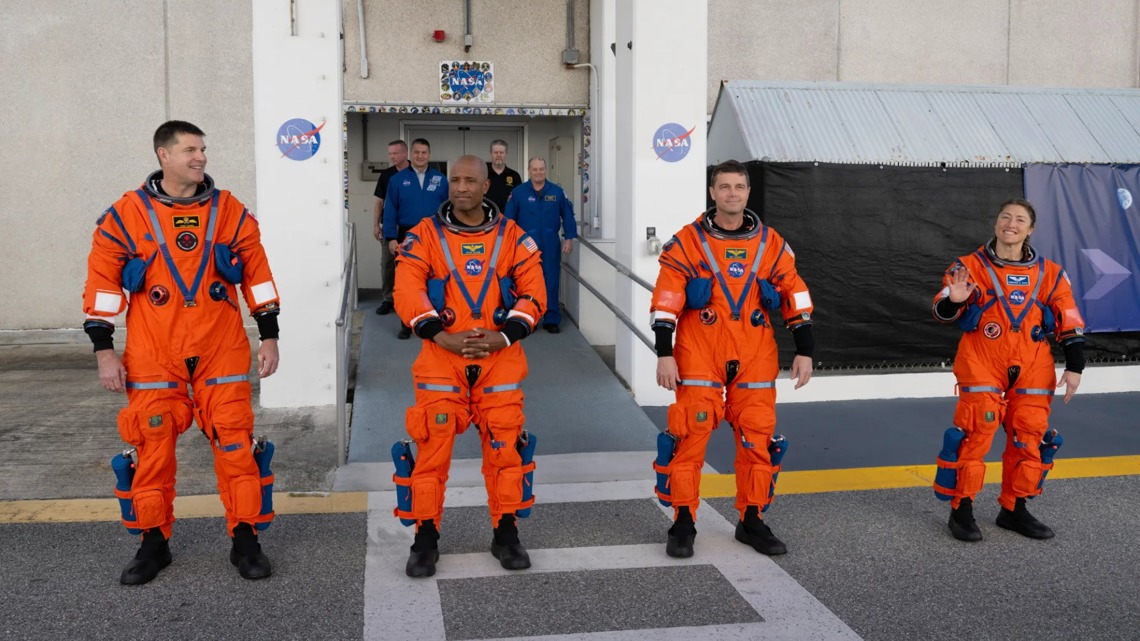
Artemis II Launch Window and Four‑Person Crew NASA has opened a launch window beginning Feb 8, 2026, with the exact lift‑off date pending final safety checks [3][4]. The crew consists of commander Reid Wiseman, pilot Victor Glover, mission specialist Christina Koch, and Canadian astronaut Jeremy Hansen, marking the first crewed lunar‑related launch in over five decades [1][3][4]. This international lineup reflects NASA’s partnership with the Canadian Space Agency and the program’s return to deep‑space human flight after Apollo 17 [3][4].
Ten‑Day Lunar Flyby Tests Orion and SLS Systems The mission will last roughly ten days, including a two‑day Earth‑orbit segment to verify Orion’s life‑support, air‑regeneration, and carbon‑dioxide removal systems [1][3][4]. Afterward the spacecraft will perform a targeting demonstration before looping around the Moon for a flyby, without attempting a surface landing [1][3][4]. Data gathered will inform hardware and operational designs for future Artemis landings and longer‑duration Mars missions [3][4].
Artemis Program Targets Moon Base and Mars Pathway Artemis aims to establish a permanent human presence at the lunar south pole, where water‑ice deposits are suspected, serving as a staging point for crewed missions to Mars [1][4]. The program competes with China’s announced 2030 Taikonaut lunar landing, prompting congressional calls for an accelerated U.S. return [2]. NASA’s long‑term roadmap envisions the Artemis II flight as a critical step toward the Artemis III landing and eventual Martian exploration [1][3][4].
February Planetary Parade and New Majority‑Female Astronaut Starting Feb 17, a planetary alignment featuring Venus, Jupiter, Saturn, Uranus, Neptune and Mercury will be visible, with Venus appearing at sunset on the new‑moon day [1]. Washington native Dr Lauren Edgar, selected in 2025 for NASA’s first majority‑female astronaut class, is now in a two‑year training program that includes ISS robotics and geology practice [1]. Edgar’s training underscores the program’s emphasis on diverse expertise for upcoming Artemis missions [1].
Blue Origin Shifts to Lunar Program as NASA Contracts Expand Blue Origin announced a minimum two‑year pause of its New Shepard suborbital tourism flights to redirect resources toward its human lunar‑lander development [2]. NASA has awarded lunar‑lander contracts to both Blue Origin and SpaceX, with SpaceX slated for Artemis III and Blue Origin positioned as a backup if schedule slips occur [2]. Lawmakers are urging a swift lunar return before China’s 2030 goal, adding political pressure to the commercial lunar‑landscape [2].
Sources
-
1.
King5: February Sky Above: Planet Parade, Artemis II Launch, and a New NASA Astronaut: Highlights the Feb 8 Artemis II launch window, crew details, planetary parade beginning Feb 17, and Dr Lauren Edgar’s selection to the majority‑female astronaut class, emphasizing training and cold‑weather launch risks.
-
2.
CNN: Blue Origin pauses New Shepard tourism flights to focus on lunar program: Reports Blue Origin’s two‑year suspension of suborbital tourism to prioritize lunar‑lander development, notes NASA contracts with both Blue Origin and SpaceX, and mentions congressional pressure to beat China’s 2030 lunar goal.
-
3.
WBNS: Artemis II Crewed Moon Flyby Set for Early February 2026: Confirms the Feb 8 launch window, outlines the four‑person crew, describes the lunar flyby mission profile, and frames the flight as a stepping stone toward Moon and Mars exploration.
-
4.
King5: Artemis II crewed lunar flyby set for early February 2026: Reiterates the launch window, crew composition, ten‑day mission objectives, public engagement via #Artemis, and the flight’s role in the broader Artemis roadmap.
Timeline
Dec 1972 – Apollo 17 lands the last humans on the Moon, ending the Apollo era and setting a half‑century benchmark that Artemis II seeks to surpass [2].
Sep 23, 2025 – NASA targets a Feb 5, 2026 launch for Artemis II, names astronauts Reid Wiseman, Victor Glover, Christina Koch and Canadian Jeremy Hansen, and confirms the mission will loop around the Moon without landing [3].
Dec 28, 2025 – The 2026 lunar calendar highlights Artemis II’s far‑side mapping, Blue Origin’s 26‑ft “Blue Moon” lander prototype, and China’s south‑pole rover and ice‑seeking hopper, underscoring growing international activity on the Moon [8].
Dec 31, 2025 – Artemis II stays on track for a possible Feb 6 launch, with the heat‑shield issue from Artemis I resolved, and the crew will conduct health‑science experiments during the ten‑day deep‑space flight [6].
Jan 9, 2026 – NASA announces the rollout of the 322‑ft Space Launch System and Orion capsule from the Vehicle Assembly Building to Launch Complex 39B, plans a wet‑dress rehearsal in late January, and lists Feb 6 as the earliest launch if all systems are green [2].
Jan 17, 2026 – The SLS begins a 4‑mile, 12‑hour crawl to Pad 39B; astronauts watch the move, NASA administrator Jared Isaacman leads cheers, and officials say a February launch remains possible [7].
Jan 18, 2026 – The SLS arrives at Pad 39B, opening launch windows from early February; mission‑management chair John Honeycutt stresses safety, a wet‑dress rehearsal is scheduled, and Airbus’s European Service Module provides essential propulsion for Orion [1].
Jan 18, 2026 – NASA opens Artemis II virtual boarding passes, adding more than 1.5 million public names to an SD card that will fly aboard the spacecraft [10][13].
Late Jan 2026 – NASA conducts a wet‑dress rehearsal on Pad 39B, simulating fuel handling and countdown procedures to validate launch readiness [1][2].
Jan 30, 2026 – NASA sets the first launch window to begin Feb 8, confirms the four‑person crew, and outlines a lunar flyby that will test Orion’s life‑support, navigation and targeting systems [9][12].
Jan 30, 2026 – Blue Origin pauses New Shepard sub‑orbital tourism flights for at least two years to redirect resources toward its human‑lunar capabilities [4].
Jan 31, 2026 – NASA administrator Jared Isaacman meets with SpaceX and Blue Origin to discuss accelerating the Artemis timeline and ensuring NASA does not wait on a single contractor [4].
Early Feb 2026 – NASA performs a fueling test of the SLS on Pad 39B, a prerequisite before confirming the exact Artemis II launch date [11][13].
Feb 8, 2026 – The first Artemis II launch window opens, marking the first crewed lunar‑related launch in over 50 years and a key step toward a sustainable lunar presence [9][12].
Feb 17, 2026 – A planetary parade featuring Venus, Jupiter, Saturn, Uranus, Neptune and Mercury begins, offering public sky‑watching opportunities throughout February [11].
2027 (earliest) – Artemis III plans a lunar south‑pole landing, with the surface lander still undecided between SpaceX’s Starship and Blue Origin’s concept [2].
2028 – NASA expects SpaceX’s Starship Human Landing System to carry astronauts to the Moon for Artemis III, though schedule risks keep the exact date uncertain [5].
2030 – China targets a crewed south‑pole mission by 2030, prompting U.S. congressional calls for an earlier American lunar return [4].
Ongoing – The Artemis program pursues a permanent lunar base, Gateway expansion, and a stepping‑stone architecture for future crewed missions to Mars [2][11].
Dive deeper (4 sub-stories)
-
Artemis II Targets Feb 8 Launch Amid Cold Florida Weather and New Astronaut Spotlight
(8 articles)
-
Blue Origin Halts New Shepard Suborbital Flights to Accelerate Lunar Program
(2 articles)
-
NASA Opens Virtual Boarding Passes for Artemis II, Over 1.5 Million Names Registered
(2 articles)
-
AP: NASA moon rocket rolls to launch pad for crewed Artemis Moon flyaround
All related articles (13 articles)
-
King5 (Seattle, WA): February Sky Above: Planet Parade, Artemis II Launch, and a New NASA Astronaut
-
CNN: Blue Origin pauses New Shepard tourism flights to focus on lunar program
-
WBNS (Columbus, OH): Artemis II Crewed Moon Flyby Set for Early February 2026
-
King5 (Seattle, WA): Artemis II crewed lunar flyby set for early February 2026
-
WBNS (Columbus, OH): NASA offers virtual boarding passes for Artemis II Moon mission
-
King5 (Seattle, WA): NASA opens Artemis II virtual boarding passes for Moon mission
-
BBC: Artemis II set for early February launch after SLS rollout
-
BBC: NASA’s SLS Rocket Reaches Launch Pad 39B for Artemis II
-
AP: NASA moon rocket rolls to launch pad for crewed Artemis Moon flyaround
-
CNN: Artemis II will fly near the Moon with four astronauts but not land
-
CNN: Artemis II on track for first crewed lunar mission with February launch target
-
AP: Moon and sun lead 2026 cosmic lineup with lunar missions, eclipses, and interstellar comet
-
BBC: Artemis II aims for February crewed lunar flyby with four astronauts
External resources (14 links)
- https://www.nasa.gov/news-release/launch-your-name-around-moon-in-2026-on-nasas-artemis-ii-mission/ (cited 6 times)
- https://www3.nasa.gov/send-your-name-with-artemis/ (cited 4 times)
- https://www.nasa.gov/humans-in-space/astronauts/christina-koch/ (cited 2 times)
- https://www.nasa.gov/humans-in-space/astronauts/g-reid-wiseman/ (cited 2 times)
- https://www.nasa.gov/humans-in-space/astronauts/victor-j-glover/ (cited 2 times)
- https://t.co/5nu5GdtPvo (cited 2 times)
- https://t.co/XWDUrrQxhd (cited 2 times)
- https://t.co/ZUh4kMIQqO (cited 2 times)
- https://t.co/xHhp44Qzr4 (cited 2 times)
- https://twitter.com/hashtag/Artemis?src=hash&ref_src=twsrc%5Etfw (cited 2 times)
- https://x.com/NASA/status/2012969742559060312?s=20 (cited 2 times)
- https://x.com/NASAAdmin/status/2011550104608498109?s=20 (cited 1 times)
- https://bit.ly/4q4Vy1O (cited 2 times)
- https://www.asc-csa.gc.ca/eng/astronauts/canadian/active/bio-jeremy-hansen.asp (cited 2 times)