Budget 2026‑27 Targets 4.3% Deficit, 50% Debt‑to‑GDP, Modest Capital Growth
Updated (12 articles)
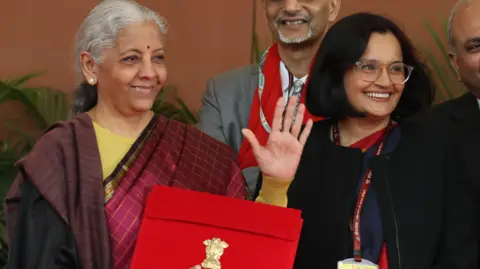
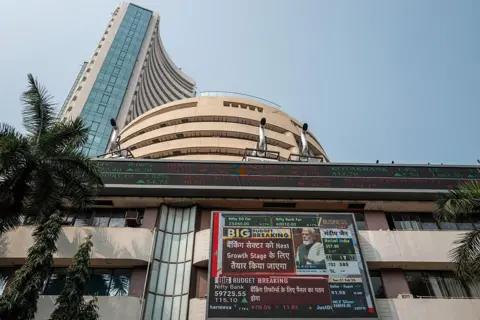
Budget Presentation and Fiscal Framework Finance Minister Nirmala Sitharaman delivered the Union Budget on 1 February 2026, setting a fiscal deficit of 4.3 % of GDP and gross borrowing of ₹17.2 trillion for FY 2026‑27 [8][6][7][11]. The government replaced the traditional deficit‑target with a debt‑to‑GDP ceiling of about 50 % to be achieved by 2031, allowing a higher debt ceiling than the previous 40 % limit [6]. Primary deficit is projected to fall to 0.7 % of GDP in FY 27, while overall deficit narrows slightly from 4.4 % to 4.3 % [6][11].
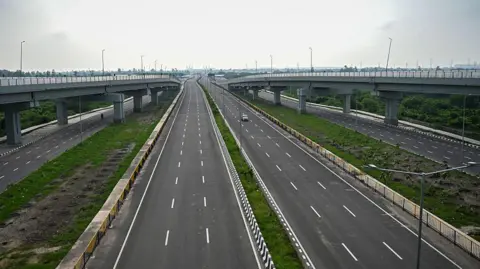
Capital Expenditure Targets and Growth Pace The budget raises centre‑run capex to ₹12.2 lakh crore (≈ 12.2 trillion rupees), roughly 3.1 % of GDP, continuing the shift toward infrastructure‑driven growth [7][9][4]. Since 2020‑21, capex’s share of total outlays has more than doubled, from 12 % to over 22 %, but the annual growth rate of capital spending slowed to 4.2 % in 2025‑26 and only modestly rebounds to 11.5 % in 2026‑27 [1][4]. Analysts note that despite higher headline numbers, the pace of new investment remains near‑static, raising questions about the multiplier impact [1][7].
Defence Budget Expansion and Domestic Procurement record ₹7,84,678 crore is allocated to defence, representing 14.7 % of total spending, with capital outlay rising to ₹2,19,306 crore (27.9 % of the defence budget) [3]. The increase follows Operation Sindoor 2025 and emphasizes replenishing precision‑guided munitions and institutionalising emergency procurement mechanisms [3]. Approximately 75 % of the capital funds are earmarked for Indian manufacturers under the Aatmanirbhar Bharat initiative, though concerns persist about public‑sector absorption capacity [3].
Rural Employment Scheme Funding and Transition Uncertainty The budget combines ₹95,692 crore for the new VB‑GRAMG programme with ₹30,000 crore for MGNREGS, claiming a 43 % increase over the previous year [5]. Activists argue the MGNREGS allocation lacks transparency regarding liability clearance, programme wind‑down, and state‑wise cost‑sharing, warning that the announced ₹125‑day work guarantee is financially untenable [5]. The NREGA Sangarsh Morcha highlighted the omission of any timeline or normative allocations in the Finance Minister’s speech, describing the transition plan as opaque [5].
Manufacturing, Technology Incentives and Execution Gaps New schemes boost seven strategic manufacturing sectors, including a ₹40,000 crore electronics component outlay, a second semiconductor mission, and a tax holiday for foreign cloud providers until 2047 [7][11]. Rare‑earth corridors are announced in four states, and container‑manufacturing and SME growth funds each receive ₹10,000 crore [7][9]. However, execution concerns surface: disinvestment revenue fell far short of the ₹47,000 crore target, and capital spending in 2025‑26 lagged its estimate, while e‑mobility schemes face cuts of over ₹3,700 crore due to under‑utilisation [10][7].
Sources
-
1.
The Hindu Union Budget 2026‑27 Highlights Fiscal Consolidation Challenges: Analyzes revenue‑expenditure ratios, sluggish capital‑expenditure growth, low tax‑revenue buoyancy, and stalled deficit‑reduction pace, warning of debt‑service pressures .
-
2.
The Hindu Union Budget 2026‑27, Economic Survey, India‑EU Deal and Ajit Pawar Crash Summarized: Summarises budget presentation on 1 Feb, Economic Survey forecasts, India‑EU trade pact benefits, and the death of Maharashtra deputy chief minister Ajit Pawar .
-
3.
The Hindu India Boosts Defence Capital Spending in FY27 Budget: Details record defence outlay, increased capital share, post‑Operation Sindoor priorities, and domestic industry focus .
-
4.
The Hindu India’s Capex‑Heavy Budget Raises Growth Prospects but Leaves Labour Behind: Highlights capex‑driven growth model, rising capital share, stagnant youth NEET rates, and divergent employment elasticities .
-
5.
The Hindu Activists Criticise Budget’s Rural Job Scheme Funding and Transition Clarity: Reports on VB‑GRAMG and MGNREGS allocations, activist concerns over opacity, and feasibility of the 125‑day work guarantee .
-
6.
The Hindu India’s New Fiscal Rule Shifts Focus to Debt Ratio, Cuts Rural Spending: Explains the new debt‑to‑GDP target, modest deficit reduction, cuts to rural development outlays, and potential distributional impacts .
-
7.
The Hindu Union Budget 2026‑27 pushes capital spending, manufacturing and cloud incentives: Covers raised capex ceiling, deficit figures, manufacturing incentives across seven sectors, container and SME schemes, and opposition criticism .
-
8.
The Hindu Union Budget 2026‑27: Key Highlights and Policy Direction: Notes budget presentation, emphasis on global integration, infrastructure projects in poll‑bound states, customs duty cuts, and energy‑transition measures .
-
9.
The Hindu Union Budget 2026 Sets Record Capital Spend and Launches Rare‑Earth Corridors: Announces capital‑spending target, three “kartavyas”, new waterways, rare‑earth corridors, and sectoral productivity goals .
-
10.
The Hindu Union Budget 2026 Cuts Funding for Electric Mobility Schemes: Details cuts to PM E‑DRIVE, PM‑eBus Sewa, and SMEC schemes, citing under‑utilisation and a shift toward fiscal prudence .
-
11.
BBC India’s 2026‑27 Budget Targets Infrastructure, Manufacturing and Debt Ratio Amid Global Tensions: Provides an international perspective on infrastructure focus, 7.4 % growth forecast, defence outlay rise, semiconductor mission, cloud tax holiday, and debt‑to‑GDP target shift .
Timeline
Dec 30, 2025 – Prime Minister Narendra Modi convenes Finance Minister Nirmala Sitharaman, Niti Aayog leaders and leading economists to gather input for the upcoming Union Budget, signalling a consultative approach ahead of the February 1 presentation [12].
Jan 31, 2025 – The Economic Survey is tabled in Parliament, projecting FY 26 real GDP growth of 6.8‑7.2 % and noting average headline inflation of 1.7 % for April‑December 2025, setting the macro backdrop for the 2026‑27 budget [5].
2025 – Operation Sindoor, a four‑day aerial clash after the Pahalgam terror attack, prompts the government to institutionalise emergency procurement for precision‑guided munitions, shaping defence capital‑spending priorities in the FY 27 budget [3].
Jan 28, 2026 – Maharashtra Deputy Chief Minister Ajit Pawar dies in a plane crash near Baramati, Pune, an event that dominates national headlines just days before the budget rollout [5].
Feb 1, 2026 – Finance Minister Nirmala Sitharaman presents the Union Budget on a Sunday for the first time, outlining a fiscal deficit of 4.3 % of GDP, gross borrowing of ₹17.2 trn and a capital‑expenditure target of ₹12.2 lakh crore for FY 27, framing the plan as a “Viksit Bharat” vision to 2047 [10][9][4].
Feb 1, 2026 – The budget raises capital spending to ₹12.2 lakh crore, launches rare‑earth corridors in Odisha, Kerala, Andhra Pradesh and Tamil Nadu, and announces a new national waterway in Odisha linking Talcher to Paradip, underscoring infrastructure as a growth engine [4][1].
Feb 1, 2026 – A second semiconductor mission receives $436 m, a zero‑tax concession for foreign cloud providers extends to 2047, and mega‑textiles parks aim to boost exports under the recent India‑EU free‑trade agreement, reflecting a push into high‑tech and trade‑linked sectors [1][9][5].
Feb 1, 2026 – The Union Budget cuts funding for electric‑mobility schemes, slashing the PM E‑DRIVE allocation by ₹2,700 crore and the PM‑eBus Sewa allocation by ₹1,010 crore due to under‑utilisation, marking a shift toward fiscal prudence [8].
Feb 1, 2026 – The budget combines ₹95,692 crore for VB‑GRAMG and ₹30,000 crore for MGNREGS, claiming a 43 % increase, but activist Nikhil Dey warns “the MGNREGS allocation lacks clarity” and says states are left “in the dark” about funding shares [11].
Feb 2, 2026 – The fiscal framework pivots from a deficit target to a debt‑to‑GDP ratio of about 50 % by 2031, allowing a higher debt ceiling while modestly reducing the primary deficit to 0.7 % of GDP and cutting rural development spending to 1.2 % of GDP [7].
Feb 3, 2026 – Analysts note that capex now accounts for over 22 % of total outlays, yet youth NEET rates stall around 25 % and construction’s employment elasticity falls to 0.42, highlighting a dual economy where capital‑intensive firms drive growth but labour creation lags [6].
Feb 4, 2026 – Defence allocation reaches a record ₹7,84,678 crore, with capital outlay rising to ₹2,19,306 crore (27.9 % of the defence budget) to replenish precision‑guided munitions after Operation Sindoor, and 75 % of the capital funds earmarked for domestic industry under Aatmanirbhar Bharat [3].
Feb 4, 2026 – Opposition leaders Mallikarjun Kharge and Rahul Gandhi say “the budget fails the test of economic strategy” and label it anti‑people, while disinvestment revenue falls far short of the ₹47,000 crore target, raising doubts about execution capacity [9].
Feb 5, 2026 – The Union Budget highlights AI, biopharma, semiconductors and critical minerals as pillars of a “Viksit Bharat” by 2047, but low tax‑revenue buoyancy (overall 0.8) and a stalled deficit‑reduction pace threaten sustainable consolidation, with interest payments already consuming 40 % of revenue [2].
Future (by 2047) – The government aims to achieve “Viksit Bharat” status by the centenary year, leveraging the cloud‑tax holiday, semiconductor missions and rare‑earth corridors to position India as a high‑tech manufacturing hub, while targeting a debt‑to‑GDP ratio of 50 % ± 1 % by FY 2030‑31 [1][2][7].
Dive deeper (7 sub-stories)
-
Union Budget 2026‑27 Faces Slowed Deficit Reduction and Weak Tax Buoyancy
(5 articles)
-
India’s FY 2026‑27 Budget Unveiled as Deputy Chief Minister Ajit Pawar Dies in Crash
(2 articles)
-
The Hindu: India Boosts Defence Capital Spending in FY27 Budget
-
The Hindu: India’s Capex‑Heavy Budget Raises Growth Prospects but Leaves Labour Behind
-
The Hindu: Activists Criticise Budget’s Rural Job Scheme Funding and Transition Clarity
-
The Hindu: India’s New Fiscal Rule Shifts Focus to Debt Ratio, Cuts Rural Spending
-
The Hindu: Union Budget 2026 Cuts Funding for Electric Mobility Schemes
All related articles (12 articles)
-
The Hindu: Union Budget 2026‑27 Highlights Fiscal Consolidation Challenges
-
The Hindu: Union Budget 2026‑27, Economic Survey, India‑EU Deal and Ajit Pawar Crash Summarized
-
The Hindu: India Boosts Defence Capital Spending in FY27 Budget
-
The Hindu: India’s Capex‑Heavy Budget Raises Growth Prospects but Leaves Labour Behind
-
The Hindu: Activists Criticise Budget’s Rural Job Scheme Funding and Transition Clarity
-
The Hindu: India’s New Fiscal Rule Shifts Focus to Debt Ratio, Cuts Rural Spending
-
The Hindu: Union Budget 2026‑27 pushes capital spending, manufacturing and cloud incentives
-
The Hindu: Union Budget 2026‑27: Key Highlights and Policy Direction
-
The Hindu: Union Budget 2026 Sets Record Capital Spend and Launches Rare‑Earth Corridors
-
The Hindu: Union Budget 2026 Cuts Funding for Electric Mobility Schemes
-
BBC: India’s 2026‑27 Budget Targets Infrastructure, Manufacturing and Debt Ratio Amid Global Tensions
-
The Hindu: PM Modi meets economists ahead of 2026-27 Union Budget
External resources (4 links)
- https://www.youtube.com/@bbcnewsindia/featured (cited 1 times)
- https://www.facebook.com/bbcindia/ (cited 1 times)
- https://www.instagram.com/bbcnewsindia/ (cited 1 times)
- https://x.com/BBCIndia (cited 1 times)