Spain Announces Under‑16 Social‑Media Ban, Expands Executive Criminal Liability
Updated (38 articles)
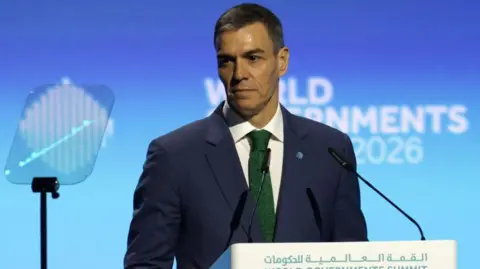
Ban on Social Media for Under‑16s Announced at Dubai Summit Prime Minister Pedro Sánchez revealed the draft law at the World Governments Summit in Dubai on 3 February 2026, prohibiting users younger than 16 from accessing major platforms and mandating stringent age‑verification tools [1][2]. The measure aims to shield minors from addiction, abuse, pornography, manipulation and violence online [1][2]. Spain will begin parliamentary debate next week, following similar restrictions already adopted in Australia and under consideration in France, Denmark and the United Kingdom [2].
Criminal Liability Extended to Platform Executives and Algorithms The legislation creates a new criminal offense for executives who fail to remove illegal or hateful material, holding them personally accountable [1][2]. It also penalises platforms that use algorithms to amplify illegal content, introducing a “hate and polarization footprint” to monitor such activity [2]. Violations could lead to prosecution of senior managers and sanctions against algorithmic practices [1].
Age‑Verification Must Be Robust, Not Simple Check‑Boxes Sánchez warned that current verification methods are easily bypassed, citing Australian children using adult photos to evade checks [1]. The draft law requires verification systems that go beyond superficial check‑boxes, ensuring genuine age confirmation before granting access [1]. Platforms will be obliged to implement these stronger controls as a condition for operating in Spain [1].
Political Reactions and International Context Shape Debate The centre‑right People’s Party backs the ban, while far‑right Vox opposes it, reflecting a split in domestic politics [1]. Elon Musk labeled Sánchez a “tyrant and traitor,” highlighting industry criticism, though platforms have not issued formal statements [1]. Spain’s move follows Australia’s 2025 under‑16 ban and prompts scrutiny from the European Commission and the UK’s ICO, which are investigating related AI tools and platforms [1].
Sources
-
1.
BBC: Spain moves to ban social media for under‑16s – Details Sánchez’s Dubai announcement, robust age‑verification demands, criminal liability for executives, investigations into AI tools, and mixed political and industry reactions .
-
2.
CNN: Spain Moves to Ban Social Media for Under‑16s, Expands Criminal Liability for Platforms – Emphasises the upcoming parliamentary process, hate‑footprint system, algorithmic amplification offenses, and places Spain’s action within a broader international trend .
Timeline
2023 – France enforces a parental‑consent rule for users under 15 on social platforms, a precedent that later fuels broader age‑limit proposals across Europe [22].
Nov 2024 – Australia passes the Online Safety Amendment (Social Media Minimum Age) Bill, establishing a nationwide minimum age of 16 for major social‑media services and setting fines up to A$49.5 million for non‑compliance [19].
2024 – Social‑psychologist Jonathan Haidt publishes The Anxious Generation, arguing that social media harms teen mental health and inspiring Australia’s federal ban [8].
10 Dec 2025 – Australia’s under‑16 ban takes effect at midnight, forcing ten major platforms (including Instagram, TikTok and YouTube) to block or deactivate accounts of users younger than 16; the eSafety Commissioner begins enforcement and announces penalties of up to A$49.5 million [27][20].
12 Dec 2025 – Australia deliberately excludes gaming services such as Discord and Roblox from the ban, prompting those platforms to roll out their own age‑verification tools while critics label the policy “blunt” and “reactionary” [15].
13 Dec 2025 – The Australian government publishes the first‑round compliance notices, confirming that more than 200,000 TikTok accounts and roughly 550,000 Meta accounts have been removed; Prime Minister Anthony Albanese says the reform “puts families back in control” [17][11].
20 Dec 2025 – International media highlight Australia’s ban as a “first‑of‑its‑kind” move, noting that Denmark, France and the UK are already debating similar age limits and that the EU’s Digital Services Act provides a regulatory backdrop [4][16].
30 Dec 2025 – Year‑end tech reviews cite Australia’s under‑16 restriction as a key example of “youth‑access rules” amid a broader AI boom, underscoring global momentum to curb online harms for minors [13].
9 Jan 2026 – One month after the ban, Australian teens like 14‑year‑old Amy report reduced phone use and a shift toward texting, while others such as 13‑year‑old Aahil note only modest changes, illustrating mixed behavioural impacts [12].
12 Jan 2026 – Meta confirms it has blocked about 550,000 Australian teen accounts across Instagram, Facebook and Threads in the first week of compliance, and urges age checks be handled at the app‑store level [11].
14 Jan 2026 – South Korea’s KMCC asks X to implement safeguards against sexual content generated by the Grok AI model and to appoint a minor‑protection officer, reflecting growing regulator focus on AI‑driven harms [28].
20 Jan 2026 – The UK government launches a three‑month public consultation on an under‑16 social‑media ban and new Ofsted powers to make schools “phone‑free by default,” citing Australia’s December 2025 ban as a catalyst [5].
23 Jan 2026 – Meta temporarily disables AI‑generated “characters” for all teen users on Instagram and WhatsApp, a move timed a week before a federal trial of Meta, TikTok and YouTube over alleged child‑harm allegations [10]; eSafety Commissioner Julie Inman Grant tells the BBC that platforms are complying “kicking and screaming” [3].
25 Jan 2026 – French President Emmanuel Macron pushes a fast‑track procedure to enact a ban on social‑media use for under‑15s by September, declaring that “children’s minds are not for sale … to American platforms nor to Chinese networks” and urging swift legislative action [8][9].
26 Jan 2026 – France’s National Assembly adopts core provisions of the under‑15 ban, creating regulator‑approved “harmful” and “less‑harmful” lists and mandating parental consent for the latter; the bill now awaits a full‑text vote and Senate approval [2].
27 Jan 2026 – The French Parliament passes the under‑15 ban by a 130‑21 vote, scheduling implementation for the start of the September school year and simultaneously prohibiting mobile‑phone use in high schools; Macron cites scientific consensus and warns that “children’s brains are not for sale” [7].
3 Feb 2026 – Spain’s Prime Minister Pedro Sánchez announces a draft law to ban social‑media access for under‑16s, to criminalise platform executives who ignore illegal content, and to create a “hate‑and‑polarisation footprint,” with parliamentary debate slated to begin the following week [1][6].
Mid‑Feb 2026 (planned) – Spain’s parliament is expected to vote on the under‑16 ban and related criminal liability provisions within weeks of Sánchez’s announcement [6].
Sep 2026 (planned) – France aims to have the under‑15 ban fully in force at the start of the new school year, pending fast‑track passage through the Senate [2][8].
Mid‑2026 (planned) – Denmark targets a mid‑2026 rollout of its under‑15 ban, using a “digital evidence” app to certify ages and allowing parental exceptions from age 13 [16].
Apr 2026 (planned) – The UK’s three‑month consultation on an under‑16 ban concludes, after which ministers will decide whether to pursue legislation and new Ofsted school‑phone powers [5].
Dive deeper (7 sub-stories)
-
Spain’s Parliament to Ban Social Media for Under‑16s, Expand Executive Criminal Liability
(2 articles)
-
France Parliament Passes Under‑15 Social‑Media Ban, Set for September Implementation
(3 articles)
-
France Seeks Accelerated Under‑15 Social‑Media Ban Ahead of School Year
(27 articles)
-
AP: Meta Temporarily Blocks Teens From AI Characters on Instagram and WhatsApp
-
South Korea’s KMCC Demands X Implement Minor‑Protection Safeguards for Grok AI
(3 articles)
-
BBC: A month into Australia's teen social media ban, teens report changed online habits
-
The Hindu: AI boom, youth-access rules, and flagship launches define 2025 tech year
All related articles (38 articles)
-
BBC: Spain moves to ban social media for under‑16s
-
CNN: Spain Moves to Ban Social Media for Under‑16s, Expands Criminal Liability for Platforms
-
AP: France Approves Bill Banning Social Media for Under‑15s
-
BBC: France Moves Toward Ban on Social Media for Under‑15s
-
CNN: Macron pushes fast‑track ban on social media for under‑15s in France
-
AP: Macron pushes accelerated ban on social media for under‑15s as France cites teen health risks
-
AP: Meta Temporarily Blocks Teens From AI Characters on Instagram and WhatsApp
-
BBC: Australia’s Under‑16 Social Media Ban Faces Reluctant Industry Compliance
-
BBC: Australia imposes first-of-its-kind under-16 social media ban on major platforms
-
BBC: UK to consult on social media ban for under-16s
-
AP: Australia bans under-16 social media use as 4.7 million child accounts are deactivated
-
Yonhap: KMCC asks X to set up minor protection measures for Grok
-
BBC: Meta blocks about 550,000 Australian accounts under new under-16 ban
-
BBC: A month into Australia's teen social media ban, teens report changed online habits
-
The Hindu: AI boom, youth-access rules, and flagship launches define 2025 tech year
-
Yonhap: KMCC nominee says social media ban for teens could be considered
-
Yonhap: KMCC Nominee Signals Consideration of Teen Social Media Ban
-
The Hindu: Australia’s social media minimum age takes effect, with fines for noncompliance
-
BBC: Australia’s under‑16 social‑media ban excludes gaming platforms
-
AP: Reddit Files Court Challenge to Australia’s Under‑16 Social‑Media Ban
-
AP: Denmark Moves Toward 15‑Year‑Old Social Media Ban
-
AP: Australia’s under-16 social media ban takes effect
-
CNN: Australia Enacts First Global Under‑16 Social Media Ban
-
AP: Australia’s Social Media Ban Takes Effect, 15‑Year‑Old Riley Faces Loss of Online Connections
-
BBC: Australia enacts nationwide ban on social media for children under 16
-
BBC: Australia’s world-first under-16 social media ban takes effect
-
CNN: Australia rolls out under-16 social media ban as platforms pledge compliance
-
The Hindu: Australia bans social media for under-16s as others move to curb access
-
The Hindu: Australia begins enforcing world-first teen social media ban (Dec 10, 2025)
-
The Hindu: Meta says Australia pushing teens to 'less regulated' platforms
-
CNN: Australia enacts world-first nationwide ban on social media for under-16s
-
CNN: Australia is banning young teens from social media. Could it happen in the US?
-
The Hindu: Australia to enforce under-16 social media ban starting Dec 10, 2025
-
BBC: Australia’s under-16 social media ban takes effect December 10, 2025
-
BBC: Can you ban kids from social media? Australia is about to, but some teens are a step ahead
-
BBC: Meta starts removing Australian children from social media ahead of ban
-
BBC: Australia’s Social Media Ban: Minister Stays Firm Amid Tech Company Pushback
-
CNN: Australia Approaches Dec 10 Social Media Ban for Under‑16s
External resources (19 links)
- https://governor.nebraska.gov/gov-pillen-signs-last-bills-protect-children-online (cited 1 times)
- https://www.gov.uk/government/news/government-to-drive-action-to-improve-childrens-relationship-with-mobile-phones-and-social-media (cited 1 times)
- https://sml.stanford.edu/sites/g/files/sbiybj22976/files/media/file/academicadvisorygroupstatement.pdf (cited 1 times)
- https://www.tiktok.com/@cnn/video/7581841747634916663 (cited 2 times)
- https://www.tiktok.com/@_heyitszoeyandmark/video/7554659239663324434?_r=1&_t=ZS-91THUdlkMrv (cited 1 times)
- https://x.com/RahmEmanuel/status/1998467923774681394 (cited 1 times)
- https://corp.roblox.com/newsroom/2025/11/roblox-requires-age-checks-limits-minor-and-adult-chat (cited 1 times)
- https://ec.europa.eu/commission/presscorner/detail/en/ip_26_203 (cited 1 times)
- https://ico.org.uk/about-the-ico/media-centre/news-and-blogs/2026/02/ico-announces-investigation-into-grok/ (cited 1 times)
- https://medium.com/chamber-of-progress/utahs-app-store-age-verification-bill-sets-a-dangerous-precedent-3f49058ea343 (cited 1 times)
- https://medium.com/meta-australia-policy-blog/removing-access-to-instagram-threads-and-facebook-for-under-16s-in-australia-1ab448660c0f (cited 1 times)
- https://www.36months.com/ (cited 1 times)
- https://www.aph.gov.au/e-petitions/petition/EN8494 (cited 1 times)
- https://www.bfmtv.com/politique/elysee/document-bfmtv-interdiction-des-reseaux-sociaux-aux-mineurs-emmanuel-macron-engage-la-procedure-acceleree-pour-une-loi-applicable-des-la-rentree-prochaine_AV-202601240240.html (cited 1 times)
- https://www.infrastructure.gov.au/department/media/publications/age-assurance-technology-trial-final-report (cited 1 times)
- https://www.lemon8-app.com/h5/feoffline/report/osa-detail?region=au (cited 1 times)
- https://www.pcgamer.com/hardware/brits-can-get-around-discords-age-verification-thanks-to-death-strandings-photo-mode-bypassing-the-measure-introduced-with-the-uks-online-safety-act-we-tried-it-and-it-works-thanks-kojima/ (cited 1 times)
- https://www.safeonsocial.com/ (cited 1 times)
- https://www.westernsydney.edu.au/young-and-resilient/news/in_media/young_and_resilient_research_centre_joins_chorus_of_nearly_150_australian_and_international_experts_opposing_social_media_ban_for_u16s (cited 1 times)