US Leads Critical Minerals Summit, Proposes Trading Bloc and $12 Billion Reserve
Updated (11 articles)

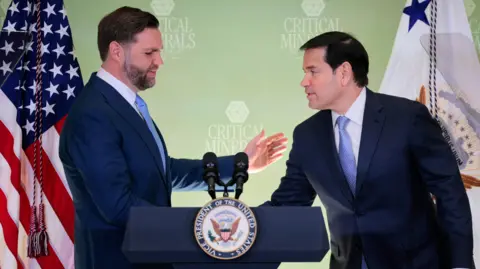


Washington Hosts First Critical Minerals Ministerial on Feb 4 The State Department convened the inaugural Critical Minerals Ministerial on 4 February 2026, drawing 56‑plus nations including the United Kingdom, EU, Japan, India, South Korea and the Democratic Republic of Congo [1][7][8]. Vice President JD Vance, Secretary of State Marco Rubio and South Korean Foreign Minister Cho Hyun attended, underscoring the diplomatic weight of the gathering [1][7][8]. Delegates pledged to diversify supply chains for rare‑earths, lithium and other minerals essential to chips, electric‑vehicle batteries and defense technologies [1][2][4].
FORGE Initiative Rebranded, South Korea Chairs Through June During the ministerial, the Minerals Security Partnership was renamed the Forum on Resource Geostrategic Engagement (FORGE), with South Korea appointed chair until June 2026 [2][3][4]. The rebranding signals a shift toward “bold and decisive action” on global critical‑minerals challenges, building on the earlier MSP framework [3]. Cho Hyun pledged expanded cooperation and concrete projects, while officials from 54‑56 countries and the European Commission participated, representing roughly two‑thirds of global GDP [3][4].
Vance Calls for Trading Bloc with Price Floors and Tariffs Vice President Vance urged allies to form a critical‑minerals trading bloc that would operate a “preferential trade zone” featuring reference price floors and adjustable tariffs to shield members from external disruptions [1][4][5]. The proposal aims to guarantee stable pricing across production stages and protect U.S. industrial access, while coordinating trade policies with Japan and the EU [1][4]. Vance emphasized that the bloc would unite nations accounting for close to two‑thirds of world GDP, reducing reliance on China’s rare‑earth dominance [4].
Trump Announces $12 Billion Project Vault and Massive Mining Funding President Trump unveiled a $12 billion “Project Vault” mineral reserve, praised by industry leaders as critical for U.S. mineral security [1]. The administration also pledged “hundreds of billions of capital” to domestic mining, backing firms such as MP Materials and Lithium Americas to expand production capacity [1]. Trade Representative Jamieson Greer announced coordinated trade mechanisms with Japan and the EU to prevent future access problems for critical minerals [1].
China’s Export Curbs Accelerate Allies’ Diversification Efforts A Chinese Foreign Ministry spokesperson warned against market‑economy violations, while Beijing’s tightened export restrictions in October had previously dealt a “major blow” to U.S. industries [1]. The curbs reinforced the urgency of the ministerial’s goals, prompting the U.S. and its partners to accelerate diversification and secure alternative supply chains [1][2][4].
Sources
-
1.
BBC: US Pushes Trade Zone and Funding to Diminish China’s Grip on Critical Minerals: Details the ministerial launch, Vance’s tariff proposal, $12 bn Project Vault, massive mining investment, and China’s export curbs, highlighting Trump’s call with Xi .
-
2.
Yonhap: South Korea Leads New Critical‑Minerals Initiative Through June: Announces South Korea’s chairmanship of FORGE until June, outlines the initiative’s scope, and notes Vance’s preferential trade zone concept .
-
3.
Yonhap: South Korea Chairs New FORGE Initiative After U.S.-Led Critical Minerals Meeting: Reports Cho Hyun’s participation, 56‑nation attendance, FORGE launch and chair appointment, and bilateral talks on mineral cooperation .
-
4.
Yonhap: U.S. Vice President Vance Calls for Allies to Form Critical Minerals Trading Bloc: Focuses on Vance’s bloc proposal, price‑floor trade zone, and the bloc’s potential to secure U.S. industrial access .
-
5.
Yonhap: U.S. Vice President Vance Proposes Critical Minerals Trading Bloc to Counter China: Emphasizes the bloc’s design, price‑floor mechanism, and its strategic aim to limit Beijing’s influence without naming China .
-
6.
Yonhap: South Korean and U.S. diplomats meet in Washington amid Trump’s tariff warning: Covers Cho Hyun’s meeting with Rubio, the pending trade deal, and the tariff threat preceding the ministerial .
-
7.
Yonhap: U.S. Holds First Critical Minerals Ministerial to Counter China: Summarizes the inaugural ministerial, high‑level attendance, diversification goals, and the Pax Silica coalition .
-
8.
Yonhap: South Korean Foreign Minister Cho to Join First U.S.-Led Critical Minerals Summit: Highlights Cho’s upcoming attendance, Rubio’s chairmanship, tariff dispute background, and South Korea’s $350 bn investment pledge .
Timeline
2022 – The United States launches the Minerals Security Partnership (MSP), a multilateral framework with Japan, Canada, France, the EU and other allies to coordinate investment and policy for lithium, cobalt, nickel and rare‑earth supply chains, laying groundwork for later initiatives such as FORGE. [10]
Aug 2025 – President Donald Trump meets Chinese President Xi Jinping, prompting a temporary pause on Beijing’s stricter export rules and giving U.S. partners a brief window to negotiate alternative sourcing. [2]
Oct 2025 – China imposes tightened export restrictions on rare‑earths and other critical minerals, delivering a “major blow” to U.S. industries and spurring Washington to accelerate diversification efforts; the curbs are later eased, underscoring Beijing’s leverage in trade talks. [1]
Oct 2025 – The United States and Australia sign a landmark critical‑minerals agreement at the White House, committing to joint development of supply chains for chips and EV batteries and responding directly to China’s export curbs. [2]
Dec 8, 2025 – Secretary of State Marco Rubio and Defense Secretary Pete Hegseth meet Australian Foreign Minister Penny Wong and Defense Minister Richard Marles in Washington, reaffirming the AUKUS submarine pact and noting that “the United States remains the foremost partner for Australia’s security in a contested world,” while highlighting the October 2025 U.S.–Australia critical‑minerals deal. [2]
Jan 12, 2026 – Treasury Secretary Scott Bessent hosts a finance ministerial in Washington with 20+ finance leaders, including South Korea’s Deputy Prime Minister Koo Yun‑cheol, and warns that critical‑mineral supply chains are “highly concentrated and vulnerable,” urging coordinated investments to derisk the network. [11]
Jan 22, 2026 – Seoul signals that Foreign Minister Cho Hyun may attend the upcoming U.S.–led critical‑minerals summit, emphasizing South Korea’s role as chair of the Minerals Security Partnership and its commitment to cooperative measures that reduce reliance on China. [10]
Jan 29, 2026 – Cho Hyun confirms his travel to Washington for the inaugural Critical Minerals Ministerial, stating that Seoul “wants to clear up misunderstandings with Washington and honor its investment commitments,” including a $350 billion pledge linked to a pending trade deal. [9]
Feb 2, 2026 – The United States holds its first Critical Minerals Ministerial, chaired by Secretary of State Marco Rubio and attended by Vice President JD Vance, special assistant David Copley and Cho Hyun; the meeting launches the “Pax Silica” coalition to coordinate AI‑related mineral supply and sets the agenda to diversify minerals essential for high‑tech military and consumer products. [7]
Feb 3, 2026 – Cho Hyun meets privately with Secretary of State Rubio, using the one‑on‑one dialogue to address the pending U.S.–South Korea trade pact and President Trump’s threat to raise reciprocal tariffs from 15 % to 25 % if legislative delays persist. [8]
Feb 4, 2026 – Vice President JD Vance urges allies to form a “critical minerals trading bloc,” saying participants are “on the same team” and proposing a preferential trade zone with “price floors” enforced by “adjustable tariffs” to protect against external disruptions; at the same meeting, the Forum on Resource Geostrategic Engagement (FORGE) is launched, rebranding the MSP and appointing South Korea as chair, with Cho Hyun pledging to “broaden cooperation among member states and pursue tangible cooperative projects.” [5][6][4]
Feb 5, 2026 – The United States unveils a $12 billion “Project Vault” mineral reserve, earmarks “hundreds of billions of capital” for mining firms such as MP Materials and Lithium Americas, and announces coordinated trade mechanisms with Japan and the EU; Vice President Vance warns that “foreign supply flooding markets could depress prices and deter investment,” while President Trump describes his call with Xi as “very positive,” and Advanced Magnet Lab’s Wade Senti calls Project Vault “critical” for U.S. mineral security. [1]
June 2026 (expected) – South Korea chairs the FORGE initiative through June, guiding “bold and decisive action” on global critical‑minerals challenges and overseeing implementation of the trading‑bloc framework and price‑floor mechanisms agreed earlier in February. [3]
Dive deeper (2 sub-stories)
All related articles (11 articles)
-
BBC: US Pushes Trade Zone and Funding to Diminish China’s Grip on Critical Minerals
-
Yonhap: South Korea Leads New Critical‑Minerals Initiative Through June
-
Yonhap: South Korea Chairs New FORGE Initiative After U.S.-Led Critical Minerals Meeting
-
Yonhap: U.S. Vice President Vance Calls for Allies to Form Critical Minerals Trading Bloc
-
Yonhap: U.S. Vice President Vance Proposes Critical Minerals Trading Bloc to Counter China
-
Yonhap: South Korean and U.S. diplomats meet in Washington amid Trump’s tariff warning
-
Yonhap: U.S. Holds First Critical Minerals Ministerial to Counter China
-
Yonhap: South Korean Foreign Minister Cho to Join First U.S.‑Led Critical Minerals Summit
-
Yonhap: S Korea weighs Cho Hyun attendance at US-led critical minerals meeting
-
Yonhap: US hosts finance ministerial talks on critical mineral supply chains with S. Korea, Japan and partners
-
AP: Rubio, Hegseth Meet Australian Counterparts to Discuss China, AUKUS, and Critical Minerals