NASA Pushes Artemis II Launch to March After Wet Dress Rehearsal Hydrogen Leak
Updated (13 articles)
Launch Timeline Shifted to March After Rehearsal Issues A wet‑dress rehearsal on Feb 2 exposed a liquid‑hydrogen leak and forced an automatic stop with five minutes left on the simulated countdown, prompting NASA to move the earliest possible launch from the Feb 8 target to early March while it reviews data and schedules a second rehearsal [1].
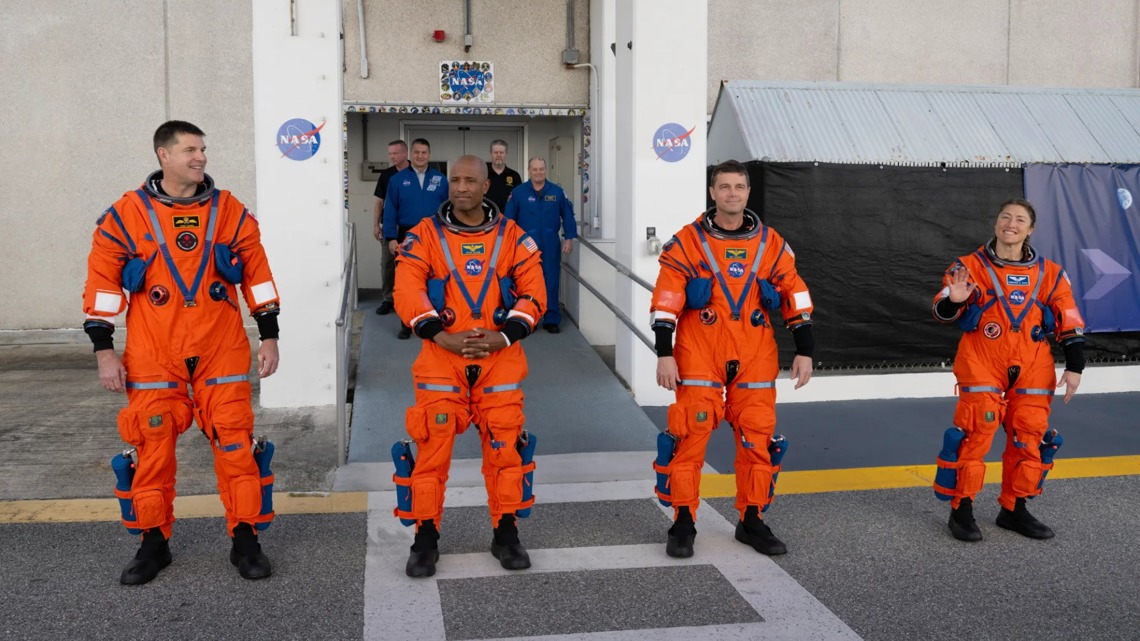
Crew and Mission Profile Remain Unchanged The four‑person crew—Commander Reid Wiseman, Pilot Victor Glover, Mission Specialist Christina Koch and CSA astronaut Jeremy Hansen—will still fly a ten‑day Orion deep‑space flight that loops around the Moon without landing, testing life‑support, navigation and SLS performance [4][5][3].
Quarantine and Training Adjustments Align With New Schedule Astronauts were released from their initial quarantine that began Jan 21 and will re‑enter quarantine about two weeks before the revised launch window, with March 6, 7, 8, 9 and 11 listed as possible dates; meanwhile, new astronaut Lauren Edgar begins a two‑year training program for future Artemis missions [1][3].
Cold Weather and Potential Rollback Add Operational Uncertainty A polar vortex bringing unusually cold temperatures to Florida could delay the “tanking day” and a simulated countdown, and NASA is still evaluating whether the SLS will need to be rolled back to the Vehicle Assembly Building for servicing such as upper‑stage battery replacement [1][3].
Public Outreach and Media Coverage Highlight Mission Significance CNN’s new “Countdown” newsletter promotes the March 6 earliest launch date and promises on‑site coverage, while NASA’s #Artemis social media campaign shares images of the SLS and Orion transport to launch pad, underscoring the mission as humanity’s first deep‑space crewed flight since Apollo 17 [2][5].
Sources
-
1.
CNN: NASA Targets March Launch for Artemis II After Wet Dress Rehearsal Issues: details the hydrogen‑leak problem, shift from Feb 8 to March, quarantine changes, and possible SLS rollback .
-
2.
CNN: CNN Launches Countdown Newsletter Ahead of Artemis II Crew Mission: announces a free newsletter, cites March 6 as earliest launch, and describes on‑site reporting plans .
-
3.
King5: February Sky Above: Planet Parade, Artemis II Launch, and a New NASA Astronaut: notes the original Feb 8 window, cold‑weather concerns, and introduces astronaut Lauren Edgar’s training .
-
4.
WBNS: Artemis II Crewed Moon Flyby Set for Early February 2026: outlines the Feb 8 launch window, crew roster, lunar flyby mission profile, and its role as a Mars stepping stone .
-
5.
King5: Artemis II crewed lunar flyby set for early February 2026: repeats the Feb 8 window, crew details, ten‑day test objectives, and highlights NASA’s #Artemis public engagement .
Timeline
Dec 1972 – Apollo 17 lands the last humans on the Moon, marking the end of the Apollo era and setting a half‑century gap that Artemis II now seeks to close [2].
2022 – NASA launches the uncrewed Artemis I mission, demonstrating the Space Launch System and Orion but later revealing heat‑shield wear that drives a year‑long redesign effort [5].
Sep 2025 – NASA announces that Artemis II could launch as early as Feb 5, 2026, with a crew of Reid Wiseman, Victor Glover, Christina Koch and Canadian astronaut Jeremy Hansen, and outlines a proximity‑operations docking rehearsal for future lunar landings [3].
Dec 31 2025 – Artemis II remains on track for a February 6 launch; NASA confirms the heat‑shield issue from Artemis I has been fixed, and highlights the mission’s role as a pathfinder amid geopolitical competition with China [7].
Jan 17 2026 – The 322‑foot Space Launch System and Orion capsule begin a 4‑mile, 12‑hour rollout from the Vehicle Assembly Building to Launch Pad 39B, watched by the crew and a cheering crowd led by Administrator Jared Isaacman [8].
Jan 18 2026 – The SLS arrives at Pad 39B; NASA opens launch windows from early February onward, cites the European Service Module as essential (“we basically can’t get to the Moon without it”) and stresses safety as the top priority [1].
Jan 18 2026 – NASA opens virtual boarding‑pass sign‑ups, adding more than 1.5 million public names to an SD card aboard Artemis II; Acting Associate Administrator Lori Glaze calls the flight “a key test flight for returning humans to the Moon” [10][13].
Jan 30 2026 – NASA sets the first launch window to begin on Feb 8, 2026, confirming the four‑person crew and describing the 10‑day lunar flyby that will test Orion’s life‑support, navigation and targeting systems; Glaze reiterates the mission’s importance for Moon and Mars exploration [9][12].
Feb 3 2026 – CNN’s “Countdown” newsletter announces that Artemis II could lift off as early as Mar 6, 2026, and promises on‑site coverage from Kennedy Space Center [5].
Feb 3 2026 – NASA’s planetary‑parade brief notes a Feb 17 Venus‑Jupiter‑Saturn alignment and warns that an unusually cold polar vortex could delay the Feb 8 launch, stressing the need to complete a “tanking day” and simulated countdown [11].
Feb 3 2026 – After a wet‑dress rehearsal reveals hydrogen‑leak problems and a five‑minute countdown abort, NASA pushes the earliest launch to March, plans a second rehearsal, and evaluates whether to roll the SLS back to the VAB for battery replacement; crew quarantine is reset for a mid‑March launch window (Mar 6, 7, 8, 9, 11) [4].
Early Feb 2026 (planned) – NASA schedules a fueling test of the SLS on Pad 39B to verify cryogenic propellant loading before confirming a final launch date, with the test serving as the final “go/no‑go” checkpoint [10][13].
2027 – 2028 (planned) – Artemis III aims for the first crewed lunar landing at the Moon’s south pole, with launch no earlier than 2027; NASA is weighing SpaceX’s Starship and Blue Origin’s lander, while SpaceX’s Starship HLS is slated to land on the Moon in 2028 [2][6].
2025 – 2026 (ongoing) – NASA’s newest astronaut class, selected in 2025 and the first to be majority‑female, begins a two‑year training pipeline that includes ISS robotics and prepares candidates for future Artemis missions [11].
Dive deeper (4 sub-stories)
-
CNN: NASA Targets March Launch for Artemis II After Wet Dress Rehearsal Issues
-
Artemis II Launch Window Set for Feb 8, 2026, with Possible March 6 Slip Amid Cold‑Weather Risks
(9 articles)
-
NASA Opens Virtual Boarding Passes for Artemis II, Over 1.5 Million Names Already Registered
(2 articles)
-
AP: NASA moon rocket rolls to launch pad for crewed Artemis Moon flyaround
All related articles (13 articles)
-
CNN: NASA Targets March Launch for Artemis II After Wet Dress Rehearsal Issues
-
CNN: CNN Launches Countdown Newsletter Ahead of Artemis II Crew Mission
-
King5 (Seattle, WA): February Sky Above: Planet Parade, Artemis II Launch, and a New NASA Astronaut
-
WBNS (Columbus, OH): Artemis II Crewed Moon Flyby Set for Early February 2026
-
King5 (Seattle, WA): Artemis II crewed lunar flyby set for early February 2026
-
WBNS (Columbus, OH): NASA offers virtual boarding passes for Artemis II Moon mission
-
King5 (Seattle, WA): NASA opens Artemis II virtual boarding passes for Moon mission
-
BBC: Artemis II set for early February launch after SLS rollout
-
BBC: NASA’s SLS Rocket Reaches Launch Pad 39B for Artemis II
-
AP: NASA moon rocket rolls to launch pad for crewed Artemis Moon flyaround
-
CNN: Artemis II will fly near the Moon with four astronauts but not land
-
CNN: Artemis II on track for first crewed lunar mission with February launch target
-
BBC: Artemis II aims for February crewed lunar flyby with four astronauts
External resources (15 links)
- https://www.nasa.gov/news-release/launch-your-name-around-moon-in-2026-on-nasas-artemis-ii-mission/ (cited 6 times)
- https://www3.nasa.gov/send-your-name-with-artemis/ (cited 4 times)
- https://www.nasa.gov/blogs/missions/2026/02/03/nasa-conducts-artemis-ii-fuel-test-eyes-march-for-launch-opportunity/ (cited 2 times)
- https://www.nasa.gov/humans-in-space/astronauts/christina-koch/ (cited 2 times)
- https://www.nasa.gov/humans-in-space/astronauts/g-reid-wiseman/ (cited 2 times)
- https://www.nasa.gov/humans-in-space/astronauts/victor-j-glover/ (cited 2 times)
- https://t.co/5nu5GdtPvo (cited 2 times)
- https://t.co/XWDUrrQxhd (cited 2 times)
- https://t.co/ZUh4kMIQqO (cited 2 times)
- https://t.co/xHhp44Qzr4 (cited 2 times)
- https://twitter.com/hashtag/Artemis?src=hash&ref_src=twsrc%5Etfw (cited 2 times)
- https://x.com/NASA/status/2012969742559060312?s=20 (cited 2 times)
- https://x.com/NASAAdmin/status/2018578937115271660 (cited 1 times)
- https://bit.ly/4q4Vy1O (cited 2 times)
- https://www.asc-csa.gc.ca/eng/astronauts/canadian/active/bio-jeremy-hansen.asp (cited 2 times)