Modi’s Feb 22 Broadcast Warns of Digital Scams While Highlighting AI Milestones at India’s Global‑South Summit
Updated (13 articles)
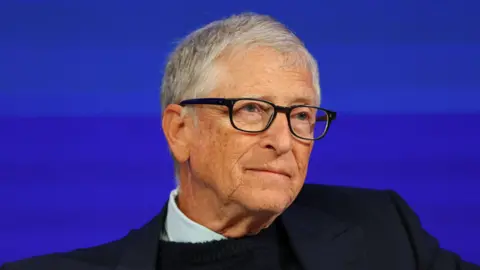
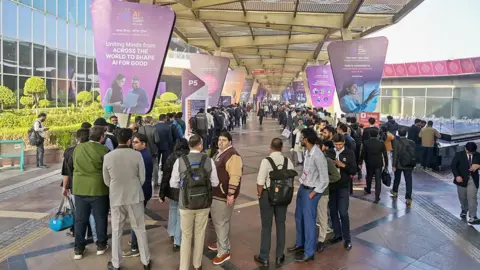
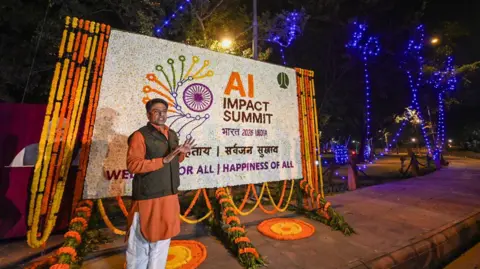
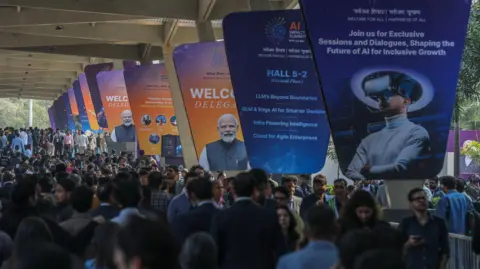
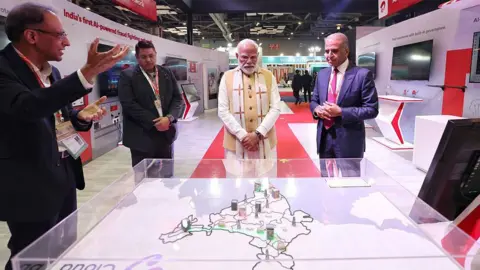
AI Impact Summit draws global leaders to Delhi’s Bharat Mandapam The five‑day summit opened on Feb 17 2026, billed as the first Global‑South AI gathering, with participation from over 100 countries and CEOs such as Sam Altman and Sundar Pichai; Prime Minister Narendra Modi inaugurated the event and Bill Gates later confirmed a keynote appearance [10][11][5][6][8].
India proposes a “Third Way” AI governance model distinct from West and China Host officials unveiled a framework that blends adoption, diffusion, diplomacy and capacity‑building, built on the November 2025 guidelines and a Feb 10 amendment to the IT Rules requiring AI‑generated content labels and three‑hour takedowns; the model stresses strategic autonomy, public‑private partnerships and agility for the Global South [8][6][5].
Human‑centred AI agenda links to millions of jobs and expanded social protection The AI Mission, backed by a $1.2 bn budget, aims to create more than 3 million technology jobs by 2030 and reshape over 10 million existing roles; the ILO‑supported e‑Shram platform now covers 315 million informal workers (64.3 % coverage in 2025) with a $17.5 bn Microsoft AI investment to improve skill matching [6][6][6].
Youth Congress protest underscores trade‑deal and data‑sovereignty worries On Feb 20 2026, shirtless Youth Congress members staged a demonstration at the summit, displaying white tees with Modi and Trump, detaining at least ten activists; they condemned the India‑U.S. interim trade agreement as harmful to farmers and a risk to citizen and military data, while India signed the Pax Silica AI‑governance declaration [2].
Modi’s Mann Ki Baat warns of digital arrest scams and showcases AI breakthroughs In his Feb 22 broadcast, Modi cautioned against fake KYC re‑verification messages and “digital arrest” fraud, highlighted AI‑assisted livestock monitoring at an Amul booth and tools digitising ancient manuscripts, and celebrated Indian‑origin athletes in the Canada T20 World Cup and a Kerala village cultivating 570 rice varieties [1].
Sources
-
1.
The Hindu: PM Modi warns of digital arrest scams and touts AI, sports, and farming milestones: Details Modi’s Mann Ki Baat warnings, AI demos at the summit, and agricultural achievements .
-
2.
The Hindu: Youth Congress Protest Leads to Detentions at India AI Summit Amid Trade‑Deal Criticism and New AI Initiatives: Describes the shirtless protest, detentions, trade‑deal objections, IMF growth estimate, and Pax Silica signing .
-
3.
The Hindu: India’s People‑Led AI Health Consultation Calls for Rights‑Based Framework: Summarises a Feb 7 health‑sector consultation urging patient rights, bias safeguards, and public‑funded AI .
-
4.
The Hindu: Satire Piece Portrays “Saltman” Praising India at AI Impact Summit 2026: Presents a fictional interview lauding India’s infrastructure and AI leadership, clearly labeled satire .
-
5.
The Hindu: Experts Call for Social Good, Guardrails and Governance at 2026 AI Impact Summit: Compiles editorial opinions stressing ethical AI, defense guardrails, and rapid online updates .
-
6.
The Hindu: India pushes human‑centred AI at Impact Summit, cites job growth and social‑protection goals: Highlights human‑centred AI, job creation forecasts, ILO partnership, and e‑Shram expansion .
-
7.
The Hindu: India’s Push for a Non‑Binding Military AI Framework After REAIM Abstention: Reports India’s abstention from REAIM, preference for flexible accountability norms, and concerns over LAWS .
-
8.
The Hindu: India Positions “Third Way” AI Governance at Delhi Summit: Outlines India’s distinct governance proposal, labeling amendment, and strategic autonomy aims .
-
9.
The Hindu: Indian Army showcases homegrown dual‑use AI at India AI Summit: Describes the army’s indigenous AI suite, dual‑use platforms, and self‑reliance focus .
-
10.
BBC: India’s AI Impact Summit Highlights Global‑South Shift and Ongoing Inequities: Notes summit’s global reach, Bill Gates keynote, data‑labeler wage gaps, language coverage limits, and sovereign AI platform ambitions .
-
11.
BBC: India's AI Impact Summit Marred by Logistical Chaos on Opening Day: Reports opening‑day crowd control failures, Modi’s inauguration, IT minister’s apology, and mixed session feedback .
Related Tickers
Timeline
Dec 29, 2025 – Analysts note that India regulates AI primarily under the Information Technology Act and related rules, lacking a dedicated consumer‑safety regime for AI products, and call for stronger downstream regulation, incident reporting, expanded compute access and workforce upskilling to build a frontier‑model ecosystem [12].
Dec 29, 2025 – The government announces that the upcoming AI Impact Summit will match G20‑scale participation, expecting 15‑20 heads of state and about 100,000 delegates, with over 300 pre‑summit events already held, signalling India’s intent to shape global AI governance [13].
Nov 2025 – India releases “Third Way” AI governance guidelines focusing on adoption, diffusion, diplomacy and capacity‑building, designed to offer an agile, inclusive framework for the Global South distinct from EU, US and China models [8].
Feb 7, 2026 – A national People‑led AI in Health consultation convenes clinicians, technologists and patient advocates in Delhi, warning that AI tools often fail outside pilots, highlighting risks of digital extractivism, bias and the need for a rights‑based framework that keeps human care central and prevents workforce displacement [6].
Feb 10, 2026 – The government amends the IT (Intermediary Guidelines and Digital Media Ethics Code) Rules to require platforms to label AI‑generated content and to takedown harmful material within three hours, marking India’s first mandatory AI‑disclosure mandate [8].
Feb 17, 2026 – Prime Minister Narendra Modi inaugurates the five‑day Global‑South AI Impact Summit at Bharat Mandapam, with leaders such as Sam Altman and Sundar Pichai attending, while IT Minister Ashwini Vaishnaw apologises for “very slow” organization, declares a “war‑room” response and pledges to assess AI’s societal impact [2][4].
Feb 17, 2026 – Bill Gates confirms he will deliver his scheduled keynote after earlier doubts, underscoring the summit’s prominence and drawing attention to India’s AI ecosystem where data‑labelers earn an average 480,000 rupees a year versus firms like OpenAI valued over $500 bn [1].
Feb 17, 2026 – The Indian Army showcases an indigenous dual‑use AI suite—including AI Examiner, SAM‑UN, EKAM cloud and PRAKSHEPAN climatology tool—at the summit, emphasizing self‑reliance, disaster‑management capabilities and data sovereignty through an air‑gapped AI‑as‑a‑Service platform [11].
Feb 18, 2026 – India proposes a “Third Way” AI governance model at the summit, arguing that the EU’s compliance‑heavy regime, the US’s hands‑off stance and China’s centralized approach “do not suit the global majority” and promoting strategic autonomy with public‑private partnerships for the Global South [8].
Feb 18, 2026 – India abstains from signing the REAIM “Pathways to Action” declaration, labeling a binding LAWS instrument “premature” and advocating a non‑binding, accountability‑based framework that bans AI‑augmented autonomous nuclear decision‑making while encouraging voluntary confidence‑building data exchanges [9].
Feb 18, 2026 – The summit aligns with the World Day of Social Justice, and the government launches the AI Mission, National Quantum Mission and a High‑Powered “Education to Employment and Enterprise” Standing Committee to assess AI’s impact on jobs, while e‑Shram registers over 315 million informal workers and Microsoft pledges $17.5 billion for AI diffusion in social‑protection platforms [10].
Feb 19, 2026 – Experts publish a collection of opinion pieces urging social‑good AI applications, clear guardrails for defence use and robust governance, while The Hindu’s editorial team highlights diverse scholarly perspectives on AI’s societal role [7].
Feb 19, 2026 – A satirical “Saltman” interview appears in The Hindu Sunday Magazine, humorously proclaiming India the “greatest country” and predicting a six‑layer AI stack, underscoring the summit’s cultural resonance despite its fictional nature [3].
Feb 20, 2026 – Youth Congress activists stage a shirtless protest at the summit, displaying white tees with Modi and Trump, detaining ten participants; protest leader Uday Bhanu claims the India‑U.S. interim trade deal harms farmers and risks sharing Indian data, while IMF Managing Director Kristalina Georgieva tells a panel that AI could lift global growth by about one‑percentage point [5].
Feb 20, 2026 – India signs the Pax Silica declaration on AI and semiconductor supply‑chain security, with Union Minister Ashwini Vaishnaw calling the partnership “crucial for building a domestic semiconductor ecosystem and earning global trust” [5].
Feb 20, 2026 – Tech CEOs—including Qualcomm’s Cristiano Amon, Google’s Sundar Pichai and Maharashtra Chief Minister Devendra Fadnavis—stress AI’s transformative impact on mobile devices, U.S.–India collaboration and a statewide interoperable agriculture data exchange, while former WHO deputy director Soumya Swaminathan urges rigorous testing of AI health tools before scaling [5].
Feb 20, 2026 – IT Secretary S. Krishnan announces the summit’s exhibition will continue on Feb 21, extending access for students and professionals under relaxed security arrangements [5].
Feb 21, 2026 – The AI Impact Summit’s expo remains open, allowing additional delegates to engage with AI demonstrations and policy sessions, aiming to mitigate earlier crowd‑control issues and broaden participation [5].
Feb 22, 2026 – In his Mann Ki Baat broadcast, Prime Minister Modi warns citizens against “digital arrest” scams and fake KYC messages, stating updates are “only for the security of your own money,” and highlights AI breakthroughs such as an Amul‑booth system for 24‑hour livestock monitoring and tools that digitise ancient manuscripts for cultural preservation [4].
Feb 22, 2026 – Modi also celebrates Indian‑origin athletes in the Canada T20 World Cup and cites a Kerala village growing 570 rice varieties and India’s status as the world’s largest rice producer with over 150 million tons, linking AI‑driven agricultural innovations to national pride [4].
Feb 2026 – Feb 2027 – India’s “Third Way” framework will be tested over the coming year, with expectations to balance innovation, security and welfare, while gaps such as insufficient worker protection could undermine the intended stability of inclusive AI development [8].
Dive deeper (10 sub-stories)
-
The Hindu: PM Modi warns of digital arrest scams and touts AI, sports, and farming milestones
-
The Hindu: Youth Congress Protest Leads to Detentions at India AI Summit Amid Trade‑Deal Criticism and New AI Initiatives
-
The Hindu: India’s People‑Led AI Health Consultation Calls for Rights‑Based Framework
-
The Hindu: Satire Piece Portrays “Saltman” Praising India at AI Impact Summit 2026
-
The Hindu: Experts Call for Social Good, Guardrails and Governance at 2026 AI Impact Summit
-
India’s AI Impact Summit Pushes Human‑Centred Policies While Highlighting Job Growth and Ongoing Inequities
(2 articles)
-
The Hindu: India’s Push for a Non‑Binding Military AI Framework After REAIM Abstention
-
India Unveils ‘Third Way’ AI Governance Model, Mandates Content Labeling at Delhi Summit
(2 articles)
-
The Hindu: Indian Army showcases homegrown dual‑use AI at India AI Summit
-
India’s AI Impact Summit Opens Chaotically, Modi Inaugurates Amid Logistical Failures
(2 articles)
All related articles (13 articles)
-
The Hindu: PM Modi warns of digital arrest scams and touts AI, sports, and farming milestones
-
The Hindu: Youth Congress Protest Leads to Detentions at India AI Summit Amid Trade‑Deal Criticism and New AI Initiatives
-
The Hindu: India’s People‑Led AI Health Consultation Calls for Rights‑Based Framework
-
The Hindu: Satire Piece Portrays “Saltman” Praising India at AI Impact Summit 2026
-
The Hindu: Experts Call for Social Good, Guardrails and Governance at 2026 AI Impact Summit
-
The Hindu: India pushes human‑centred AI at Impact Summit, cites job growth and social‑protection goals
-
The Hindu: India’s Push for a Non‑Binding Military AI Framework After REAIM Abstention
-
The Hindu: India Positions “Third Way” AI Governance at Delhi Summit
-
The Hindu: Indian Army showcases homegrown dual‑use AI at India AI Summit
-
BBC: India’s AI Impact Summit Highlights Global‑South Shift and Ongoing Inequities
-
BBC: India's AI Impact Summit Marred by Logistical Chaos on Opening Day
-
The Hindu: India urged to expand AI rules, widen access, and upskill workforce
-
The Hindu: India eyes G20-level participation for AI Impact Summit in February
External resources (3 links)
- https://t.co/fmO9bV0vwV (cited 1 times)
- https://twitter.com/hashtag/IndianArmy?src=hash&ref_src=twsrc%5Etfw (cited 1 times)