Heavy Snow Levels Descend to Low Elevations as Western Washington Braces for Continuous Storms
Updated (19 articles)

Snow Levels Plunge to Lowland Elevations Across the Region Snowfall is now reaching elevations as low as 500 ft, with forecasts keeping the snow‑level band between 500 ft and 1,000 ft through Friday [1][2][3][5]. Spotty snow already fell in Snohomish, King and Pierce counties on Wednesday‑Thursday, producing brief accumulations in Bothell (≈300 ft) and Maltby (≈400 ft) [3][5]. Meteorologists warn that any pause in precipitation could allow temperatures to dip below freezing, creating icy patches on roads that briefly clear before refreezing [5].
Mountain Snowfall Expected to Build Several Feet by Week’s End series of storm systems will deliver repeated rounds of rain and mountain snow, with models projecting up to several feet of accumulation on the Cascades by the end of next week [2][1]. Snow levels are forecast to drop from near 4,000 ft early in the period to around 2,500 ft by mid‑week, intensifying snowfall on higher terrain while lower slopes remain in the 500‑1,000 ft band [2][1]. Forecasters are increasing confidence in heavy mountain snowfall and advise residents to monitor updates as the pattern evolves [2].
Short‑Term Outlook Shows Mixed Showers, Sunbreaks, Then Partly Sunny Weekend Tuesday will feature mixed showers and sunbreaks with mountain snow showers, especially in the South Cascades, while highs reach the upper 40s to low 50s °F [1]. Wednesday through Friday will see intermittent showers and limited snow as the snow‑level band hovers near 2,000‑2,500 ft, with temperatures remaining in the mid‑30s to low 40s °F [1][2]. Saturday through Monday are expected to turn partly sunny with lingering fog, though long‑range models hint at a chance of renewed rain in lowlands and additional mountain snow later next week [1].
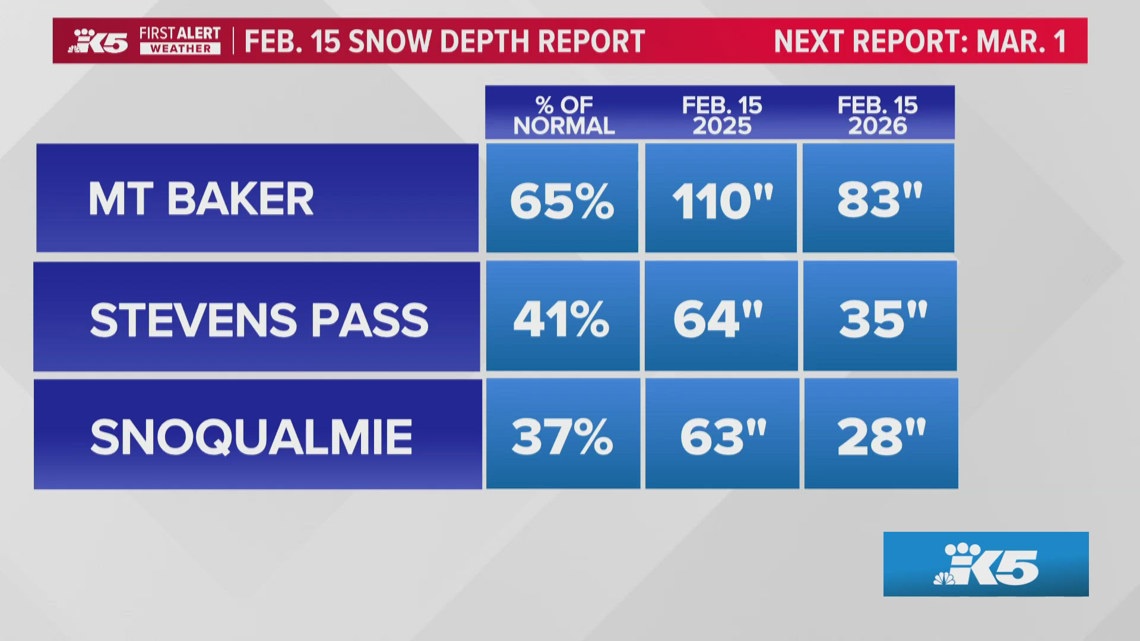
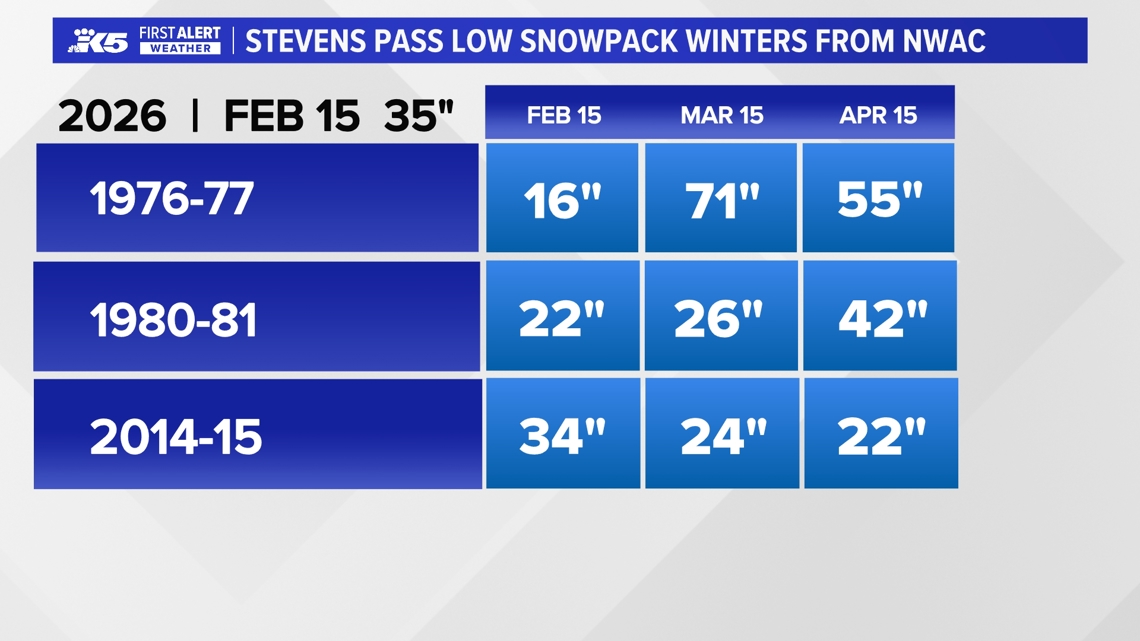
Statewide Snowpack Remains Well Below Normal, Raising Summer Water Concerns As of mid‑February, the Cascades hold roughly 65 % of average snowpack, with elevations between 3,000‑5,000 ft at only 40 % of typical depth, threatening summer water storage [4]. Snoqualmie Pass shows the greatest deficit, while higher sites on Mt. Rainier and Mt. Baker are closer to normal, and additional snowfall this week may modestly improve conditions [4]. The low snowpack mirrors past El Niño‑linked winters and could affect fire risk, ski tourism, and irrigation supplies later in the year [4].
Sources
-
1.
King5: Puget Sound Weather Outlook Through Early February 2026: Details Tuesday’s mixed showers, mountain snow, recent heavy snow on passes, and a dry weekend with a possible return to rain next week .
-
2.
King5: Western Washington Braces for Repeated Rain, Snow and Winds Through Next Week: Highlights a series of storm systems, dropping snow levels, and forecasts several feet of mountain snow by week’s end .
-
3.
King5: Spotty Lowland Snow Hits Snohomish, King, and Pierce Counties: Reports brief low‑elevation snow bursts on Wednesday‑Thursday, school delays, and snow levels staying between 500‑1,000 ft .
-
4.
King5: Washington Snowpack Lags Normal, Raising Summer Water Concerns: Shows statewide snowpack at about 65 % of normal, emphasizing deficits at Snoqualmie Pass and potential water‑resource impacts .
-
5.
King5: Lowland Snow Possible Wednesday as Western Washington Precipitation Increases: Forecasts snow levels near 500 ft on Wednesday, mixed rain‑snow in coastal foothills, and mountain snowfall of 6‑12 inches by week’s end .
Related Tickers
Timeline
Nov 28, 2025 – A ridge of high pressure over the Gulf of Alaska builds a dry pattern for the holiday weekend, keeping snow levels elevated near 4,000‑5,000 ft and limiting precipitation to occasional spotty showers, while a weak system may bring light snow on Monday‑Tuesday (snow levels 3,000‑4,000 ft) [19].
Dec 17, 2025 – Blustery winds ease across western Washington as a cooler seasonal flow settles, snow levels drop and the National Weather Service forecasts 5‑10 inches of snow at Snoqualmie and Stevens passes, while an atmospheric river heads toward Oregon with ½‑inch rain in lowlands and 1‑2 inches in the mountains [18].
Dec 19, 2025 – Warm weather and low snowpack cripple Western ski resorts: Lake Tahoe lifts run at minimal capacity, Utah’s Midway Ice Castles are postponed, torrential rain floods Northwest roads, Oregon’s Deschutes Basin records its warmest November since 1981, and snow often falls as rain, prompting climate scientists to warn of worsening drought [17][2].
Dec 20, 2025 – Heavy mountain snow returns to the Cascades ahead of Christmas, delivering >18 inches at Stevens Pass and ≈10 inches at Snoqualmie Pass, with 8‑12 more inches possible through Sunday; snow levels sit 2,000‑3,000 ft, prompting travel advisories and forecasts of up to 2‑3 feet at Mount Baker by Tuesday [16].
Dec 27, 2025 – Light snow lingers in the Puget Sound convergence zone, depositing up to 2 inches in Snohomish and King counties while mountain passes collect 10‑14 inches; a dry stretch follows with freezing nights and a dense‑fog advisory, and the next system is expected late Wednesday or Thursday to bring gradual warming [14].
Dec 27, 2025 – A Winter Weather Advisory warns that snow levels drop to ≈2,500 ft and 6‑12 inches of snow threaten Cascade passes, especially I‑90 over Snoqualmie, prompting officials to urge travelers to check conditions and carry emergency kits (chains, blankets, flares) [15].
Dec 27, 2025 – “Travel could be very difficult to impossible,” warns the National Weather Service as black‑ice risk rises on lowland roads, and WSDOT highlights key winter‑watch routes such as Snoqualmie, Stevens, and White Pass for heightened vigilance [15].
Jan 1, 2026 – A high‑pressure ridge keeps western Washington dry on New Year’s Eve, allowing celebrations without rain; a weak system brings showers on New Year’s Day and a stronger system is monitored for the weekend, while a dense‑fog advisory covers early mornings [13].
Jan 8, 2026 – Spotty lowland snow becomes possible as snow levels plunge to 500 ft overnight, producing brief wet‑snow events in the lowlands and a Winter Storm Warning that could add 2‑4 feet of snow to the Cascades, though accumulation at sea level remains minimal [12].
Jan 9, 2026 – A persistent ridge creates a snow drought across the western U.S.; Utah backcountry snowmobiling owner Brad Riesenberg says “customers are canceling tours,” while Arizona records its hottest December on record, with climatologist Erinanne Saffell noting the unprecedented warmth, and officials warn that weak snowpacks could complicate preparations for the 2034 Salt Lake City Winter Olympics [1].
Jan 15, 2026 – A ridge of high pressure extends the dry spell across western Washington, producing a record‑tying 58 °F in Seattle and keeping snow levels near 12,000 ft; the next meaningful rain chance is projected for late next week [11].
Jan 27, 2026 – Seattle’s 14‑day rainless streak approaches the 1963 record, and meteorologists forecast showers Tuesday night that could end the drought; warmer southwest moisture threatens the already thin snowpack, with snow levels dropping to ≈4,000 ft on Wednesday before rising to 5,000‑6,000 ft later in the week [10].
Jan 29, 2026 – Despite recent snowfall, the Cascade Mountains’ snowpack remains far below normal, with Stevens Pass gaining only 2‑3 inches and Oregon’s statewide snowpack at its second‑lowest level since 1981, raising concerns for spring streamflow and water resources [9].
Feb 4, 2026 – Skiers at Snoqualmie Pass encounter “spring‑like” conditions as regional snowpack falls below 50 % of normal; Climate Central meteorologist Shel Winkley calls it “the worst snow drought on record,” Mount Hood Skibowl halts operations, and snowboarder Jeremy Sampson notes “empty lifts” while reduced snow threatens water supplies and extends wildfire risk [8].
Feb 17, 2026 – Meteorologist Rich Marriott warns that snow levels may fall to 500‑1,000 ft, allowing a rain‑snow mix across the Kitsap Peninsula and coastal foothills, while weather anchor Parella Lewis says “the overall effect on lowland communities should remain limited”; Arctic air keeps temperatures low and mountains add 6‑12 inches of snow by week’s end before snow levels rise to ≈1,500 ft on Saturday [7].
Feb 18, 2026 – Washington’s snowpack sits at roughly 65 % of normal, with Snoqualmie Pass most deficient; models predict additional snow but prevailing winds limit capture, and a weak La Niña shifts toward neutral, giving a 50‑60 % chance of a weak El Niño next winter—mirroring past El Niño‑linked low‑snow winters of 1976‑77, 1980‑81, and 2014‑15 [6].
Feb 19, 2026 – Spotty lowland snow falls in Snohomish, King, and Pierce counties, with Bothell and Maltby receiving snow at 300‑400 ft; Granite Falls schools operate on delay, snow levels hover 500‑1,000 ft, and accumulation remains minimal, leaving roadways mainly slushy [5].
Feb 23, 2026 – A series of storm systems brings repeated rain, mountain snow, and gusty winds to western Washington; snow levels start near 4,000 ft and gradually drop to 2,500 ft mid‑week, with models suggesting several feet of mountain snow by week’s end and officials urging residents to monitor updates [4].
Feb 24, 2026 – The Puget Sound outlook shows mixed showers and mountain snow with snow levels near 2,500 ft; a recent cold front delivered 3‑17 inches of new snow on passes, and an offshore low brings limited Tuesday showers before exiting, while later in the week a chance of renewed rain and snow returns [3].
Future (2034) – Utah officials warn that increasingly weak snowpacks could complicate preparations for the 2034 Winter Olympics in Salt Lake City, noting that December recorded one of the latest measurable snowfalls on record and that weak‑snow years may become common [1].
Dive deeper (4 sub-stories)
-
Western Washington Faces Week‑Long Rain, Snow, and Strong Winds Starting Feb 23
(10 articles)
-
King5 (Seattle, WA): Spring‑like Ski Conditions Hit Snoqualmie Pass as Snowpack Plummets
-
Puget Sound Warm Midweek Turns to Rain and Snow on Weekend
(5 articles)
-
Western U.S. Snow Drought Deepens, Threatening Tourism, Water Supplies, 2034 Olympics
(3 articles)
All related articles (19 articles)
-
King5 (Seattle, WA): Puget Sound Weather Outlook Through Early February 2026
-
King5 (Seattle, WA): Western Washington Braces for Repeated Rain, Snow and Winds Through Next Week
-
King5 (Seattle, WA): Spotty Lowland Snow Hits Snohomish, King, and Pierce Counties
-
King5 (Seattle, WA): Washington Snowpack Lags Normal, Raising Summer Water Concerns
-
King5 (Seattle, WA): Lowland Snow Possible Wednesday as Western Washington Precipitation Increases
-
King5 (Seattle, WA): Spring‑like Ski Conditions Hit Snoqualmie Pass as Snowpack Plummets
-
King5 (Seattle, WA): Cascade Mountains Snowpack Lags Behind Recent Snowfall
-
King5 (Seattle, WA): Seattle’s 14‑Day Dry Spell Nears Record as Rain Returns Tuesday
-
King5 (Seattle, WA): Extended dry weather persists across western Washington through weekend
-
CNN: The western US is in a snow drought, raising fears for summer water supplies
-
King5 (Seattle, WA): Snow levels fall overnight across western Washington, raising chance of lowland wet snow and slick roads
-
King5 (Seattle, WA): Dry New Year’s Eve ends rain; showers expected on New Year’s Day in Western Washington
-
King5 (Seattle, WA): Western Washington sees light snow, then dry stretch with freezing nights ahead
-
King5 (Seattle, WA): Snow could complicate post-Christmas mountain pass travel in Washington
-
King5 (Seattle, WA): Heavy mountain snow continues toward Christmas across Cascades, with up to 2–3 feet possible at some passes
-
King5 (Seattle, WA): Warm weather and low snowpack disrupt Western ski resorts
-
AP: Warm weather and low snowpack slow Western ski resorts
-
King5 (Seattle, WA): Blustery weather eases in western Washington
-
King5 (Seattle, WA): Dry Weather Expected Over Holiday Weekend, With Spotty Showers Possible
External resources (12 links)
- https://nwcc-apps.sc.egov.usda.gov/imap/#version=2&elements=&networks=!&states=!&basins=!&hucs=&minElevation=&maxElevation=&elementSelectType=any&activeOnly=true&activeForecastPointsOnly=true&hucLabels=false&hucIdLabels=false&hucParameterLabels=true&stationLabels=&overlays=&hucOverlays=state&basinOpacity=100&basinNoDataOpacity=100&basemapOpacity=100&maskOpacity=0&mode=data&openSections=dataElement,parameter,date,basin,options,elements,location,networks,baseMaps,overlays,labels&controlsOpen=true&popup=&popupMulti=&popupBasin=&base=esriWgc&displayType=basin&basinType=6&dataElement=SNWD&depth=-8¶meter=PCTPORMED&frequency=MONTHLY&duration=I&customDuration=&dayPart=E&monthPart=E&forecastPubDay=1&forecastExceedance=50&useMixedPast=true&seqColor=2&divColor=7&scaleType=D&scaleMin=&scaleMax=&referencePeriodType=POR&referenceBegin=1991&referenceEnd=2020&minimumYears=20&hucAssociations=true&relativeDate=-1&lat=41.305&lon=-112.429&zoom=5.5 (cited 2 times)
- https://forecast.weather.gov/wwamap/wwatxtget.php?cwa=SEW&wwa=winter%2520weather%2520advisory (cited 1 times)
- https://nwcc-apps.sc.egov.usda.gov/imap/#version=169&elements=&networks=!MSNT&states=!&basins=!&hucs=&minElevation=&maxElevation=&elementSelectType=any&activeOnly=true&activeForecastPointsOnly=false&hucLabels=true&hucIdLabels=false&hucParameterLabels=true&stationLabels=&overlays=&hucOverlays=state&basinOpacity=75&basinNoDataOpacity=0&basemapOpacity=100&maskOpacity=100&mode=data&openSections=dataElement,parameter,date,basin,options,elements,location,networks,baseMaps,overlays,labels&controlsOpen=true&popup=&popupMulti=&popupBasin=&base=esriWsr&displayType=basin&basinType=wa_8&dataElement=WTEQ&depth=-8¶meter=PCTMED&frequency=DAILY&duration=I&customDuration=&dayPart=E&monthPart=B&forecastPubDay=1&forecastExceedance=50&useMixedPast=true&seqColor=1&divColor=7&scaleType=D&scaleMin=&scaleMax=&referencePeriodType=fixed&referenceBegin=1991&referenceEnd=2020&minimumYears=20&hucAssociations=true&relativeDate=-1&lat=48.124&lon=-120.914&zoom=6.9&autoExport=full,pdf,2,2,L,BL,Washington%2520SNOTEL,49.4893,44.9175,-114.8615,-125.2705 (cited 1 times)
- https://wsdot.com/travel/real-time/mountainpasses/Blewett (cited 1 times)
- https://wsdot.com/travel/real-time/mountainpasses/Cayuse (cited 1 times)
- https://wsdot.com/travel/real-time/mountainpasses/Chinook (cited 1 times)
- https://wsdot.com/travel/real-time/mountainpasses/Crystal-to-Greenwater (cited 1 times)
- https://wsdot.com/travel/real-time/mountainpasses/Mt.-Baker (cited 1 times)
- https://wsdot.com/travel/real-time/mountainpasses/North-Cascade-Hwy (cited 1 times)
- https://wsdot.com/travel/real-time/mountainpasses/Snoqualmie (cited 1 times)
- https://wsdot.com/travel/real-time/mountainpasses/Stevens (cited 1 times)
- https://wsdot.com/travel/real-time/mountainpasses/White (cited 1 times)